(Canto 1, Chapter 9: Description of Vasudeva’s Wedding)
Śrī Nārada said: One day, by his own wish, the great scholar Garga Muni, whom all the Yadus had made their chief priest, went to the king’s handsome palace in the city of Mathurā. The palace had great glittering golden doors studded with diamonds. It was filled with the humming of bees and the flapping of elephants’ ears, wet with streams of ichor flowing from the elephants, and decorated with many pavilions. It was well guarded by heroic soldiers in armor carrying bows, swords, and shields, and by a powerful army riding on chariots, elephants, and horses.
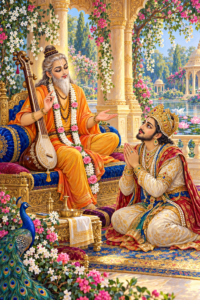
There Garga Muni saw Emperor Ugrasena seated on his throne, accompanied by Akrūra, served by Devaka and Kaṁsa, and surrounded by royal parasols, canopies, and cāmaras. Seeing the sage, the emperor at once rose from his throne. With the Yādavas he offered respectful obeisances, seated the sage on the throne, worshiped him, glorified him, circumambulated him, and bowed down before him.
Garga Muni blessed the king and asked about the welfare of the king and his associates. Then the saintly sage spoke to the powerful and wise Devaka, the best of the Yādavas.
Śrī Garga Muni said, “After thinking for many days, I have concluded that there is no king in this world better than Vasudeva. Therefore, O king, please give your daughter Devakī to Vasudeva in marriage.”
Śrī Nārada said: Offering betel nuts to show his agreement, Devaka, the best of pious men, performed all the auspicious ceremonies and gave his daughter to Vasudeva as Garga Muni desired.
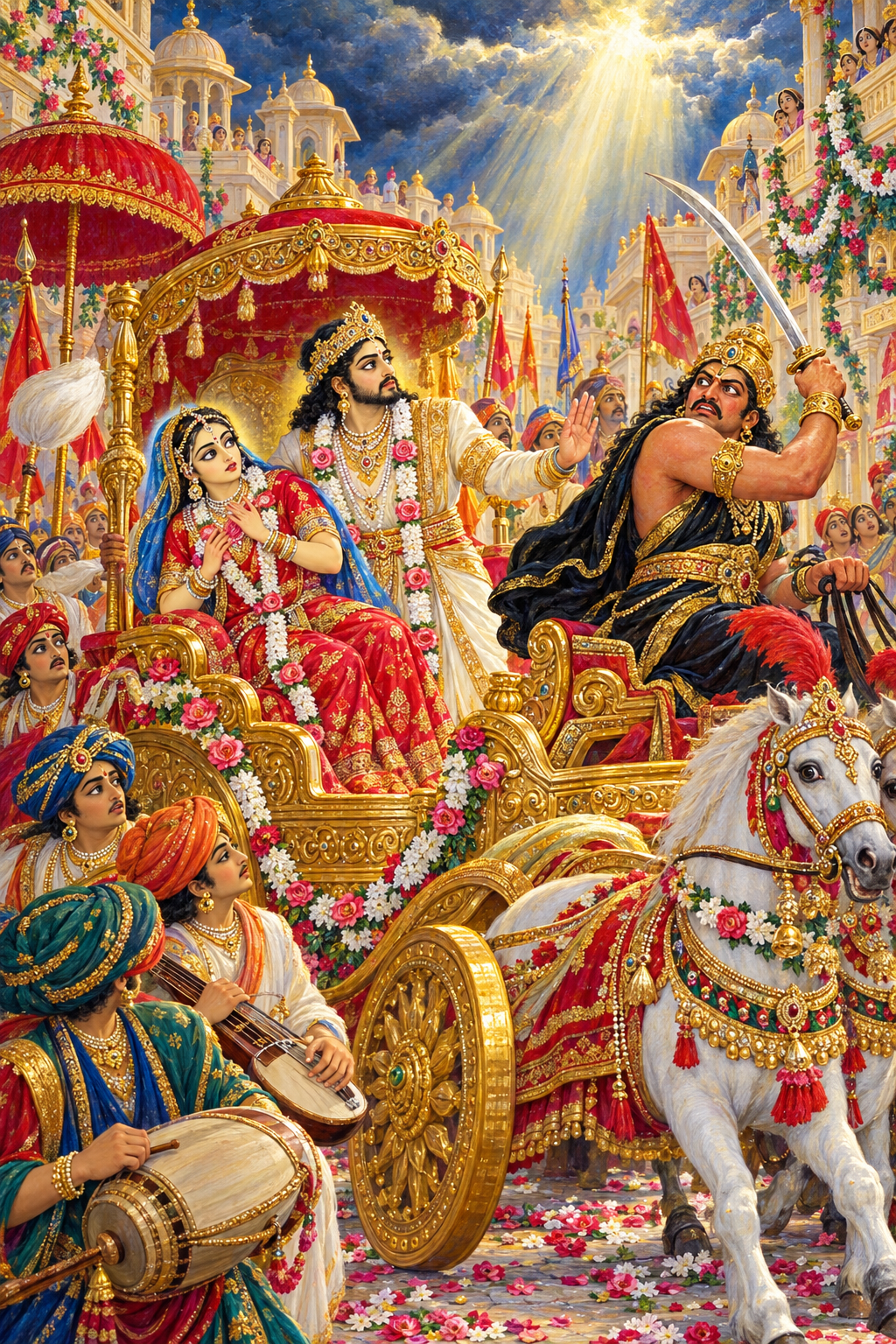
When the ceremony was over, Vasudeva and Devakī, who was beautiful with gold and jewels, climbed onto a graceful, decorated chariot drawn by many horses. To please his sister, Kaṁsa took the reins himself. Affectionate toward Vasudeva and surrounded by an army, he drove the chariot. King Devaka gave his daughter a dowry of a thousand maidservants, ten thousand elephants, a million horses, a hundred thousand chariots, and two hundred thousand cows. As the Yādavas departed, the road was filled with the auspicious sound of many drums, mṛdaṅgas, horns, vīṇās, and flutes.
Then a voice from the sky said to Kaṁsa, “You fool! You do not know that the eighth son of the girl in the chariot you are driving will kill you.”
Wicked, shameless, merciless Kaṁsa, whose friends were demons and whose deeds were horrible, threw his sister to the ground, grabbed her by the hair, and took up a sharp sword to kill her. The musicians dropped their instruments. Those in front shrank back. Everyone’s face turned pale. Then Vasudeva, the best of devotees, spoke to Kaṁsa.
Vasudeva said, “O king of the Bhojas, you are the glory of the Bhoja dynasty. Narakāsura, Jarāsandha, Bakāsura, Vatsāsura, and Bāṇāsura, who all longed to fight with you, praise your qualities in battle. Why are you now about to kill your own sister with a sword? Following the code of chivalry, you refused to fight with Pūtanā, a woman who wanted to fight you, and to pacify her you called her your sister. This girl is your real sister. Why do you act like this? On her wedding day you should be kind to your younger sister and treat her as your daughter. O king of Mathurā, you should not kill her. You should set your heart on removing the sufferings of the distressed.”
Although he heard this good instruction, wicked Kaṁsa, whose friends were demons, did not take it seriously. Then Vasudeva, reflecting on how Lord Hari’s time works, became calm and cheerful and spoke to Kaṁsa again.
Vasudeva said, “My lord, you never need to fear this girl. Listen to what the divine voice said. I will give you the sons who frighten you. Do not be afraid of the sons that may be born from her.”
Śrī Nārada said: Hearing Vasudeva’s words and agreeing to them, Kaṁsa praised him and went home. Then Vasudeva, still frightened, went home with Devakī, the daughter of King Devaka.
Lessons to be learned
Even at the happiest moment, the wedding day, the danger of material life appeared. Śrīla Prabhupāda often quoted the Bhāgavatam’s teaching that this world is a place of danger at every step (padaṁ padaṁ yad vipadām). We should never become too confident in material happiness.
Kaṁsa’s affection was only external. As soon as his own life seemed threatened, he was ready to murder his sister. This is the nature of material affection: it is based on self-interest. Only love for Kṛṣṇa is truly unselfish.
Vasudeva did not panic or fight. First he tried to reason with Kaṁsa using Kaṁsa’s own sense of honor. When that failed, he thought of the Lord’s plan and found an intelligent way to save Devakī by promising to give up his sons. A devotee uses his intelligence in difficulty while depending on the Lord. As Śrīla Bhaktivinoda Ṭhākura taught, surrender includes accepting what is favorable, rejecting what is unfavorable, and having full faith in the Lord’s protection.
Garga Muni, the family priest, arranged this marriage after careful thought. The spiritual guide of a family is meant to arrange things for the Lord’s plan, and indeed this marriage became the doorway for Kṛṣṇa’s appearance.