(Canto 1, Chapter 10: Description of the Birth of Lord Balarāma)
Śrī Nārada said: In the course of time, year after year, Vasudeva begot in Devakī eight sons and one daughter, who was the eternal goddess Māyā.
Vasudeva, who knew the ultimate goal of life, brought his first son, Kīrtimān, to Kaṁsa’s assembly and offered him. Seeing that Vasudeva had kept his promise and that his word was true, even Kaṁsa’s heart softened. Indeed, what suffering will a saint not bear? What will he not tolerate?
Kaṁsa said, “This child may go home. I am not afraid of him. I will kill your eighth son. Of this there is no doubt.”
So Vasudeva took his son home, but he did not believe the demon would keep his word.
Then I came there from the sky. Kaṁsa bowed to me, worshiped me, and asked about the plans of the demigods. I said to him, “Learn this from me. O king of kings, all the Vasus have become the people led by Nanda, and the demigods have become the people led by Vṛṣabhānu. A group led by the Vedic hymns has become gopīs. They are all now on the earth. The devas have become the Vṛṣṇis headed by Vasudeva, and the demigoddesses have become their wives, headed by Devakī. Depending on how you count, any of Vasudeva’s sons could be the eighth. Any one of them could be the one who will kill you.”
After I left, Kaṁsa was filled with anger at this plan of the demigods to kill the demons, and in his heart he decided to kill all the Yādavas. He bound Vasudeva and Devakī tightly in chains and dashed Devakī’s son against a stone. Remembering his previous life, and out of his demonic nature and fear of Lord Viṣṇu, he killed each son as soon as it was born. Of this there is no doubt.
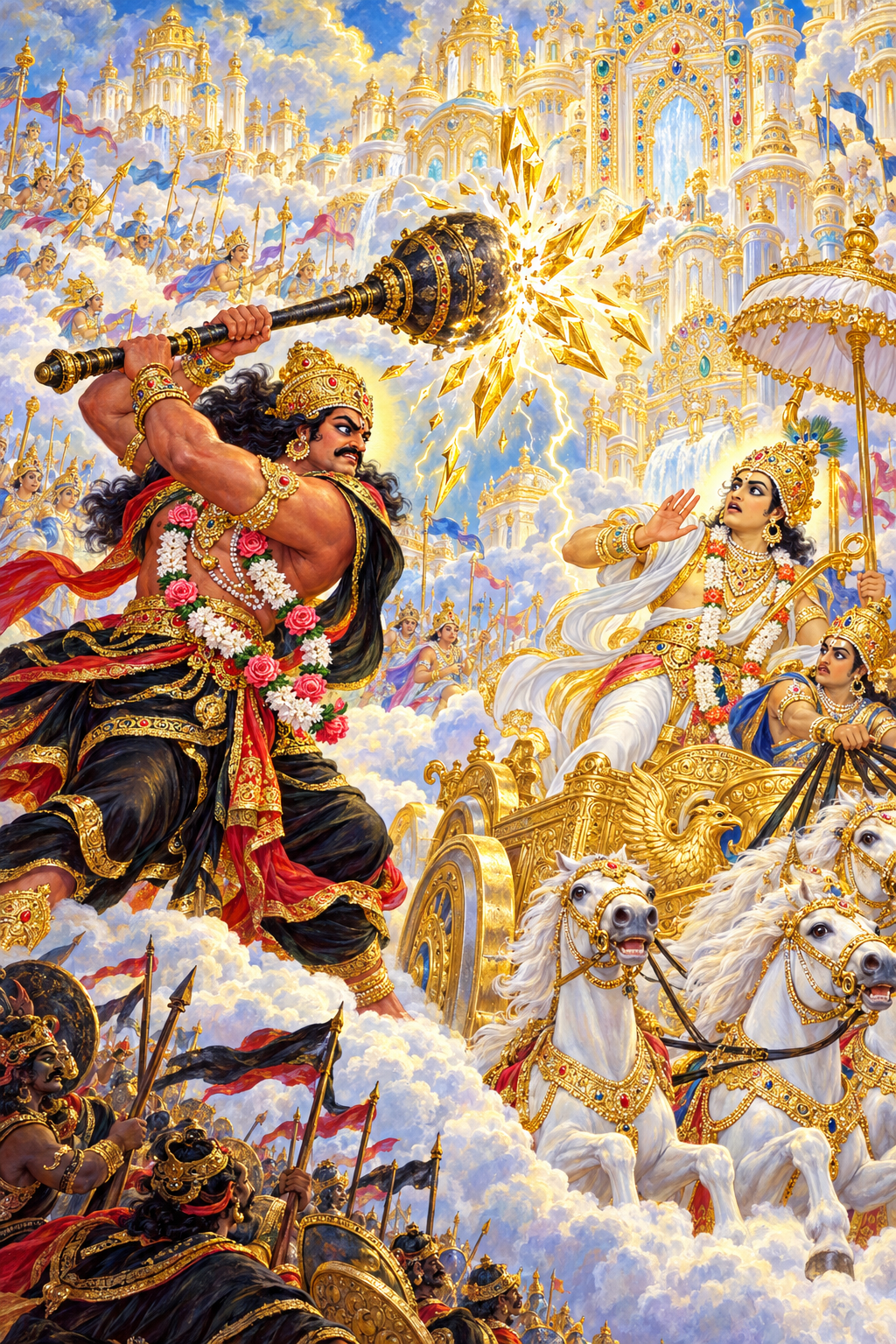
Angered by this, Emperor Ugrasena, the master of the Yādavas, tried to stop Kaṁsa and help Vasudeva. Seeing Kaṁsa’s demonic intentions, Ugrasena’s soldiers took up their swords to protect Vasudeva and Devakī. Kaṁsa’s soldiers rose against them, and a great battle broke out in the middle of the assembly. The soldiers fought fiercely at the doorway, and ten thousand people died by the blows of swords. Then Kaṁsa took up his club and crushed his father’s army. Many fell in an instant with their weapons, with broken heads, legs, shoulders, and arms. Many vomited blood, fell unconscious, and died, and the assembly hall ran red with streams of blood.
Having overpowered the enemy soldiers, the angry demon king seized his own father, dragged him from the royal throne, bound him with ropes, and with his royal friends locked him in a prison cell. Sitting on the throne, Kaṁsa personally ruled the rich kingdoms of the Madhus and Śūrasenas. Harassed by Kaṁsa, all the Yādavas fled to other countries on the pretext of visiting relatives, and waited for a better time.
When Yogamāyā carried Devakī’s seventh child, who had brought her both joy and grief, to Vraja and placed it in the womb of Rohiṇī, the people of Mathurā said, “Where has the child gone?”
Then in Vraja, after only five days, in the month of Bhādra, on the sixth day of the bright fortnight, at midday, when Mercury and five exalted planets were in the sky and Libra was on the horizon, while the demigods showered beautiful flowers and the clouds sprinkled drops of water, the Supreme Personality of Godhead appeared from Rohiṇī, the wife of Vasudeva, illuminating Nanda’s home with His splendor.
Nanda performed the birth ceremony and gave a million cows in charity to the brāhmaṇas. Then he called the gopas and held a very auspicious festival with many singers and musicians.
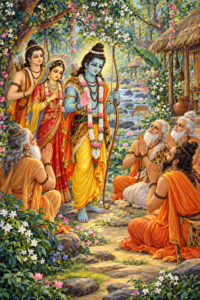
Śrīla Vyāsadeva came there with Devala, Devarāta, Vasiṣṭha, Bṛhaspati, and myself. Nanda washed his feet and worshiped him in many ways, and Vyāsa was pleased.
Nanda said, “Who is this handsome boy, whose equal cannot be seen anywhere? How was He born after only five days in the womb? O great sage, please tell me.”
Śrī Vyāsa said, “Nanda, you are very fortunate. This child is the eternal Ananta Śeṣa. He was conceived in Mathurā by Vasudeva in Devakī, and by Lord Kṛṣṇa’s wish He was brought here to Rohiṇī. O King Nanda, you are able to see Him, although the great yogīs cannot. I, Vedavyāsa, have come here to see Him. Please show us the Supreme Person, who is greater than the greatest and who now appears as an infant.”
Then Nanda showed them the child Ananta Śeṣa. Gazing at Him in the cradle, Vyāsa was struck with wonder. He bowed down and prayed:
“O master of the demigods, O Supreme Personality of Godhead, O Lord who fulfils all desires, obeisances to You! Obeisances to You, who are Ananta Śeṣa! Obeisances to You, who are directly Lord Rāma! Eternal obeisances to You, Lord Saṅkarṣaṇa, maintainer of the earth, perfect and complete, effulgent and glorious, holding a plow in Your hand and possessing a thousand heads!
“You are Baladeva, the husband of Revatī and the elder brother of the infallible Supreme Lord. You are armed with a plow and You are the killer of Pralambāsura. O Supreme Person, please save me! Obeisances, obeisances to You, who are known as Bala and Balabhadra, and whose flag bears the palm tree! Obeisances to You, fair-complexioned son of Rohiṇī, dressed in blue garments!
“You are the enemy of Dhenuka, Muṣṭika, Kūṭa, Rukmī, Kūpakarṇa, and Kumbhāṇḍa. You put an end to Balvala. You divided the Yamunā and dragged the city of Hastināpura. You are the enemy of Dvivida, the king of the Yādavas, and the ornament of the land of Vraja. You are the killer of Kaṁsa’s brothers, a pilgrim to holy places, the supreme master, and the teacher of Duryodhana. O Lord, please protect, please protect the world!
“O infallible Lord, greater than the greatest, O Ananta, whose fame is everywhere, glory, glory to You! Obeisances to You, who hold a plow and club and are the master of the demigods, the great sages, and the kings of the serpents!
“A person who regularly reads or recites these prayers attains Lord Hari’s supreme abode. Even in this world he gains all strength, crushes his enemies, and attains victory, wealth, and followers.”
Śrī Nārada said: After circumambulating Lord Balarāma and bowing down to Him a hundred times together with the other sages, the wise Vyāsa Muni, the son of Parāśara and Satyavatī, went to the Sarasvatī River.
Lessons to be learned
Vasudeva kept his word even though it meant handing over his own child. Seeing such truthfulness, even Kaṁsa softened for a moment. A saint tolerates everything to keep his word; truthfulness is one of the pillars of religion.
Nārada’s words to Kaṁsa seem to have caused suffering, but the ācāryas explain that Nārada wanted to fill the cup of Kaṁsa’s sins quickly so that the Lord would appear without delay. What looks like cruelty from a devotee is often mercy working for the Lord’s plan.
Kaṁsa imprisoned even his own father. Envy of God destroys every natural relationship. The Yādavas left their homes and waited patiently for a better time. Sometimes a devotee must endure difficulties and wait for the Lord’s arrangement.
Lord Balarāma is not an ordinary child. He is Ananta Śeṣa, the original spiritual master, who comes first to prepare the way for Kṛṣṇa. Śrīla Prabhupāda taught that Balarāma gives spiritual strength (nāyam ātmā bala-hīnena labhyaḥ): without His mercy no one can make spiritual advancement. That is why Vaiṣṇavas pray to Nityānanda-Balarāma first.
Vyāsadeva said to Nanda, “You can see Him even though the yogīs cannot.” The simple loving residents of Vraja attain what great mystics cannot. Pure love is greater than all mystic perfection.