(Canto 1, Chapter 13: The Liberation of Pūtanā)
While Nanda was in Mathurā to ask about Vasudeva’s welfare, pay his taxes to the king, and describe his son’s birth festival, the murderess Pūtanā, sent by Kaṁsa, was travelling through cities, towns, and cowherd villages, making a menacing rumbling sound. Coming to Gokula, which was full of gopas and gopīs, the demoness took the form of a splendid sixteen-year-old girl. No gopa or gopī stopped this beautiful girl, whose beauty seemed to eclipse the goddesses Śacī, Sarasvatī, Lakṣmī, Rambhā, and Rati.
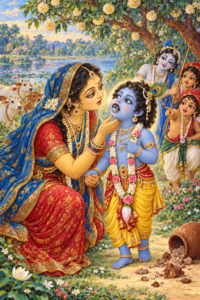
Ignoring Rohiṇī and Yaśodā, she took the infant on her lap, fondled Him again and again, and offered Him her breast. When the horrible demoness gave Him her poison-smeared breast, the infant Lord Hari became angry and sucked out her life-breath together with the bitter milk.
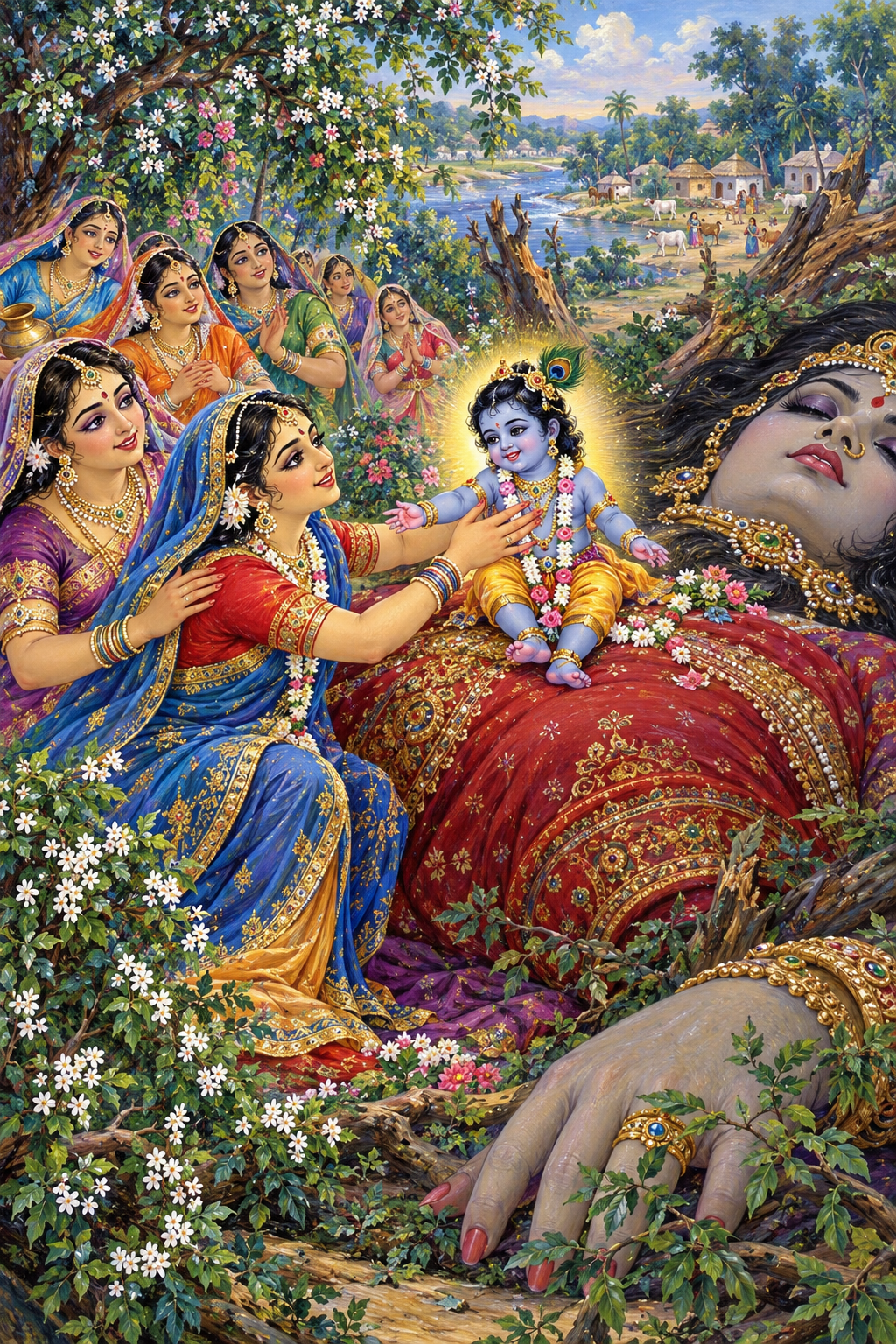
Screaming “Let me go! Let me go!” in agony, she ran outside carrying the child, her magical disguise gone. Screaming, her eyes bulging and her limbs covered in sweat, she fell to the ground with a sound that filled the universe with its seven planetary systems and outer space. A great wonder occurred. The earth with all its continents shook. Her body stretched twelve miles long, and as it fell, her thunderbolt-hard body broke many tall, strong trees.
O king of kings, when the gopas saw her horrible gigantic body, they said, “The child must have been crushed by her fingers. He cannot still be alive.” But then they saw the infant smiling, yawning after drinking her milk, and playing on her breast. The astonished women, together with Yaśodā and Rohiṇī, grabbed Him and pulled Him down from her breast.
Then they performed rituals to protect the child: they bathed Him with the sacred water and clay of the Yamunā, had a cow wave its tail over Him, and did other things as well. The gopīs chanted protective prayers, invoking the Lord’s many forms for the different parts of His body: “May Śrī Kṛṣṇa protect Your head. May Lord Vaikuṇṭha protect Your neck. May the Lord of Śvetadvīpa protect Your ears. May Lord Yajña protect Your nose. May the four Kumāras, Lord Hari’s kalā expansions, protect Your cheeks. May Lord Śveta-Varāha protect Your forehead. May Lord Nārada protect the vines of Your eyebrows. May Lord Balarāma protect Your knees. May Lord Buddha protect Your shins. May Lord Kalki, the master of religion, protect Your ankles and feet.”
This glorious and transcendental Śrī Kṛṣṇa-kavaca, the armor of Lord Kṛṣṇa that gives all protection, was first given by the Supreme Lord to Brahmā on the lotus of His navel. Brahmā gave it to Lord Śiva, Lord Śiva gave it to Durvāsā Muni, and Durvāsā Muni gave it to Yaśodā in Nanda’s palace. In this way Yaśodā and the gopīs protected the child. Then Yaśodā fed Him her own breast milk and gave great charity to the brāhmaṇas.
When the gopas headed by Nanda returned from Mathurā and saw horrible Pūtanā, they were overcome with fear. They cut her body to pieces with axes, built many pyres on the bank of the Yamunā, and burned it. The smoke that rose from her body, now purified, was fragrant like cardamom, cloves, sandalwood, tagara, and aguru. Of whom else but Kṛṣṇa should we take shelter? He is the purifier of the fallen. He gave liberation even to Pūtanā.
Why did Pūtanā receive such mercy? Long ago, when Lord Vāmana appeared at the sacrifice of Bali Mahārāja, Bali’s daughter Ratnamālā saw Him and felt a mother’s love for Him. She thought, “If I had a son like Him, I would give that gloriously smiling boy the milk of my breast, and my heart would be happy.” Lord Vāmana, the Supreme Personality of Godhead, silently blessed the daughter of His great devotee Bali: “May your desire be fulfilled.” At the end of Dvāpara-yuga she became known as Pūtanā, and by Lord Kṛṣṇa’s touch she attained her desire.
O king of Mithilā, anyone who hears of Pūtanā’s liberation becomes purified of the three kinds of material desires and attains pure love and devotion for Lord Kṛṣṇa, the Supreme Personality of Godhead, who is greater than the greatest.
Lessons to be learned
Pūtanā came to kill Kṛṣṇa, yet because she offered Him her breast, even with poison, He accepted her as a mother and gave her liberation. Her body even smelled like sandalwood when burned. Śrīla Prabhupāda often said that if Kṛṣṇa gives such mercy to one who came to kill Him, how much more will He give to one who serves Him with love. Śrīla Uddhava says in the Bhāgavatam: to whom else shall I take shelter but such a merciful Lord?
The Garga-saṁhitā reveals a secret: Pūtanā was once Ratnamālā, daughter of Bali, who longed to nurse the Lord. Her desire was fulfilled, but in a mixed way, because her later life was degraded. This shows that the Lord remembers every sincere desire, even across lifetimes, and that the Lord’s mercy works in ways we cannot understand.
The gopīs, afraid for Kṛṣṇa, prayed for the Lord’s forms to protect Him. They did not think He was God; they loved Him as a helpless child. The ācāryas describe this as the sweetness (mādhurya) of Vraja, where love covers the awareness of the Lord’s power.
Pūtanā came disguised as a beautiful woman. Śrīla Bhaktivinoda Ṭhākura explains that Pūtanā represents false teachers who poison the minds of new devotees with ideas like impersonalism. Kṛṣṇa kills such poison in the hearts of sincere devotees. We should be careful to take spiritual nourishment only from bona fide sources.