Canto One: Goloka-khaṇḍa
(Canto 1, Chapter 1: Description of Śrī Kṛṣṇa’s Glories)
Before reciting this Garga-saṁhitā, which gives victory over all obstacles, one should first offer respectful obeisances to the Supreme Personality of Godhead Nārāyaṇa, to Nara-Nārāyaṇa Ṛṣi, the best of human beings, to mother Sarasvatī, the goddess of learning, and to Śrīla Vyāsadeva. The author then places in his heart the splendid lotus feet of the Lord of Śrī Rādhā. Those feet defeat the beauty of the lotuses that bloom in autumn. The sages serve them the way bumblebees serve a lotus. They are marked with the signs of the thunderbolt and the lotus, decorated with glittering golden anklets, and they break the threefold miseries of the devotees. He then prays that Śrīla Vyāsadeva, the son of Satyavatī, who enjoys pastimes at Badarikāśrama, who drinks the nectar of the Lord’s lotus face, and who is himself an incarnation of the Lord who carries the Śārṅga bow, will protect his words.
Once upon a time Śrī Garga Muni, the best among the wise, very powerful and shining like a sun of yoga, came to the holy forest of Naimiṣāraṇya to see Śaunaka Ṛṣi. As soon as Śaunaka saw him, he immediately stood up together with all the sages, washed Garga Muni’s feet, and worshiped him with all the offerings prescribed by ancient tradition.
Then Śaunaka Ṛṣi said, “When saintly devotees travel, it is simply to bring good fortune and peace to the householders who remain at home. It is the saintly devotee, not the sun, who removes the darkness within people’s hearts. Therefore, my lord, please destroy the doubt that has arisen in my heart. How many times does Lord Hari, Viṣṇu, who removes everything inauspicious, descend into this world?”
Śrī Garga Muni replied, “O brāhmaṇa, you have asked a very good question. Describing the transcendental qualities of the Supreme Lord brings auspiciousness to everyone: to those who hear, to those who speak, and to those who ask. In this connection the sages relate an ancient history. Simply by hearing it, even great sins are destroyed.”
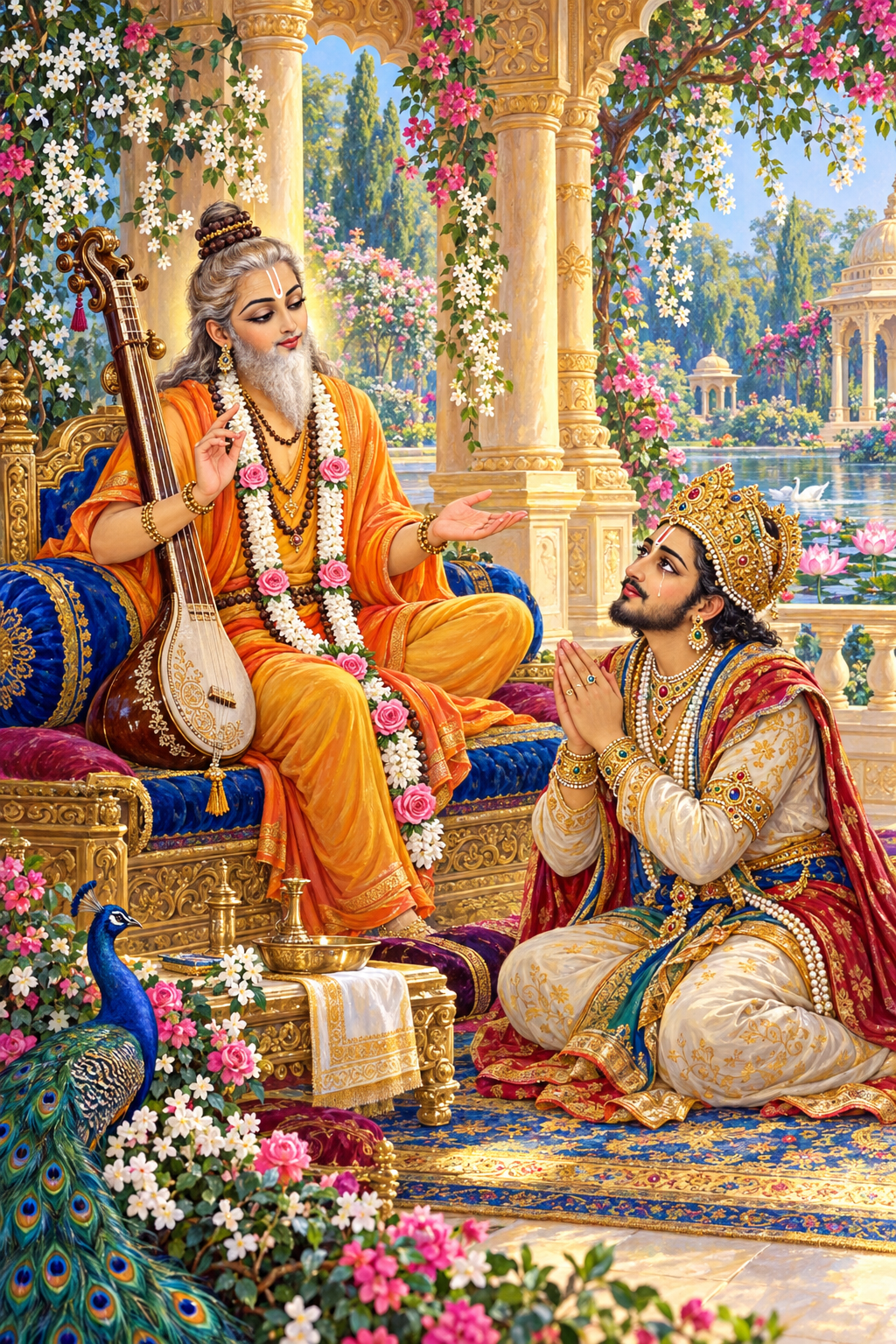
In ancient times, in the city of Mithilā, there lived a powerful king named Bahulāśva. Although he was a mighty ruler, he was peaceful at heart, completely free from false ego, and a great devotee of Lord Kṛṣṇa. One day the king saw Nārada Muni, the best of sages, descending from the sky. He at once worshiped Nārada, offered him a seat, and with folded hands spoke to him.
King Bahulāśva said, “O wise sage, the Supreme Person has no beginning, and He is beyond the material energy. Why, then, does He place His transcendental form in this world?”
Śrī Nārada said, “Lord Hari, the original Supreme Personality of Godhead, places His own transcendental form and pastimes in this world to protect the cows, the devotees, the demigods, and the Vedas. A magician is never bewildered by his own magic, although the audience is bewildered by it. In the same way, the Supreme Lord is never bewildered by the tricks He performs with His illusory potency, although those who see them are bewildered again and again.”
King Bahulāśva said, “How many times does Lord Viṣṇu, who removes all that is inauspicious, descend to this world to protect His devotees? O my lord, kindly tell me this.”
Śrī Nārada said, “In the smṛti-śāstras, the great sages led by Śrīla Vyāsadeva explain that the Lord descends in six kinds of forms. These are the aṁśāṁśa, or part of a part; the aṁśa, or part; the āveśa, when the Lord empowers a living being by entering him; the kalā, or full part; the pūrṇa, or full incarnation; and the paripūrṇatama, the most complete of all.
“The aṁśāṁśa incarnations begin with Marīci. The aṁśa incarnations begin with Brahmā. The kalā incarnations begin with Kapila and Kūrma. The āveśa incarnations begin with Paraśurāma. According to the smṛti, the pūrṇa incarnations are Lord Nṛsiṁha, Lord Rāma, Lord Hari the master of Śvetadvīpa, the Lord of Vaikuṇṭha, Lord Yajña, and Lord Nara-Nārāyaṇa.
“But the paripūrṇatama form of the Lord is Śrī Kṛṣṇa. He is the original Supreme Personality of Godhead Himself, the master of countless universes, and He shines eternally in His own realm of Goloka.
“The aṁśa incarnations oversee the Lord’s mission in the world, and the aṁśāṁśa incarnations carry out the work of that mission. O great-hearted king, in His āveśa incarnations Lord Viṣṇu enters a particular soul, accomplishes His purpose, and then departs. Age after age, His kalā incarnations teach and establish the principles of religion and then disappear. The pūrṇa incarnations include the catur-vyūha forms; in them one sees the Lord’s heroic powers and all nine rasas.
“Some authorities say that the form into which all powers and glories enter is the paripūrṇatama form, the original form of the Lord. All the transcendental qualities that people see distributed among the full incarnations are completely present in that original form. That paripūrṇatama form is Śrī Kṛṣṇa and no one else. When He comes into this world to perform one mission, He accomplishes millions of missions at the same time.
“He is perfect and complete. He is the oldest person. He is the most exalted of all exalted persons and greater than the greatest. He is the Supreme Person and the master of all masters. He is full of bliss, a jewel-mine of mercy and a jewel-mine of transcendental virtues. I take shelter of Him.”
Śrī Garga Muni continued: Hearing these words, the king became very happy. He was overcome with love, and the hairs of his body stood on end in ecstasy. Wiping the tears from his eyes, he spoke again to Nārada.
King Bahulāśva said, “Why did Śrī Kṛṣṇa, the original and most complete form of the Lord, come to the land of Bhārata-varṣa, and why did He appear so gloriously? O brāhmaṇa, O great sage, please describe to me the countless activities of the master of Goloka and the beauty of His Goloka realm.
“When a human being has visited many holy places and has devotedly performed austerities for a hundred years, he attains the association of devotees. Only then does he attain Śrī Kṛṣṇa Himself. When will my heart melt with love so that I will think, ‘I am the servant of the servant of the servant of Śrī Kṛṣṇa’? Will that Supreme Personality of Godhead, whom even the greatest demigods cannot attain, ever appear before my eyes?”
Śrī Nārada replied, “O tiger among kings, you are most fortunate. Śrī Kṛṣṇa honors you, and Lord Hari loves you. The Lord of the devotees will personally come to reveal Himself to you. Lord Janārdana, the master of the brāhmaṇas, remembers both you and His devotee Śrutadeva. Ah, how great is the good fortune of the devotees!”
Lessons to be learned
The Garga-saṁhitā opens by establishing the most important truth of Vaiṣṇava philosophy: Śrī Kṛṣṇa is not one incarnation among many but the source of all incarnations. This is the same conclusion the Śrīmad-Bhāgavatam gives in its famous verse ete cāṁśa-kalāḥ puṁsaḥ kṛṣṇas tu bhagavān svayam, which Śrīla Prabhupāda repeated constantly: all the others are parts and parts of parts, but Kṛṣṇa is the Supreme Personality of Godhead Himself.
Śaunaka’s words teach us the value of the sādhu. The sun removes only external darkness, but the pure devotee removes the darkness of ignorance within the heart. For this reason the ācāryas travel from place to place, not for their own benefit but to bless the householders.
The magician analogy teaches that the Lord is never covered by māyā. When He appears as a human being, He remains fully transcendental, although materialists may think Him to be an ordinary man.
King Bahulāśva’s prayer shows the proper goal of life. He did not ask for liberation, power, or heaven. He longed only to think of himself as the servant of the servant of the servant of Kṛṣṇa. Śrī Caitanya Mahāprabhu taught exactly this mood (gopī-bhartuḥ pada-kamalayor dāsa-dāsānudāsaḥ). The king also explains the process: by pious activities one gets the association of devotees, and through the association of devotees one attains Kṛṣṇa. As Śrīla Bhaktivinoda Ṭhākura taught, sādhu-saṅga is the root of all spiritual advancement.
Finally, the Lord is attracted by His devotee’s longing. Because the king wept for Kṛṣṇa, Nārada could assure him that Kṛṣṇa would personally come to him. Sincere eagerness is the price of attaining Kṛṣṇa.