(Canto 1, Chapter 19: Breaking of the Two Arjuna Trees)
Śrī Nārada said: Churning yogurt in their homes in Gokula, the gopīs sang of Lord Gopāla’s transcendental pastimes. Rising early in Nanda’s palace, beautiful Yaśodā put yogurt in a pot and churned it. With His anklets jingling, Nanda’s son eagerly danced for some butter. Dancing, following His mother, and making His ornaments jingle sweetly, He played like a child. After begging His mother again and again for some fresh butter, the clever Kṛṣṇa finally took an emerald in His hand and angrily broke the churning pot.
Beautiful Yaśodā could not catch her fleeing son, for He always stayed a hand’s length away from her. Even the kings of yogīs cannot attain Him. Why should He fall into His mother’s grasp? But then, O king of kings, Lord Hari showed that He places Himself under the control of His devotees. Yaśodā caught her son and, angry, tied Him with rope to the grinding mortar.
But every rope she used was too short for her son. He who is beyond the material world cannot be bound by rope. How could He be bound? When Yaśodā, frustrated and discouraged, stopped trying, the independent Kṛṣṇa kindly allowed her to bind Him. O king, the mercy He gave His mother He never gave to the renunciants and philosophers, what to speak of the fruitive workers. To them Lord Kṛṣṇa gives liberation, not devotional service.
The gopīs quickly came. Seeing the broken churning pot and the frightened child tightly bound to the grinding mortar, they were filled with compassion and said, “In our homes the children break these clay pots all the time. O wife of Nanda, we must say you are not kind. O cold, merciless Yaśodā, O queen of Vraja, you beat this boy with a stick and tied Him up just because He broke a clay pot.”
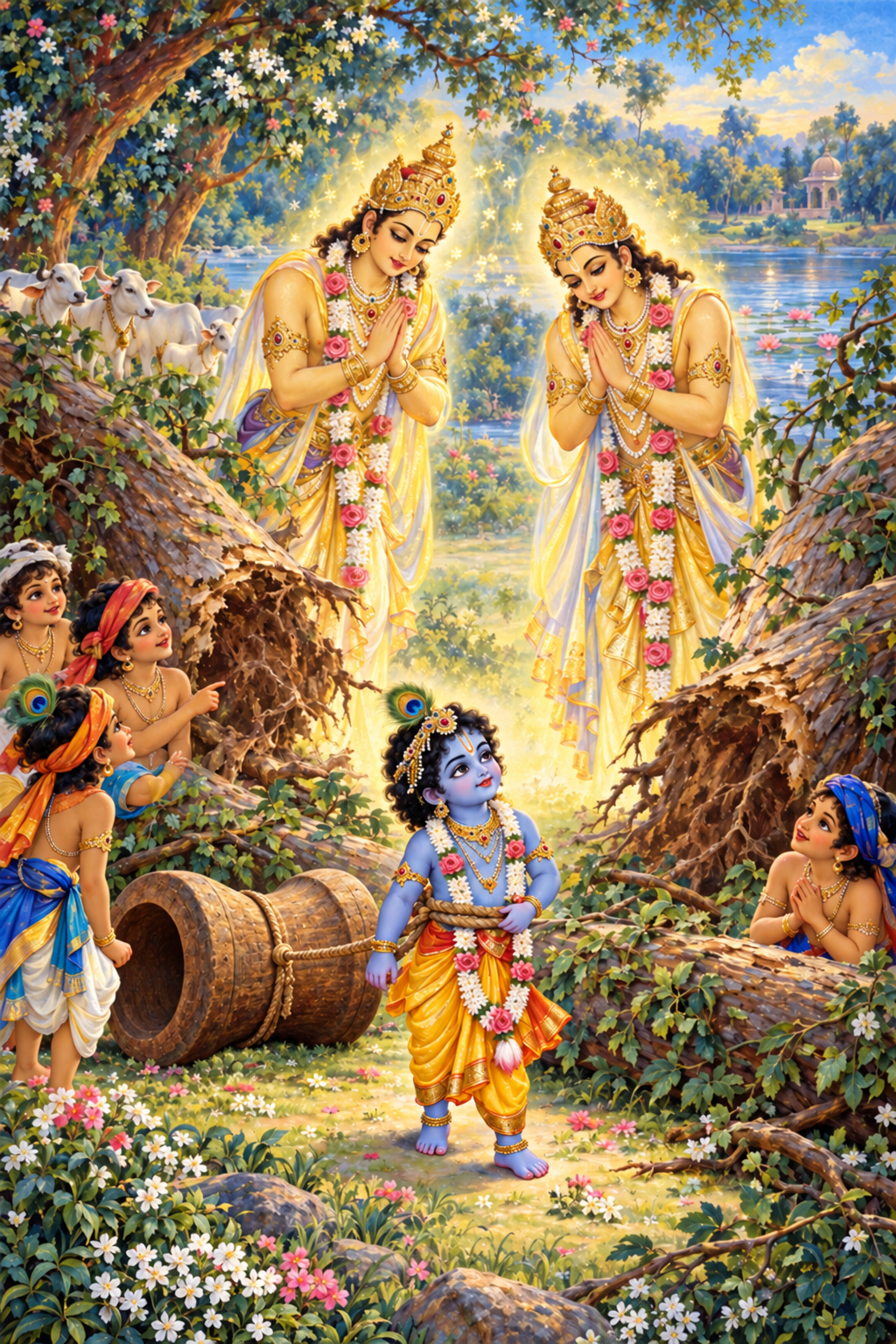
After this, when Yaśodā became absorbed in her housework, Kṛṣṇa dragged the mortar along and went with the boys toward the Yamunā. His belly bound with the rope, smiling Lord Kṛṣṇa went between two great old arjuna trees on the bank of the Yamunā. He tugged at the mortar, which was stuck sideways between them, and with that tug the two trees were uprooted and fell to the ground. The sound of their falling was violent, like thunder. From the two trees came two demigods, shining like fire. They circumambulated Lord Dāmodara, touched His feet with their helmets, bowed down to Him, and stood before Him with folded hands, praying:
“Obeisances, obeisances to You, Lord Kṛṣṇa, the pleasure of the cows, the earth, and the senses, the auspiciousness of the worlds, the ocean of mercy, the Lord whose belly is bound with a rope!”
After bowing down to Lord Hari, the two demigods departed toward the north. Then, headed by Nanda Mahārāja, the frightened cowherd people arrived. They asked, “How did these two trees fall without any wind? O children of Vraja, please tell us.”
The children said, “Kṛṣṇa made the two trees fall. Two shining men came out of the trees. They bowed down to Kṛṣṇa and went away to the north.”
The gopas did not believe the boys. Nanda untied his son from the mortar, placed Him on his lap, embraced Him, smelled His head, scolded his wife, and gave a hundred cows in charity to the brāhmaṇas.
King Bahulāśva said, “Who were those two shining men? O best of the divine sages, please tell me. Because of what sin had they become arjuna trees?”
Śrī Nārada said, “They were the demigods Nalakūvara and Maṇigrīva, the two sons of the great King Kuvera. One day they went to the Nandana garden on the bank of the celestial Gaṅgā. Drunk on vāruṇī liquor and proud of their wealth, they walked naked while many apsarās sang for them. The great sage Devala, who had crossed to the far shore of the Vedas, saw these two degraded, naked, forgetful men and said, ‘I see that you two shameless, proud men have become just like trees. Therefore you will now be trees on the earth for a hundred years. At the end of Dvāpara-yuga, in Bhārata-varṣa, in the district of Mathurā, in the land of Vraja, on the bank of the Yamunā near the Mahāvana forest, you will see Kṛṣṇa, the original Supreme Personality of Godhead and master of Goloka, who is known as Dāmodara and Hari. When you see Him, you will regain your original forms.’ In this way, by Devala Muni’s curse, Nalakūvara and Maṇigrīva became trees and were liberated by Lord Kṛṣṇa.”
Lessons to be learned
This pastime is the reason Kṛṣṇa is called Dāmodara, “He whose belly was bound with a rope.” Vaiṣṇavas celebrate it every year in the month of Kārttika by offering lamps and singing the Dāmodarāṣṭaka. Śrīla Prabhupāda loved this prayer, which says that the Lord is conquered by the love of His devotees, and that the devotee does not want liberation but only to see the Lord as Dāmodara in his heart.
Yaśodā could not bind Kṛṣṇa, because the ropes were always two fingers too short. The ācāryas explain that the two fingers represent the devotee’s sincere effort and the Lord’s mercy. Only when both are present is Kṛṣṇa “bound” by love. Our endeavor is necessary, but in the end Kṛṣṇa is attained only when He mercifully allows Himself to be caught.
Nārada says that this mercy, to be bound by His devotee, is not given to renunciants, philosophers, or fruitive workers. To them He gives liberation at most. Devotional service is far more rare and precious than liberation. Śrīla Rūpa Gosvāmī explains that Kṛṣṇa gives liberation easily, but He gives bhakti only with great care.
Nalakūvara and Maṇigrīva were sons of the richest demigod, but wealth, intoxication, and pride made them shameless like trees. Śrīla Prabhupāda often cited this example to show how wealth and intoxication destroy good sense. Yet Devala Muni’s curse was also mercy: it brought them face to face with Kṛṣṇa. The punishment of a saint purifies and leads to the Lord.