(Canto 1, Chapter 11: Description of Śrī Kṛṣṇacandra’s Birth)
Śrī Nārada said: Śrī Kṛṣṇa, the original Supreme Personality of Godhead, who is greater than the greatest, personally entered the heart of Vasudeva. The great soul Vasudeva began to shine with a glory like the sun, the moon, and fire. He appeared like a second form of the Supreme Lord, the master of all sacrifices. When Lord Kṛṣṇa, who gives fearlessness to everyone, entered Devakī, she shone as if a great flash of lightning had entered her home.
Seeing her so effulgent, Kaṁsa became frightened. He said, “Now the destroyer of my life has come. She was never like this before. As soon as He is born, I will kill Him.” Saying this, looking around in all directions, and thinking of his old enemy Lord Hari, he was filled with fear. Even by hating Him, one sees Kṛṣṇa. For this reason, in order to attain the association of Lord Kṛṣṇa, the demons hate Him.
Then the demigods headed by Brahmā and the great sages headed by me went to Vasudeva’s home, bowed down before Lord Kṛṣṇa, and offered many prayers.
The demigods said, “Philosophers who take shelter of the modes of nature debate whether the Supreme is the origin of consciousness and of all states of existence or not. As sparks come from a fire but do not enter it, so the mahat-tattva, the senses, and the demigods come from Him but cannot enter Him. Obeisances to that Supreme Personality of Godhead.
“The strongest cannot conquer Him, the illusory energy cannot conquer Him, and the Vedas cannot bring Him within their range. We take shelter of Him, the perfect, complete, eternal, peaceful, and pure Supreme Personality of Godhead.
“Through His aṁśa, aṁśāṁśa, kalā, āveśa, pūrṇa, and many other incarnations, He creates, maintains, and destroys the universes. To Lord Kṛṣṇa, the original Supreme Personality of Godhead, who is above even the pūrṇa incarnations, we offer our respectful obeisances.
“In past and future manvantaras, yugas, and kalpas You manifest Yourself in partial incarnations, but now You are manifesting Your original and most perfect form. By establishing true religion, You bring auspiciousness to the earth.
“O blissful Lord, we place in our hearts the nectarean pollen that blows gently from Your lotus feet as You walk. That pollen cannot be attained even by the purest yogīs, but only by those whose pure hearts melt with love for You. We place in our hearts wonderful You, whose form is more charming than a hundred million Kāmadevas, who are the glory of Goloka, the Lord of Rādhā, and the treasure of the earth.”
Śrī Nārada said: Bowing down to Lord Hari and singing His praises, the demigods headed by Brahmā returned with the sages to their own abodes.
O great king of Mithilā, at the time of Lord Hari’s appearance the sky and the ten directions became very clear. The stars shone brightly, the earth was joyful, and the rivers, streams, oceans, and lakes filled with pure water. Bees hummed, colorful birds sang, and fragrant, cool breezes blew gently. The countries became prosperous, the towns and villages auspicious, and the demigods, brāhmaṇas, trees, and cows became happy. The drums of the demigods resounded with victory, and everywhere there was great auspiciousness. The Vidyādharas, Gandharvas, Siddhas, Kinnaras, and Cāraṇas sang, and the great demigods offered prayers to the Supreme Lord. The Gandharvas and Vidyādharas danced in heaven, the demigods showered pārijāta, mandāra, mālatī, and sumanā flowers, and the clouds rumbled and sprinkled water.
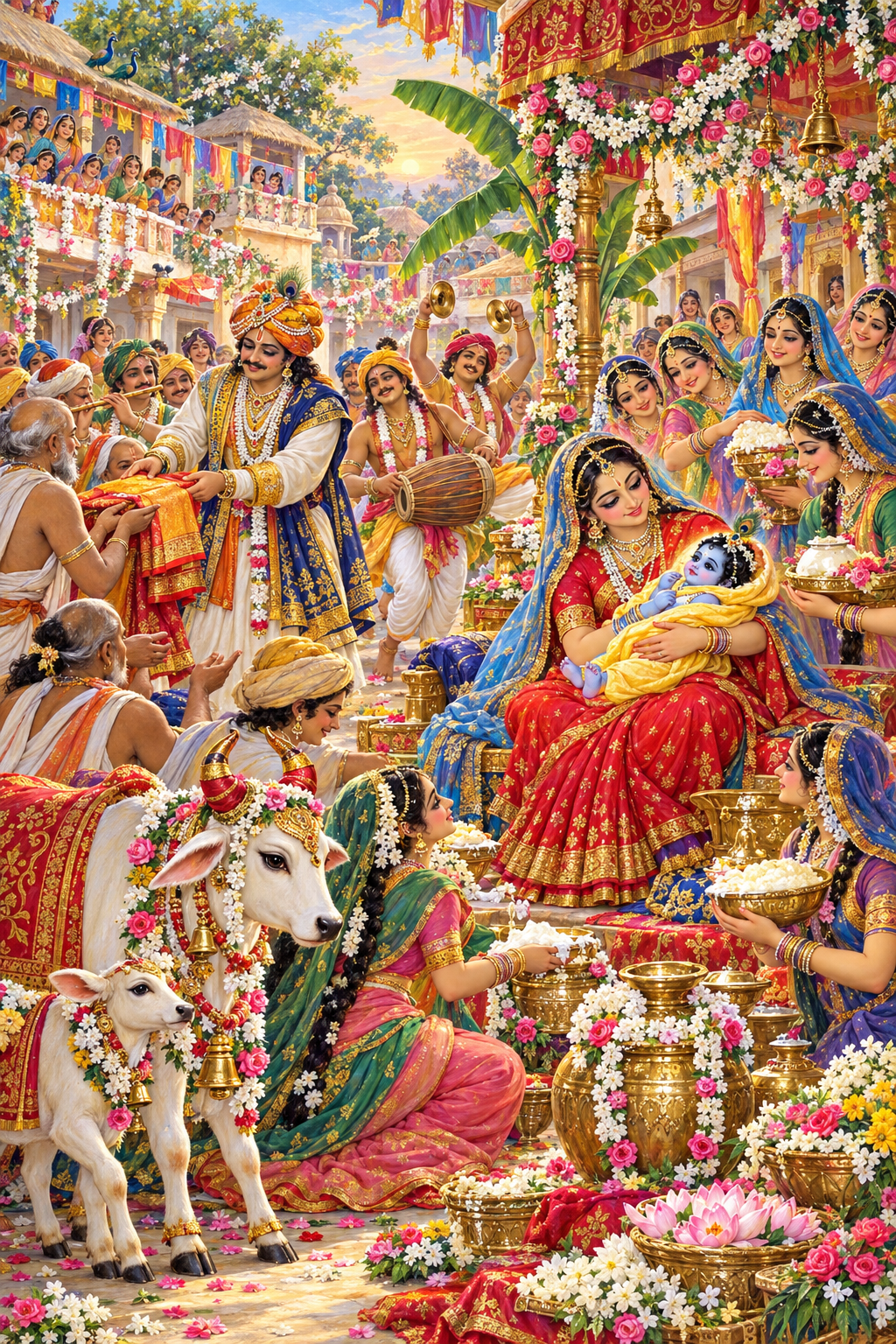
Then, in the month of Bhādra, on the eighth day of the dark fortnight, under the Rohiṇī star, at midnight, when everything was covered in darkness and the moon was rising, Lord Hari appeared from Devakī in Vasudeva’s palace, just as sacrificial fire appears from araṇi wood.
Vasudeva gazed at his son. The child wore a glittering, colorful jewelled necklace and the shining Kaustubha gem, splendid armlets and anklets, earrings and a helmet like the rising sun, bracelets like flickering flames, a belt shining like lightning, a lotus garland humming with bees, and splendid garments of new gold. He was dark and splendid like a raincloud with lightning. Black locks of hair moved on His face, His splendor dispelled the darkness, His eyes were lotus flowers, and He was decorated with wonderful designs. He was more charming than ten million Kāmadevas, the Supreme Personality of Godhead, greater than the greatest, who loves to play sweetly on the flute. Vasudeva’s eyes opened wide in festive joy, and in his heart he at once gave a million cows in charity to the brāhmaṇas.
Standing before the Lord in the birth room, the astonished Vasudeva bowed down. Now fearless, with folded hands he glorified the Lord:
“Although You are one, the modes of nature make You appear to be many. You are the creator, maintainer, and destroyer of the worlds. As crystal has no color of its own, You are untouched by material qualities. O master of the worlds, I bow down to You. You are within everything, like fire within wood, and outside everything, like the sky. You sustain everything, like the earth. You see everything, and You are present everywhere, like the air. Obeisances to You! You are the original Supreme Personality of Godhead, the protector of the cows, the demigods, the brāhmaṇas, and Your own children. You have taken birth in my home to remove the great armies that burden the earth. O master of the worlds, please protect me from sinful Kaṁsa.”
Understanding that the handsome, dark Śrī Kṛṣṇa was the original Supreme Personality of Godhead, Devakī also bowed down and said, “O Kṛṣṇa, master of countless universes, O Supreme Lord, O flag of Goloka, O original Lord, O master of the perfect, O perfect one, O most perfect original Personality of Godhead, O Supreme Controller, please protect, please protect me from Kaṁsa’s atrocities!”
Hearing this, Lord Kṛṣṇa, the destroyer of sins, smiled and spoke to Vasudeva and Devakī.
The Supreme Lord said, “In a previous creation she was the chaste Pṛśni, who worshiped her husband like a god, and you were Sutapā, who wished to have children. By Brahmā’s order you both performed great and splendid austerities, fasting from food and water. Your austerity for a son continued even after the manvantara had passed. Then I was pleased with you and said, ‘Ask for a benediction.’ You both said, ‘May we have a son like You.’ I said, ‘So be it,’ and left.
“Thinking, ‘There is no one like Me,’ I Myself became your son, famous as Pṛśnigarbha. The second time I again became your son as Vāmana, the younger brother of Indra. Now I, the Supreme Lord, greater than the greatest, have become your son once more. Take Me to Nanda’s palace. Do not fear Kaṁsa. Bring back Nanda’s daughter, and you will be happy.”
Śrī Nārada said: Then Lord Hari fell silent, became invisible, and, like an actor, reappeared as an ordinary infant on the ground.
As Vasudeva was placing the infant in a basket and preparing to leave, the goddess Yogamāyā was born in Vraja from the wife of Nanda. Yogamāyā put all the guards to sleep, unfastened the shackles and locks, and opened all the doors. When Vasudeva set out, carrying Śrī Kṛṣṇa on his head, the darkness was at once destroyed, as if the sun had suddenly risen. The Yamunā, the best of rivers, was full of great waves and whirlpools, and her banks were full of lions, snakes, and other wild creatures, yet she gave Vasudeva a path.
Entering Nanda’s Vraja, he placed the sleeping infant on Yaśodā’s bed and looked at Yogamāyā. Picking up the infant Yogamāyā, he left the house, crossed the Yamunā, returned to his prison cell, and became as he had been before. Mother Yaśodā, exhausted, slept a blissful sleep, not knowing whether a son or a daughter had been born.
Hearing the cry of an infant, the guards went to the royal palace and informed the warrior Kaṁsa. Overcome with fear, Kaṁsa rushed to the birth room. Weeping like the most wretched person, his chaste sister Devakī spoke to him:
“Now that all my sons are dead, please give me this one daughter. O brother, it is not right for you to kill a girl. You are kind to the miserable. I am your younger sister. You killed my sons and threw me in prison. O noble one, please give this beautiful daughter to me.”
Bewildered, her face covered with tears, Devakī pleaded and tried to hold the child in her lap. But the demon Kaṁsa rebuked her and snatched the child away. Then that sinful demon, the lowest of the Yādavas, whose friends were all demons, took his sister’s daughter by the feet and dashed her against a stone slab.
But the girl flew from Kaṁsa’s hand into the sky and entered a splendid chariot shaped like a hundred-petalled lotus, drawn by a thousand horses. Kaṁsa saw her standing on it with cāmaras waving around her. Served by many attendants, her form as splendid as a hundred suns, holding weapons in her eight arms, the goddess Yogamāyā spoke to Kaṁsa in a voice like thunder:
“Lord Śrī Kṛṣṇa, the original Supreme Personality of Godhead, is already born. Where is He born? He will kill you. You torture this poor girl in vain.”
Saying this, the goddess went to the Vindhya Hills, where she became known by many names.
Kaṁsa was astonished. Following his mother’s words, he released Vasudeva and Devakī from their chains and said, “I am a sinner. I have committed many sins. I am a demon, the lowest of the Yādavas. Please forgive what I have done. Please forgive the killer of your sons. O sister, O Vasudeva, listen to me. I think all this was done by time, which moves even what cannot be moved, just as the wind moves the clouds. I believed the words of the demigods, but even the demigods lie. The goddess said my enemy is already born on the earth. Where? I do not know.”
Weeping, his face covered with tears, Kaṁsa fell at their feet. He served them nicely and showed them friendship. Ah, even upon such a person, did not the merciful glance of Śrī Kṛṣṇacandra, the Supreme Personality of Godhead, fall upon the earth?
But early in the morning the demon Kaṁsa called together the great demons headed by Pralambāsura and told them what Yogamāyā had said. “The one who will bring my end has already been born on the earth. Therefore all of you must kill every infant, whether older or younger than ten days.”
The demons said, “When you string your bow for battle, the demigods tremble at the twang of its string. The cows, brāhmaṇas, devotees, Vedas, demigods, and the principles of religion are the limbs of Lord Viṣṇu. When they are destroyed, the power of the demons will be established. If your enemy Mahā-Viṣṇu is indeed born on the earth, the way to kill Him is to attack the cows and the others.”
Sent by Kaṁsa, these powerful, sinful demons flew through the sky. They killed many newborn infants, many cows, and many other pious beings. Traveling over the earth from sea to sea and entering house after house, these demons, who could take any form they wished, moved about like snakes. Having left the path of religion, they behaved like monkeys, like drunkards ruined by liquor, or like men possessed by ghosts. O king of Videha, O lord of Mithilā, O devotee of Lord Upendra, O first among the pious, O pious King Bahulāśva, in this way the demons harassed the devotees on the earth and destroyed the four goals of pious life.
Lessons to be learned
Kṛṣṇa’s birth is completely transcendental. He first entered Vasudeva’s heart, then Devakī’s heart, and appeared as fire appears from araṇi wood. In the Bhagavad-gītā He says janma karma ca me divyam: whoever understands the divine nature of His birth and activities does not take birth again and goes back home to Him. Śrīla Prabhupāda stressed that Kṛṣṇa does not accept a material body. He appears in His eternal form, and only afterward, out of love for His parents, acts like an ordinary infant.
Kaṁsa thought of Kṛṣṇa constantly out of fear. Nārada says that even by hating Him the demons attain His association. The ācāryas explain this as the power of the Lord’s name and form. But enmity gives only liberation, while loving remembrance gives the service of Kṛṣṇa, which is infinitely greater. We should think of Kṛṣṇa constantly, but with love.
Vasudeva’s prayer teaches that the Lord is both within everything and beyond everything, untouched by matter like crystal. The same Lord who is everywhere also appears in a particular place, in a particular family, for His devotees.
Vasudeva and Devakī had performed austerities for a son like the Lord, and He became their son three times. The Lord repays His devotees’ desires beyond their expectations.
The river Yamunā gave way, the guards slept, and the chains opened. When one carries Kṛṣṇa on one’s head, all obstacles disappear. Śrīla Bhaktivinoda Ṭhākura explained that the heart of the devotee who carries Kṛṣṇa within is freed from the prison of material life in the same way.
Kaṁsa repented with tears, but the next morning he ordered the killing of infants and cows. His repentance was only sentimental, not real. True repentance means changing one’s actions. The demons also understood that to attack God, they must attack the cows, brāhmaṇas, devotees, Vedas, and religion, which are His limbs. Therefore, as Śrīla Prabhupāda emphasized, protecting cows, brahminical culture, and devotees is a direct service to Kṛṣṇa.