The Final Days of the Saint
Years passed as Tulsīdās continued his life of pure devotion in Kāśī. The holy city resounded daily with his songs and discourses. Men and women from all walks of life—scholars, kings, beggars, and saints—gathered near the Gaṅgā to hear him sing the glories of Lord Rāma.
Even in old age, his voice remained filled with sweetness and power. But gradually, the saint’s body began to show signs of exhaustion. His disciples, seeing his frail form, wept. They begged, “O Gurudeva, do not leave us! The world is still in darkness; we need your presence.”
Tulsīdās smiled gently. “My children, do not grieve. The body must one day rest, but the Lord’s name never dies. When you chant Śrī Rāma Jaya Rāma Jaya Jaya Rāma, I shall be there among you. The Lord is calling me to His eternal abode.”
The Vision of Lord Rāma
On a serene evening, as the sun set over the Gaṅgā, Tulsīdās sat facing the golden waters, his eyes half-closed in meditation. His chanting became slower, deeper, and filled with profound sweetness.
Suddenly, the sky above Kāśī was illumined with divine radiance. Celestial music filled the air. The devotees around him felt an extraordinary peace descend, as if the universe itself had paused in reverence.
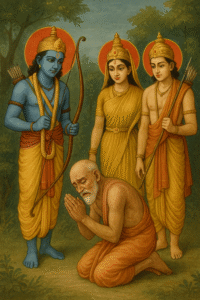
Tulsīdās opened his eyes and saw before him two radiant forms—Lord Rāma and Lakṣmaṇa, standing in divine splendor. Rāma’s eyes were filled with mercy, and His smile radiated affection.
The Lord spoke softly, “O beloved devotee, you have sung My name through every corner of the world. Come now to My abode, where endless kīrtana resounds and no shadow of sorrow falls.”
With folded hands, Tulsīdās said, “O my Lord, what greater fortune could there be than to see You and serve You eternally? May I never forget the dust of Your lotus feet.”
The Saint’s Departure
As he bowed his head, his chanting grew faint—“Śrī Rāma… Jaya Rāma… Jaya Jaya Rāma…”
Then, like a lamp merging into the sunlight, his soul left the body and entered the eternal presence of Rāma. A soft fragrance filled the air. The devotees who sat around him saw a brilliant light ascend into the sky, merging with the sun above Kāśī Viśvanātha.
The sound of conch shells, bells, and voices chanting “Victory to Rāma’s devotee!” spread across the city. Even the Gaṅgā seemed to flow more gently, carrying with her the saint’s final blessing to the world.
The Glory of His Legacy
In remembrance of the day he departed, devotees gather on the banks of the Gaṅgā to sing his verses from Rāma-charita-mānasa. It is said that even now, in Kāśī, one can feel his presence whenever the holy name of Rāma is chanted with love.
Through his words, the saint left behind the bridge to liberation—a path of devotion so simple that even the most fallen soul could cross. His songs continue to awaken sleeping hearts, reminding them of the sweetness of divine love.
As the poet himself wrote:
“Tulsī ke hriday basai, Rāma Lakṣmaṇa Jānī.
Jīvan-mukta soye kahai, jo nirmal prīti jāni.”
(In Tulsī’s heart dwell Rāma, Lakṣmaṇa, and Jānakī.
He alone is truly liberated who loves Them with pure devotion.)
Reflections – The Eternal Presence of the Saint
- The Devotee Never Dies: Though Tulsīdās’s body perished, his spirit lives eternally in his words and the holy name he glorified. Saints never disappear; they merge with God’s will.
- The True Measure of Life: The saint’s departure teaches that life’s perfection is not in wealth or power, but in complete remembrance of God at the final moment.
- The Power of Chanting: Tulsīdās’s final act was chanting. Thus, he demonstrated the path for all devotees—to leave this world with Rāma’s name on one’s lips and love in one’s heart.
- The Saint’s Ongoing Presence: The holy name and the saint’s words remain ever-living. To read or sing Rāma-charita-mānasa is to sit again at the feet of Tulsīdās and hear the same divine love that filled his life.
May we, too, remember his final lesson—that the true glory of life lies in unceasing devotion, humility, and love for Śrī Rāma.
Source: Bhaktavijaya, Chapter III, verses 325–340 (Mahīpati).