The Grieving King
In the kingdom of Chitrakūṭa, a pious ruler once reigned who had great affection for saints and holy men. His only son, a boy of radiant beauty and gentle nature, suddenly fell ill and died. The palace was filled with wailing. The king tore his robes, the queen fainted repeatedly, and all the citizens mourned as though the sun itself had vanished.
The royal priests, scholars, and physicians gathered but were helpless. Finally, one minister said softly, “There is one in Benares whose name alone can give life to the dead—the great Tulsīdās. If he so desires, your son can breathe again.”
The king seized this thread of hope. “Go at once! Bring the saint here, or I shall follow my son to the grave.” Swift horses galloped toward Kāśī to find the bhakta-poet.
The King’s Plea
When the messengers found Tulsīdās by the Gaṅgā, he was engaged in kīrtana, chanting the names of Lord Rāma. They bowed and said, “O revered one, our king has lost his only son. He begs you to come and bring him back to life. Without you, our land will perish in grief.”
Tulsīdās, with compassion shining in his eyes, replied, “I am not the giver of life. Only Śrī Rāma, the eternal protector, can restore the breath that He has withdrawn. Still, if it is the Lord’s will, let us go.”
He journeyed with the messengers to Chitrakūṭa, chanting the Lord’s name all along the way.
The Saint’s Prayer
When Tulsīdās entered the palace, the king fell at his feet, sobbing, “O ocean of mercy! Only your grace can save us. Restore my child to life and I shall dedicate my kingdom to Rāma.”
Tulsīdās raised him gently. “Do not cry, O King. Nothing in this world is truly ours. The body is but a garment that the soul wears and leaves behind. Yet, by Rāma’s compassion, even death can become life again. Let us pray.”
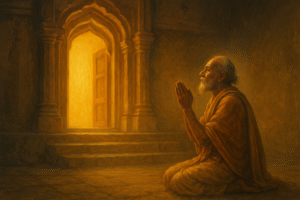
He went to the chamber where the prince’s body lay. The air was still, the lamps flickered faintly, and a fragrance of sandalwood hung in the air. Tulsīdās placed his hand upon the boy’s head, closed his eyes, and began to chant the Rāma-nāma—the holy name of the Lord.
Miracle of the Holy Name
At first, there was silence. Then, as the saint’s voice deepened in devotion, a soft breeze moved through the room. The lamps flared brightly, and the sound of the mantra seemed to echo in every corner of the palace: “Śrī Rāma Jaya Rāma Jaya Jaya Rāma.”
A faint flush appeared on the child’s cheeks. His fingers twitched. Slowly, the prince opened his eyes and took a deep breath. “Father!” he whispered.
The queen screamed in joy, the king fell to the ground in disbelief, and the entire palace erupted with shouts of “Victory to Lord Rāma!” The people gathered outside, singing and dancing, their tears flowing freely.
The King’s Gratitude
The king bowed before Tulsīdās and said, “O master, you have returned my son from the abode of Yama. Please accept half my kingdom.”
Tulsīdās smiled serenely. “O King, the Lord gives and takes according to His will. I am only His servant. If you wish to show gratitude, then rule your people with justice and chant the name of Rāma daily. This alone will please the Lord.”
The king agreed with reverence and built a temple to Rāma in his capital as an offering of thanks. The people worshipped there every day, remembering the miracle performed by Tulsīdās.
Reflections – Lessons for Devotees
- Faith Transcends Death: When all worldly help fails, the divine name alone can give life and hope.
- The Lord’s Servant Is His Instrument: Tulsīdās did not claim power; he remained an instrument of Rāma’s mercy.
- True Gratitude Is Service: The best way to honor a saint’s grace is to live by dharma and remember God always.
- Miracles Are Secondary: The revival of the prince was not for spectacle, but to demonstrate the limitless power of devotion.
Through this story, we see how the Lord fulfills the prayers of His pure devotee. Death itself bows before the name of Rāma when uttered with complete faith and love.
Source: Bhaktavijaya, Chapter III, verses 313–345 (Mahīpati).