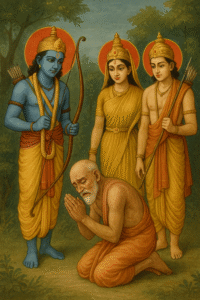
The Emperor’s Awakening
After witnessing the miracle of the monkeys, Emperor Akbar’s heart softened completely. The pride of kingship melted before the power of divine grace. When Tulsīdās emerged from meditation, the emperor bowed low before him and said, “O saint, forgive my ignorance. I desired to test your devotion, but I see now that the power of God’s name is far greater than the might of any ruler.”
Tulsīdās placed his hand gently on Akbar’s head and said, “O emperor, you are blessed because humility has entered your heart. The Lord dwells not in palaces of marble, but in hearts purified by love and surrender.”
Akbar then asked, “How shall I serve this Lord Rāma whom you worship?”
The saint replied, “Serve the people as His children. Rule not as a master, but as His instrument. Let justice be tempered with mercy, and let every act of your rule remind you that kingship is service.”
These words struck Akbar deeply. From that day forward, he ordered that the poor and holy should be honored throughout the empire. Wherever saints or mendicants traveled, they were to be treated with respect and provided food and shelter.
The Saint’s Return to Kāśī
Tulsīdās stayed in Delhi for a year, during which he inspired many to chant the Lord’s names. Even the courtiers and ministers began to repeat “Śrī Rāma” secretly, finding peace in the sound. One morning, while gazing at the dawn sky from his cell, the saint felt a soft whisper in his heart—“Return to Kāśī. There My name awaits your song.”
He went before Akbar and said, “O emperor, my time here has come to an end. I must return to the banks of the Gaṅgā.”
Akbar tried to persuade him to remain: “Revered one, your presence brings peace to my city. Stay and bless us a little longer.”
Tulsīdās smiled. “The flow of Gaṅgā cannot be stopped, nor can a devotee remain still when the Lord calls. My heart belongs to Kāśī, where every breeze carries Rāma’s name.”
The emperor reluctantly consented and arranged a royal procession to accompany the saint on his departure. As Tulsīdās left the city, thousands of citizens gathered to bid him farewell. From the rooftops, people showered flowers and cried, “Victory to Rāma’s devotee! Victory to the poet of divine love!”
A Saint Above All Castes and Creeds
Before leaving, Akbar asked one last question. “You have brought joy to both Hindu and Muslim alike. How do you see the difference between faiths?”
The saint replied, “When one chants the name of Rāma, all differences vanish. Some call Him Rāma, some Rahim, some Govinda, some Khuda. But the essence is one—the Supreme Truth dwelling in every heart. As rivers flow into one ocean, all prayers reach the same Lord.”
Hearing this, Akbar was moved to tears. He said, “O saint, your words have shown me the unity of all paths. You have conquered not with armies, but with love.”
Return to the Holy City
When Tulsīdās returned to Kāśī, the people rejoiced. Bells rang from every temple, and devotees thronged to see him. He resumed his kīrtans, chanting the holy names with renewed fervor. His fame now spread not only across India but throughout the lands of the emperor’s rule.
Many came to him—merchants, scholars, mendicants, and simple villagers—and he gave to all the same teaching:
“Chant the name of Rāma. Let your tongue be the temple, your breath the priest, and your heart the altar.”
Reflections – The Saint’s True Kingdom
- The Humility of Power: Even the greatest emperor bowed before the Lord’s devotee, showing that spiritual power surpasses all worldly might.
- True Service: Tulsīdās’s words transformed kingship into service. Every position of authority, when offered to God, becomes sacred.
- Unity of Faith: The saint saw no barrier between religions, knowing that love of God is the true religion of all souls.
- The Saint’s Real Wealth: Tulsīdās left behind palaces and gold but carried with him the only treasure worth keeping—the holy name of the Lord.
Thus, the story closes the chapter of Delhi, where pride met humility, and a worldly ruler became a servant of truth through the light of a saint’s devotion.
Source: Bhaktavijaya, Chapter III, verses 313–324 (Mahīpati).