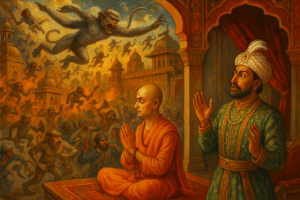
The Demon in the Forest
After twelve years of austerities on the banks of the Gaṅgā, Tulsīdās continued his practice of offering the remaining water from his ablutions to nourish trees. One day, as he poured the last drops upon a tree root, a terrible form appeared before him—a frightful demon with joined palms, his eyes softened with humility.
The demon spoke gently, “O noble sage, I am pleased with your austerities. Ask from me any boon you desire.”
Tulsīdās was astonished. “Who are you,” he asked, “and why are you pleased with me?”
The demon replied, “I am a spirit bound here for ages. I am forbidden to drink from wells or rivers, but for twelve years I have survived on the water you pour for the trees. By your mercy I am sustained. Ask anything, and I shall grant it.”
The Poet’s Lament
Hearing this, Tulsīdās sighed deeply:
“Alas! I sought the vision of Śrī Rāma, yet the first to appear before me is a ghost! I planted a mango tree and received the fruit of a thorn bush. I wished for a wish-fulfilling cow, but a pig appeared. I longed for pearls, but crystals fell before me. I sought a divine swan, but found only a crow. Such is my fortune!”
He lamented again:
“To desire association with the saintly and meet instead with the wicked; to yearn for knowledge and be given stories of sense pleasure—such is my fate. I sought Rāma, yet a ghost rewards my tapas!”
The Demon’s Wisdom
The demon, perceiving his heart, smiled and said, “O sage, do not despise the lowly instruments through which God fulfills His plans. Even gold will not melt without borax; without a broom, no floor can be swept. Use whatever means the Lord provides.”
Tulsīdās bowed and said, “Then grant me only one thing—help me to meet Śrī Rāma.”
The demon stepped back in alarm. “Ah! I dare not utter that Name—it would burn me! But I can bring you His servant, Hanumān. Seek him where the Purāṇas are recited. He comes disguised as an old brāhmaṇa—lean, staff in hand, with a cap and a simple cloth. He sits first, leaves last, and listens silently. Recognize him, and your wish shall be fulfilled.”
Having spoken thus, the demon vanished.
The Meeting with Hanumān
The next day Tulsīdās bathed, repeated Rāma’s Name, and went to the gathering where scriptures were read. Soon an aged brāhmaṇa entered—just as described. When all the hearers departed, the old man quietly rose to go.
Tulsīdās ran forward, clasped his feet, and cried, “O revered one, show compassion! Reveal Thyself—Thou art Hanumān, the servant of Śrī Rāma!”
The old man smiled faintly. “Who are you, child, and why do you hold my feet? I am only a poor pilgrim.”
But Tulsīdās would not rise. With tears he repeated, “You are Hanumān!”
Moved by such devotion, Hanumān embraced him. “You are the sage Vālmīki reborn,” he said, “and your heart is pure. What boon do you seek?”
“I desire only one thing,” replied Tulsīdās, “to see my Lord, Śrī Rāma, face to face.”
Hanumān smiled. “Be patient. I shall arrange it.” Then he vanished like lightning.
Devotional Meaning
This episode reveals the mystery of divine approach: before the Lord manifests, His servant appears. The demon’s unexpected grace teaches that even lower beings become instruments in the chain of mercy. Hanumān’s appearance as a humble brāhmaṇa shows that the divine walks among us unseen, testing our vision. The seeker who refuses to despise any circumstance, seeing all as Rāma’s arrangement, soon meets the true Guide.
Reflections – Lessons for Devotees
- Do not reject the unexpected messenger. God may use even a ghost or an enemy to fulfill your prayer.
- True vision requires humility. Tulsīdās bowed to the unseen servant of the Lord before beholding the Lord Himself.
- Hanumān embodies service before sight. The servant opens the way to the Master; therefore, worship Hanumān with gratitude.
- Patience in sādhanā. The Lord answers sincere austerity through stages—first discipline, then guidance, then revelation.
Source: Bhaktavijaya, Chapter III, verses 69–108 (Mahīpati).