(Canto 1, Chapter 8: Description of Śrī Rādhikā’s Birth)
Śrī Garga Muni said: O Śaunaka, when King Bahulāśva of Mithilā, who was full of faith and devotion for Lord Hari and the best of the wise, heard all this, he bowed down again and spoke to the great sage Nārada, the best of the divine sages.
King Bahulāśva said, “By giving my family these narrations of Lord Hari’s pure glories, you have purified my materialistic family and made it auspicious. By even a moment’s contact with a devotee of Lord Kṛṣṇa, an ordinary person becomes a saint. What more need I say? Please tell me what the Supreme Personality of Godhead did when He came to Vraja with Śrī Rādhā. O divine sage, O lord of the sages, please save me from the threefold miseries.”
Śrī Nārada said, “Fortunate is the family into which you were born, for it was made perfect by King Nimi, a great devotee of Lord Kṛṣṇa. It is no surprise that a pearl is born in an oyster. Now please hear the purifying and most auspicious pastimes of the Supreme Lord. Kṛṣṇa did not come only to kill Kaṁsa. He came to protect His devotees.
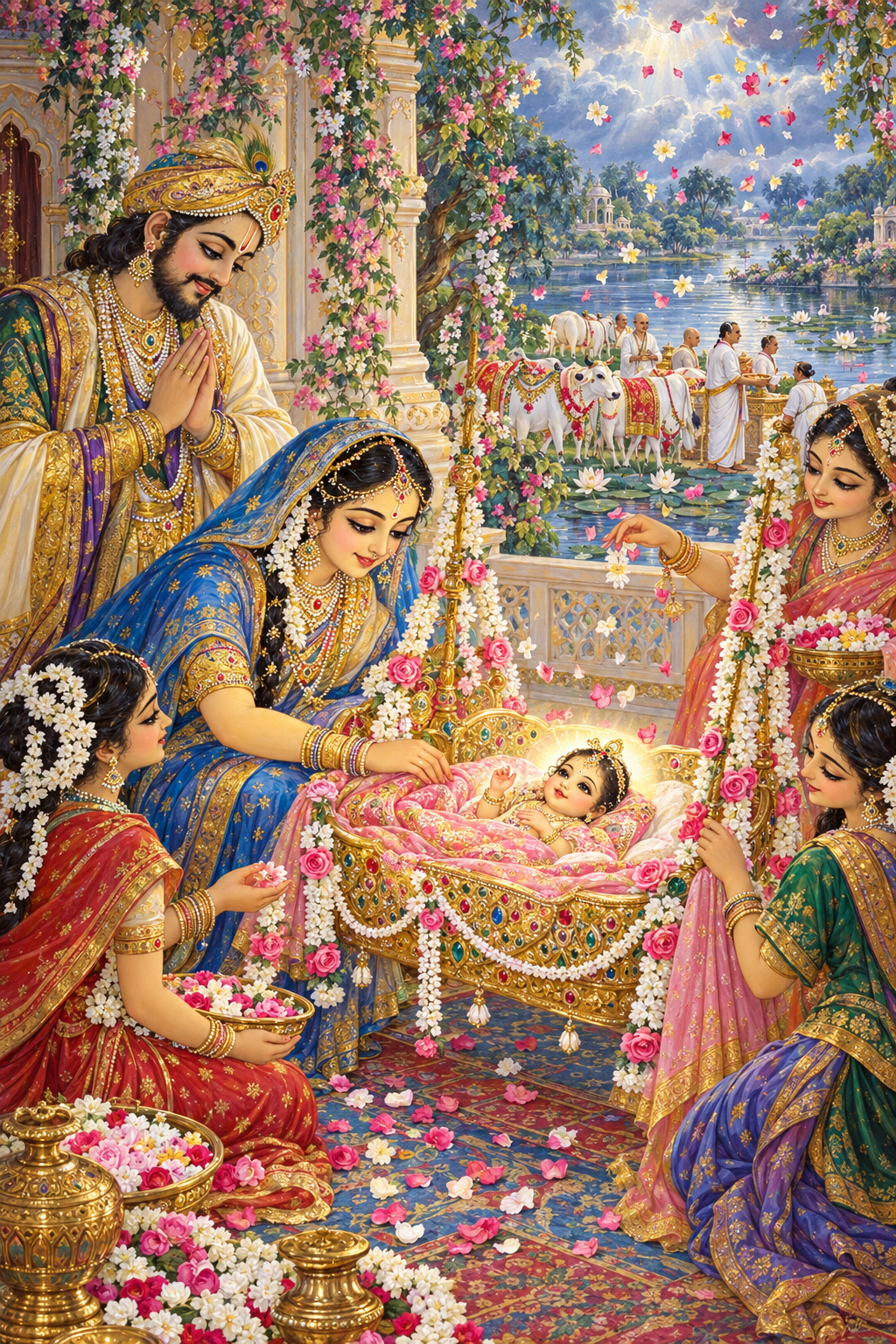
“Placing Her glorious transcendental form within the wife of King Vṛṣabhānu, Śrī Rādhā descended in a great palace in a garden grove on the bank of the Yamunā. It was the month of Bhādra, on the eighth day of the bright fortnight, a Monday, at midday, and the sky was covered with clouds. To celebrate Rādhā’s appearance, the demigods scattered on that palace flowers that had blossomed in the Nandana gardens of heaven.
“Because of Rādhā’s appearance, the rivers became pure and clear, the directions became happy and auspicious, and gentle, cooling breezes blew, carrying the pollen of lotus flowers. Gazing at her daughter, who was more beautiful than a hundred autumn moons, the gopī Kīrti became very happy. To bring auspiciousness, she at once gave two hundred thousand cows in charity to the brāhmaṇas.
“Rocked by Her friends in a golden cradle filled with the rays of inlaid jewels and anointed with sandal paste, She grew day by day like the waxing moon. Her darśana is very rare even for the best of the demigods, and it cannot be attained by sacrifices performed for millions of births. Yet in the palace of Vṛṣabhānu, the people fondled and cared for Her in Her personal form. She is the moonlight that makes the rāsa dance blossom, the row of lamps that lights Vṛṣabhānu’s palace, the jewelled necklace worn by the crest jewel of Goloka. Meditating upon Her, the Supreme, I wander over the earth.”
King Bahulāśva said, “How great is the good fortune of Vṛṣabhānu, whose daughter was Rādhā! What did Kalāvatī and Sucandra do in their previous lives?”
Śrī Nārada said, “Sucandra, the very fortunate son of King Nṛga, was a king of kings, an emperor, a partial expansion of Lord Hari, and extremely handsome. The Pitās had three beautiful mind-born daughters named Kalāvatī, Ratnamālā, and Menakā. By their own wish, the Pitās gave Kalāvatī in marriage to wise Sucandra, the partial expansion of Hari; Ratnamālā to the king of Videha; and Menakā to the Himālaya, with dowries and proper ceremonies. From Ratnamālā, Sītā appeared, and from Menakā, Pārvatī. O wise king, the histories of both of them are well known in the Purāṇas.
“Sucandra, accompanied by Kalāvatī, went to a forest on the bank of the Gomatī River and performed austerities for twelve celestial years in worship of Lord Brahmā. Then Brahmā came to him and said, ‘Ask for a benediction.’ Hearing this, Sucandra came out of the anthill that had covered his body, now bearing a divine form. He bowed down and said, ‘Please give me the divine liberation that is beyond all else.’
“Hearing this, the chaste Kalāvatī became unhappy and said to Brahmā, ‘For a woman, the husband is remembered as the supreme deity. If he attains liberation, what will become of me? I cannot live without him. If you give him liberation, I will curse you, for I am distraught at being separated from my husband.’
“Lord Brahmā said, ‘I am afraid of your curse, and yet my benediction also cannot be false. Therefore go with your beloved husband to the heavenly planets. After enjoying happiness there for some time, you two will take birth on the earth in Bhārata-varṣa, between the Gaṅgā and the Yamunā, at the end of Dvāpara-yuga. When Śrī Rādhikā, the beloved of the Supreme Personality of Godhead Himself, becomes your daughter, then you will both attain liberation.'”
Śrī Nārada said: “Thus, by Brahmā’s divine and infallible benediction, Kalāvatī and Sucandra both took birth on the earth. Kalāvatī appeared in Kānyakubja from the sacrificial fire-pit of King Bhalandana, and she remembered her previous life. Sucandra took birth as Vṛṣabhānu in the house of Surabhānu. He was the best of the gopas, as handsome as a second Kāmadeva, and he too remembered his previous life. Wise King Nanda arranged their marriage, according to the wishes of both of them, who remembered their past.
“A person who hears this narration of Vṛṣabhānu and Kalāvatī becomes free from all sins and attains intimate union with Kṛṣṇa.”
Lessons to be learned
Bahulāśva says that even a moment’s association with a devotee turns an ordinary person into a saint. Śrīla Prabhupāda loved to quote the verse from the Caitanya-caritāmṛta: sādhu-saṅga, sādhu-saṅga sarva-śāstre kaya, lava-mātra sādhu-saṅge sarva-siddhi haya. Even a moment’s association with a pure devotee brings all success.
Nārada says Kṛṣṇa did not come only to kill Kaṁsa but to protect His devotees. The ācāryas explain that killing demons can be done by Viṣṇu’s expansions. Kṛṣṇa Himself comes mainly to give His devotees the joy of His loving pastimes.
Śrī Rādhā’s appearance is not an ordinary birth. She placed Her own spiritual form in Kīrti’s womb. Her darśana cannot be attained by sacrifices over millions of births, yet the residents of Vraja held Her in their arms. This shows that pure love, not mechanical ritual, attracts the Divine Couple. Gauḍīya Vaiṣṇavas celebrate this day as Rādhāṣṭamī.
Sucandra asked for liberation, but his chaste wife refused to be separated from him. Brahmā’s answer turned out to be far greater than what Sucandra asked for: instead of impersonal liberation, they became the parents of Śrī Rādhā Herself. Śrīla Bhaktivinoda Ṭhākura and Śrīla Prabhupāda taught that impersonal liberation is insignificant compared to loving service to Rādhā and Kṛṣṇa. As Śrīla Prabodhānanda Sarasvatī wrote, for the devotee, liberation seems like hell. The best benediction is always the one that brings us into the Lord’s service.