(Canto 1, Chapters 6 and 7: Description of Kaṁsa’s Strength, and Description of the Conquest of All Directions)
Śrī Nārada said: At the time of the churning of the ocean of milk, a great demon named Kālanemi fought with Lord Viṣṇu and was violently killed by Him. Later Śukrācārya, the guru of the demons, brought him back to life with his sañjīvanī science. But in his heart Kālanemi still burned to fight Lord Viṣṇu again.
On Mount Mandara he performed severe austerities, living only on the juice of dūrvā grass and worshiping Lord Brahmā. When a hundred celestial years had passed, nothing remained of him but bones inside an anthill. Then Brahmā came and said, “Ask for a benediction.” Kālanemi made his request, and Brahmā said, “O demon, the benediction you ask for is very difficult to obtain. Still, you have now obtained it. My words are never false.”
Then that demon took another demonic birth, from the wife of King Ugrasena, and became Kaṁsa. Even as a child he used to wrestle regularly with great wrestlers.
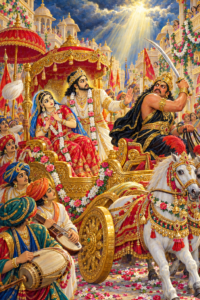
At that time Jarāsandha, the king of Magadha, set out to conquer all directions and made his royal camp at various places on the bank of the Yamunā. One day his elephant Kuvalayāpīḍa, as strong as thousands of elephants, became enraged, broke his chains, and ran out of the camp. All the wrestlers fled, but when the elephant came near Kaṁsa, he seized it by the trunk and threw it to the ground. Pleased to see such astonishing strength, Jarāsandha gave Kaṁsa his two daughters, Asti and Prāpti, and the elephant as well. As a wedding gift he also gave a hundred million horses, a hundred thousand elephants, three hundred thousand chariots, and ten thousand maidservants.
Proud of the strength of his arms and eager for battle, Kaṁsa went all alone to the city of Māhiṣmatī. There the king’s sons, Cāṇūra, Muṣṭika, Kūṭa, Śala, and Tośala, were wrestlers always eager to defeat opponents. Kaṁsa calmly told them, “Let us fight. If you win, I will become your servant. If I win, you will all become my servants.” They agreed. When Cāṇūra rushed at him, Kaṁsa roared and threw him to the ground. When Muṣṭika came at him with ferocious punches, Kaṁsa knocked him down with a single blow. When Kūṭa rushed at him, Kaṁsa knocked him down, caught his feet, and hurled him into the sky. When Śala came waving his arms, Kaṁsa grabbed one arm, pulled him down, and dragged him around. Then he grabbed Tośala, threw him down, and by the strength of his arms flung him eighty miles away. In this way Kaṁsa made them all his servants.
Then, on my advice, he went with them to the great mountain Pravarṣaṇa, where he made the same proposal to the gorilla Dvivida. For twenty days they fought without tiring. Dvivida uprooted a mountain and threw it at Kaṁsa’s head, and Kaṁsa threw a mountain back at him. Dvivida punched Kaṁsa and leapt into the sky, but Kaṁsa chased him and threw him to the ground. Knocked unconscious, weakened, dispirited, and with his bones broken, Dvivida became Kaṁsa’s servant.
Next Kaṁsa went to the Ṛṣyamūka forest, where lived a great demon named Keśī in the form of a horse whose neighing sounded like thunder. Punching him again and again, Kaṁsa subdued him, mounted him, and rode to Mount Mahendra. There Kaṁsa uprooted the mountain a hundred times, held it up, and set it back in its place.
Then he saw Lord Paraśurāma, blazing like the sun at the time of cosmic annihilation, His eyes red with anger. Kaṁsa bowed his head, circumambulated Him, and fell at His feet. Somewhat pacified, yet still fierce, Paraśurāma said, “O worm! O baby crab! You are as insignificant as a mosquito. Today I will kill you, a wicked kṣatriya falsely proud of his strength. This great bow at My side weighs a hundred thousand bhāras. Lord Viṣṇu used it in the battle for Tripura, and I received it from Lord Śiva’s own hand to destroy the kṣatriyas. If you can draw it, good for you. If you cannot, I will destroy your strength.”
Hearing this, Kaṁsa picked up the bow, which was as long as seven palm trees, and as Paraśurāma watched, he easily strung it. A hundred times he drew the string back to his ear and released it with a thunderous sound. The sound echoed through the seven planetary systems and outer space. It shook the elephants who hold up the directions and made the stars fall to the earth. Kaṁsa put the bow back, bowed again and again, and said, “O Lord, I am not a kṣatriya. I am a demon, and I am Your servant, the servant of Your servant. O Supreme Person, please protect me.”
Pleased, Lord Paraśurāma gave him that bow and said, “Whoever breaks this bow of Lord Viṣṇu will kill you.”
Kaṁsa bowed to Paraśurāma and left, his heart swelling with pride. After this no king would fight him; they only brought him tribute.
On the seashore Kaṁsa met a demon named Aghāsura, who had the body of a serpent and was hissing and licking his lips. When the serpent bit him, fearless Kaṁsa leapt on it and squeezed its neck like a necklace. In the east a great bull-demon named Ariṣṭa fought with him as one elephant fights another. Ariṣṭa uprooted a mountain with his horns and threw it at Kaṁsa’s head, and Kaṁsa threw a mountain back. With a single punch Kaṁsa knocked Ariṣṭa unconscious. After this victory he went north.
There Kaṁsa said to Narakāsura, the powerful son of the earth goddess and king of Prāgjyotiṣa, “O king of demons, give me a fight. If you win, I will be your servant; if I win, you will be mine.” Kaṁsa threw the demon Dhenuka eight hundred miles, jumped on him, and crushed him with punches. On Narakāsura’s order, the demon Tṛṇāvarta carried Kaṁsa into the sky and fought with him eight hundred thousand miles in outer space, but Kaṁsa dragged him back down to earth and made him vomit blood.
Then the powerful duck-demon Bakāsura tried to swallow Kaṁsa. Kaṁsa knocked him down with a punch hard as a thunderbolt. Rising again with a thunderous cry, the white-winged demon angrily swallowed Kaṁsa with his sharp beak. Inside, Kaṁsa grew angry and made his body as hard as a thunderbolt. His throat breaking, Bakāsura spat him out at once. Kaṁsa grabbed him, threw him down, whirled him around with both hands, and dragged him here and there.
Then Bakāsura’s sister Pūtanā came, wanting to fight. Kaṁsa laughed and said, “Listen, Pūtanā. I will never fight with a woman. Bakāsura has become my brother, so you should be my sister.”
Seeing Kaṁsa’s endless strength, Narakāsura accepted defeat, made friends with him, and joined him in an alliance against the demigods.
Accompanied by Pralamba and the other demons he had defeated, Kaṁsa went to the city of Śambara and made his challenge. Although Śambara was very powerful, he would not fight and instead became Kaṁsa’s friend. On the summit of Mount Trikūṭa slept a very strong demon named Vyoma. When Kaṁsa woke him with a kick, Vyoma’s eyes turned red with rage, and they fought a terrible battle with fists until Kaṁsa’s punches left him dizzy and he became Kaṁsa’s servant.
Then Kaṁsa came to me, bowed down, and said, “O lord, I yearn to fight. Where should I go?” I told him, “Go to the very powerful demon Bāṇāsura.” So Kaṁsa went to Bāṇa’s city of Śoṇitapura. Hearing the challenge, Bāṇāsura became furious. He kicked the ground and roared like thunder, and his leg sank through the earth up to his knee, reaching Pātāla-loka. Then Bāṇa said, “Pull me out as I was before.” With both hands Kaṁsa pulled him up as an elephant pulls up a lotus. The seven lower planetary systems were shaken, great mountains fell, and the elephants holding the directions stumbled. Seeing that Bāṇa was eager to fight, Lord Śiva arrived and said to Bāṇa, the son of Bali, “Except for Lord Kṛṣṇa, no one in the world can defeat this Kaṁsa. Lord Paraśurāma gave him that benediction and also gave him Lord Viṣṇu’s bow.” By these words, Lord Śiva made peace between them and they became great friends.
Kaṁsa then heard of a great demon named Vatsāsura in the west, who had the form of a calf. Kaṁsa caught him by the tail, threw him to the ground, and brought him under his control. Then he went to the lands of the mlecchas. Having heard of Kaṁsa from me, the red-bearded Kālayavana came with a club to fight him. Kaṁsa threw his own club, weighing a hundred thousand bhāras, and roared like a lion. They fought a terrible club duel until their clubs were ground to powder in showers of sparks. Kaṁsa threw Kālayavana down, jumped on him, and beat him almost to death. When Kālayavana’s army attacked with arrows, Kaṁsa struck down its elephants, horses, chariots, and warriors with his club. The barbarians fled, and Kaṁsa, knowing the rules of chivalry, did not attack those who were running away.
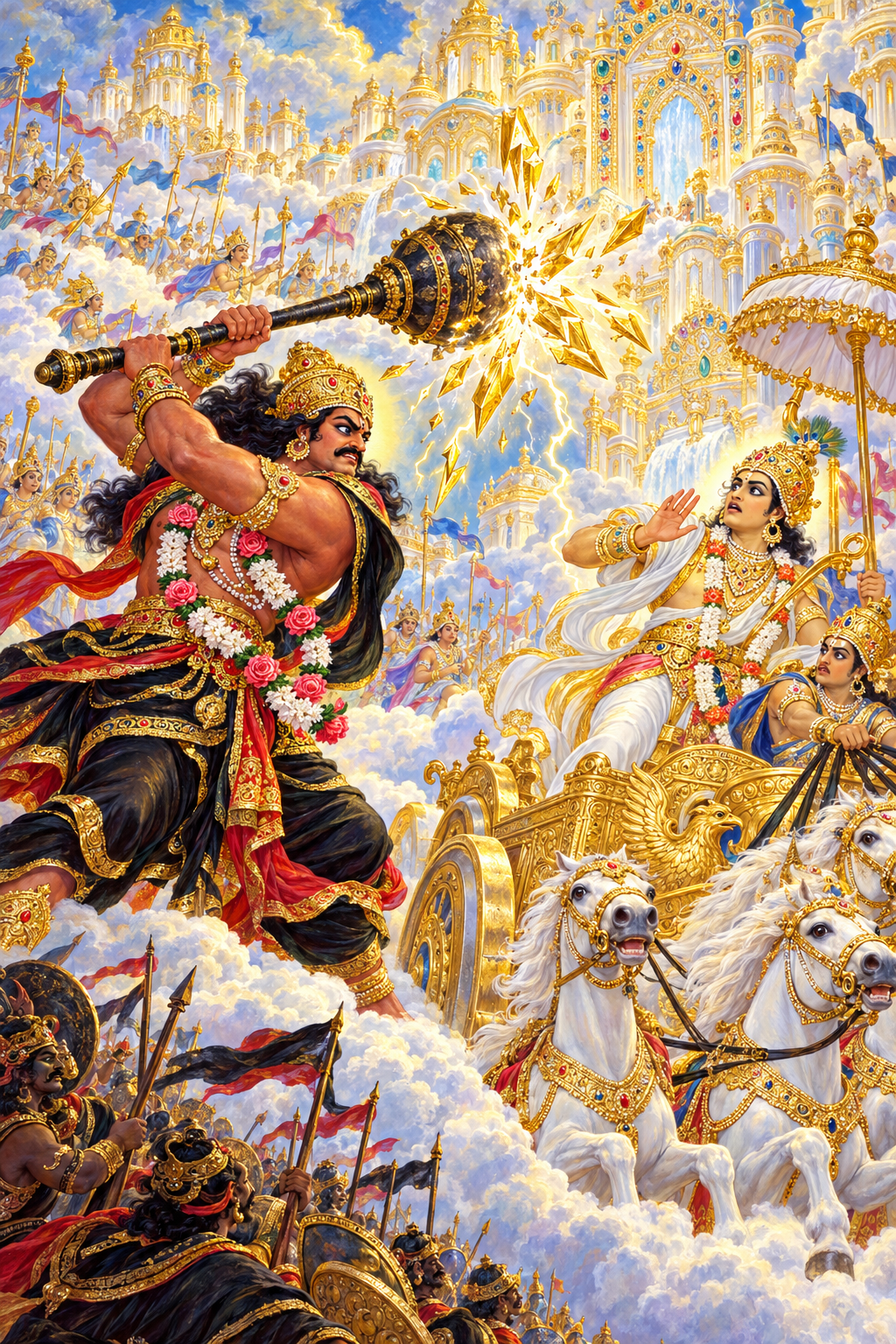
Then proud Kaṁsa set out for Amarāvatī, the city of Indra, to conquer the demigods. His thighs were like pillars, his chest broad as a great door, his arms massive, his eyes like lotuses, his hair long, and his complexion ruddy. He wore black garments, a helmet, earrings, a necklace, and a lotus garland, and he blazed like the sun at the end of the world, armed with sword, shield, quiver, and club. With Cāṇūra, Muṣṭika, Ariṣṭa, Śala, Tośala, Keśī, Pralamba, Baka, Dvivida, Tṛṇāvarta, Agha, Kūṭa, Narakāsura, Bāṇa, Śambara, Vyoma, Dhenuka, and Vatsa, he besieged Amarāvatī.
Indra, the king of the demigods, came out in anger with a great host of demigods. A terrible battle took place, and the showers of arrows and divine weapons created a blinding darkness. From his chariot Indra hurled his thunderbolt, flashing with a hundred streams of lightning. Kaṁsa struck it with his club and it fell broken. Indra took a sword and struck Kaṁsa on the head with a terrible sound, but Kaṁsa was no more hurt than an elephant struck with a flower garland. He threw his great club of eight metals at Indra. Indra caught it and threw it back, and then, with Mātali driving his chariot, cut through the enemy ranks. Then Kaṁsa struck Indra on the shoulder with an iron club, and Indra fell unconscious for a moment.
The Maruts covered Kaṁsa with arrows as monsoon clouds cover the sun, but thousand-armed Bāṇāsura drove them back with his own arrows. The Vasus, Rudras, Ādityas, and Ṛbhus surrounded Bāṇa like elephants surrounding a mountain. Then Narakāsura, with Pralamba and the other demons, gave a great roar that made the demigods fall unconscious on the battlefield.
Rising quickly with reddened eyes, Indra mounted his furious four-tusked elephant Airāvata, huge as a mountain of snow, adorned with jeweled saddle, bells, and painted designs, and charged at Kaṁsa. With one punch Kaṁsa struck the elephant, and with a second he struck Indra, who fell far away, while the wounded elephant dropped to its knees. Rising again, Airāvata caught Kaṁsa with his trunk and threw him eight hundred thousand miles away. But Kaṁsa’s body was hard as a thunderbolt, and he was only a little shaken. Trembling with anger, he returned, seized Airāvata, threw him down, twisted his trunk, and broke his tusks to pieces. Airāvata fled to the capital of the demigods.
Then Kaṁsa strung Lord Viṣṇu’s bow and, with floods of arrows and the thunder of its string, put the demigods to flight. Some lost their helmets and screamed in terror; some dropped their weapons and armor and surrendered with folded hands; others lost all desire to stand before him. Seeing the demigods defeated, Kaṁsa took Indra’s throne and royal parasol and returned with all the demons to his capital, Mathurā.
Lessons to be learned
Kaṁsa was once Kālanemi, killed by Lord Viṣṇu. Even after death, he carried his envy of the Lord into his next birth. This shows how deep the conditioning of the heart is: our desires follow us from life to life, as the Bhagavad-gītā teaches (yaṁ yaṁ vāpi smaran bhāvaṁ). Austerity performed with envy of the Lord only produces greater demonic power. Kālanemi’s austerities were severe, yet they made him an enemy of God. Austerity alone is not spiritual; its value depends on the motive.
Kaṁsa’s power was astonishing. He defeated wrestlers, demons, kings, and even Indra. Yet every one of those demons he gathered, Cāṇūra, Muṣṭika, Keśī, Agha, Baka, Pūtanā, Ariṣṭa, Dhenuka, Vatsa, Tṛṇāvarta, Pralamba, Vyoma, and Dvivida, would later be killed by Kṛṣṇa and Balarāma as child’s play. Śrīla Prabhupāda often pointed out that material power, however great, is nothing before the Supreme Lord. The very army Kaṁsa built became the stage for Kṛṣṇa’s pastimes.
Paraśurāma’s warning, “Whoever breaks this bow will kill you,” shows that the Lord arranges the end of the demon even at the height of his success. Nothing is outside His plan.
Kaṁsa said to Paraśurāma, “I am Your servant,” but his words were not sincere. He bowed only out of fear and to gain power. Real surrender is not a technique to get what we want from God; it is giving ourselves to His service.
Nārada Muni appears again and again, guiding Kaṁsa toward fights. The ācāryas explain that Nārada’s activities are always for the Lord’s pastimes. He was hastening the demon’s destruction and the appearance of Kṛṣṇa. The devotee works for the Lord’s purpose even when others cannot understand it.