(Canto 1, Chapter 20: Durvāsā Muni’s Vision of the Māyā Potency and His Prayers to Nanda’s Son)
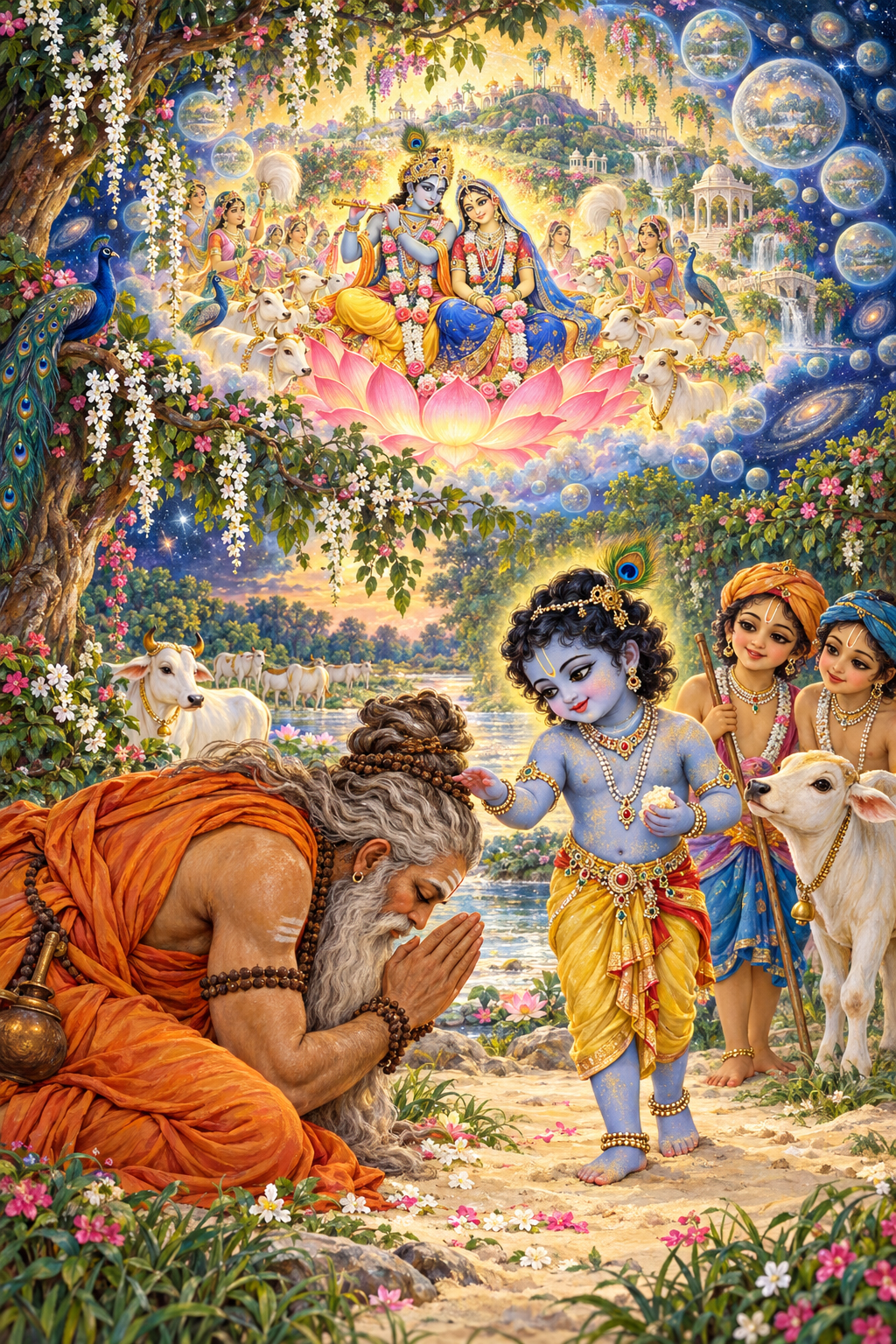
One day Durvāsā, the tiger among sages, came to the land of Vraja to see Lord Kṛṣṇacandra, the Supreme Personality of Godhead. In a beautiful place on the sandy bank of the Yamunā near Mahāvana, he saw Lord Kṛṣṇa. Lord Hari was a cowherd boy more handsome than Kāmadeva. Sometimes He rolled on the ground, play-fighting with the other boys, and sometimes He ran with them, naked, with all His limbs dark with dust. Seeing this, the sage was filled with wonder.
The sage thought, “Why would the supremely opulent Personality of Godhead, who controls everything, roll on the ground with some children? This must be a boy who is the son of someone named Nanda. He cannot be Śrī Kṛṣṇa, who is greater than the greatest.”
As the great sage Durvāsā was bewildered in this way, the playful Kṛṣṇa came up to him and on His own sat on the sage’s lap. Then He got down, and laughing gently, speaking a few words, with a glance like a lion cub’s, He came near again. As Kṛṣṇa laughed and breathed in, the sage was drawn into Lord Kṛṣṇa’s mouth.
There the sage saw a vast land with no people. Wandering through many forests, he said, “Where am I?” It was as if the great sage had been swallowed by a serpent. Then he saw the entire universe, with its many planets and outer space. Wandering over the continents, he came to the top of a great white mountain. There he worshiped the Supreme Lord and performed austerities for a billion years.
When the scheduled time of cosmic annihilation arrived, the universe became terrifying. Rushing oceans flooded the surface of the earth, and Durvāsā could find no end to the water. A thousand yugas passed. Submerged in the water, he forgot everything. Wandering through those waters, he saw another universe. He entered it and went to its heavenly planets, and at the top of that universe he lived for a lifetime as long as Brahmā’s. Then he saw an opening, and meditating on Lord Hari, he went out of the universe.
Outside he saw a great ocean, and in it many millions of universes. Gazing across that ocean, he saw the Virajā River. Crossing it, the sage entered the realm of Goloka. Seeing Vṛndāvana forest, Govardhana Hill, and the bank of the Yamunā, he became happy. Then he entered a forest grove filled with gopas, gopīs, and millions of surabhi cows. There, within a circle of light brilliant as countless millions of suns, on a splendid divine lotus of a hundred thousand petals, he saw Śrī Kṛṣṇa, the original Supreme Personality of Godhead, the Lord of Rādhā, the king of Goloka and of countless universes.
As Śrī Kṛṣṇa laughed, the sage was expelled from His mouth. He found himself gazing again at the boy who was Nanda’s son. Now understanding that Nanda’s son Kṛṣṇa, who was wandering with some boys in a beautiful place on the sandy bank of the Yamunā near Mahāvana, is the original Supreme Personality of Godhead, greater than the greatest, Durvāsā Muni bowed down to Him again and again and prayed with folded hands:
“With all my heart I bow down to Nanda’s gently smiling, sweetly graceful, handsome son, whose large eyes are hundred-petalled lotuses, whose lips are like red bimba fruits, and whose complexion is as splendid as a monsoon cloud.
“I offer my respectful obeisances to Him who plays as a child on the bank of the Yamunā, decorated with jingling anklets and ornaments, a belt of nine jewels, a beautiful necklace, and a string of lion’s nails, glorious with dots of black musk, His glance removing all sufferings.
“Obeisances, obeisances to You, Balarāma’s companion and Nanda’s son, whose bowed head is like a lotus flower, and above whose full-moon face curly locks of hair glisten like new dark monsoon clouds.
“Nanda’s son happily appears before the eyes of anyone who rises early and recites these prayers glorifying Him.”
Śrī Nārada said: Durvāsā, the best of sages, bowed down to Lord Kṛṣṇa and, meditating on Him and chanting His glories, went north to Badarikāśrama.
Śrī Garga Muni said to Śaunaka: In this way the great soul Nārada, the best of the divine sages, narrated Lord Kṛṣṇa’s transcendental pastimes to the intelligent King Bahulāśva. O brāhmaṇa, I have now described to you Lord Kṛṣṇa’s splendid transcendental glories, which wash away the sins of Kali-yuga and fulfil the four goals of life. What more do you wish to hear?
Śaunaka said, “What did King Bahulāśva of Mithilā then ask the great sage Nārada? O sage whose wealth is austerity, please tell me.”
Garga Muni said: The respectful king of Mithilā bowed down to his teacher Nārada and asked again about Lord Kṛṣṇa’s auspicious pastimes. “What wonderful activities did Śrī Kṛṣṇa then perform? O master, please tell me. The activities of the Lord’s previous incarnations are all auspicious, but Lord Kṛṣṇa’s activities are the purest of all.”
Nārada said, “Good! Good! You have asked about Lord Hari’s auspicious pastimes, and I will tell you of the glories He showed in Vṛndāvana. Śrī Kṛṣṇa Himself spoke this very wonderful and confidential Goloka-khaṇḍa in the rāsa-dance circle of Goloka. In a forest grove Lord Kṛṣṇa gave this Goloka-khaṇḍa, which fulfils all desires, to Śrī Rādhā. Rādhā gave it to me, and now I have given it to you.
“By reading it, a brāhmaṇa becomes learned in all the scriptures, a kṣatriya becomes a powerful ruler of the world, a vaiśya becomes master of great wealth, a śūdra is released from the bonds of servitude, and a person who has no desires becomes free from material bondage even while living in this world. A person who reads it regularly, properly, and with devotion goes to Lord Kṛṣṇacandra’s abode of Goloka, beyond the material world.”
Thus ends the first canto, the Goloka-khaṇḍa, of the Śrī Garga-saṁhitā.
Lessons to be learned
Durvāsā Muni was a great mystic, yet when he saw Kṛṣṇa rolling in the dust with the cowherd boys, he doubted that this boy could be God. Great learning and austerity do not qualify one to understand Kṛṣṇa’s pastimes. As Kṛṣṇa says in the Bhagavad-gītā, fools deride Him when He appears in a humanlike form, not knowing His transcendental nature. Only by His mercy can we understand that the child of Vraja is the Supreme Lord.
Kṛṣṇa’s answer was not an argument but a revelation. He drew the sage into His mouth and let him experience countless ages, universes, and finally Goloka, all within a moment. Time and space are within Kṛṣṇa, not Kṛṣṇa within them. The same Lord who sits on a thousand-petalled lotus in Goloka was sitting on the sage’s lap as a naughty child.
After this vision, the proud sage offered the sweetest prayers, not to the Lord of countless universes, but to the dust-covered son of Nanda with curly hair. The goal of all knowledge of the Lord’s greatness is to bring us to love His sweetness. Śrīla Prabhupāda said that the highest realization is to love Kṛṣṇa as the residents of Vraja love Him.
Finally, Nārada reveals the paramparā of this Goloka-khaṇḍa: from Kṛṣṇa to Rādhā, from Rādhā to Nārada, from Nārada to Bahulāśva, and through Garga Muni to Śaunaka and to us. Transcendental knowledge must be received through disciplic succession, as the Bhagavad-gītā says (evaṁ paramparā-prāptam). Received in this way, hearing Kṛṣṇa’s pastimes fulfils every desire and ultimately brings one to Goloka.