The King’s Curiosity
Word of Tulsīdās’ miracles spread across India until it reached the imperial ears of Emperor Akbar in Delhi. The courtiers told him of the saint who made a stone bull eat food and restored the dead to life. Akbar, though wise and tolerant, was skeptical. “Bring this saint to my court,” he ordered, “for I shall see with my own eyes whether these tales be true.”
The ministers selected eloquent envoys, men skilled in the knowledge of Brahma and persuasive in speech, and sent them to Benares with palanquins and royal gifts.
The Summons to Delhi
When the messengers arrived at the hermitage, they bowed before Tulsīdās and conveyed the emperor’s wish. “The great Akbar, protector of the land, desires to behold you. Please come with us to Delhi.”
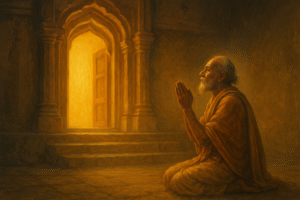
Tulsīdās reflected for a moment and thought, “The Lord may wish to turn even this meeting into a means for spreading His name.” Seeing it as Rāma’s will, he agreed.
Chanting “Śrī Rāma Jaya Rāma,” he set forth for Delhi, blessing all villages along the way with his presence. When he entered the capital, Akbar himself came forward, bowed low, and offered a seat of honor to the saint.
The King’s Demand
After honoring him with gifts and fragrant garlands, Akbar spoke: “O revered one, I have heard wondrous things about you. They say you make stone images eat, you awaken the dead, you perform deeds beyond reason. If this be true, show me a sign of your power.”
Tulsīdās replied humbly, “O Emperor, I have no power of my own. All miracles are wrought by the mercy of Śrī Rāma. I am but His servant, a beggar for His name.”
Akbar pressed further. “Then cause me to see this Rāma of whom you speak. If you can show Him to me, I will know that your devotion is true. Otherwise, you shall not be permitted to leave.”
He then instructed his guards quietly, “Do not let the saint depart from the palace until he performs this wonder.”
Tulsīdās’ Prayer to Hanumān
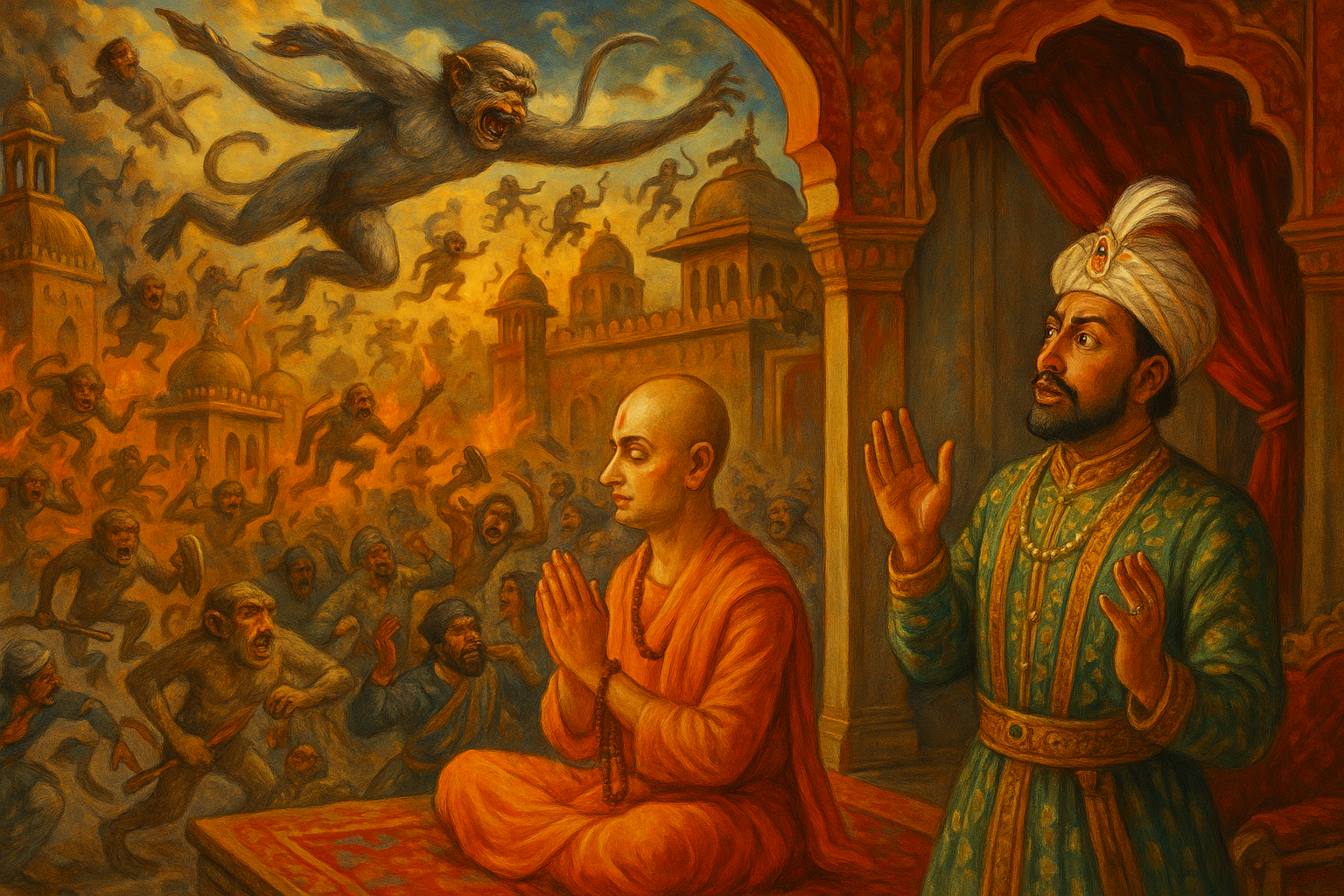
Left alone, Tulsīdās sat upon the royal throne, closed his eyes, and began to chant softly, “Śrī Rāma Jaya Rāma Jaya Jaya Rāma.” His heart turned toward his eternal protector, Hanumān.
“O mighty Hanumān,” he prayed, “the Lord’s name is now being tested in the house of power. Manifest Your strength that the glory of Rāma’s name may shine forth and no one may mock His devotee.”
Instantly, the air trembled.
Hanumān’s Vengeance
Hanumān summoned his army of monkeys from the celestial regions. They descended upon Delhi like storm clouds, their roar echoing through the skies. The streets darkened as thousands of monkey warriors filled the city—tearing up trees, breaking palace tiles, and overturning carts.
The people screamed in terror. Some monkeys snatched turbans and jewels, others pulled braids and beards together in jest. Even the royal ladies were not spared—their silks and ornaments were tossed into the Yamunā while the monkeys chattered gleefully.
Everywhere chaos reigned. The merchants’ stores were plundered, false-hearted men were beaten, and the proud were humiliated.
The Emperor’s Fear and Repentance
Panic reached the palace. Akbar’s guards rushed in, shouting, “O Emperor! A vast army of monkeys is destroying the city!”
Astonished and trembling, Akbar exclaimed, “The end of the world has come!” But his wise counselors whispered, “This is no ordinary army. These are Hanumān’s hosts. You have offended a devotee of Rāma.”
Realizing his folly, Akbar went at once to Tulsīdās. With folded hands and a humbled heart, he said, “O saint, forgive me! I did not understand your greatness. Restrain this army, for they will overturn my kingdom.”
Tulsīdās opened his eyes, smiling gently. “O Emperor, you wished to see Rāma—this is His army. Just as the dawn announces the sun, these are the heralds of His coming.”
Akbar cried, “I have seen enough! Please, let them depart!”
Tulsīdās bowed his head and prayed silently. At once, the monkey army vanished as swiftly as it had come. Peace returned, and the air was filled again with fragrance and stillness.
The Emperor’s Conversion
Overwhelmed, Akbar fell at the saint’s feet. “You are no mortal,” he said. “Forgive my arrogance. Your Rāma is the Lord of all, and His servant is my teacher.”
Tulsīdās replied kindly, “Majesty, Rāma’s glory is not shown by might but by mercy. Rule your people with compassion, and you will please the Lord more than by any offering.”
From that day, Akbar honored saints and protected temples throughout his empire. He often recited Rāma’s name, remembering the monkeys that once humbled his pride.
Spiritual Meaning
This story reveals the invincible power of divine faith. The devotee who depends wholly on the Lord is never abandoned. Kings and demons may test him, but the Lord’s servants protect him with unerring precision. The miracle in Delhi was not a display of wrath, but of love—to awaken the emperor’s dormant faith and proclaim the Lord’s supremacy to the world.
Reflections – Lessons for Devotees
- The Lord defends His devotee. Whoever threatens a bhakta invites the Lord’s own intervention.
- Power bows before humility. The emperor’s throne trembled before a saint who owned nothing but Rāma’s name.
- True victory is compassion. Tulsīdās taught that divine power must always end in mercy, not pride.
- Faith conquers fear. When surrounded by danger, remember—“Rāma protects His servant.”
Source: Bhaktavijaya, Chapter III, verses 257–312 (Mahīpati).