The King’s Journey and the Wife’s Departure
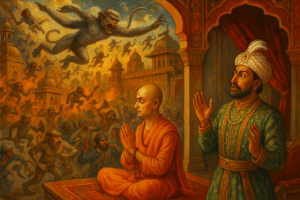
One day, Emperor Akbar set out on a royal tour, and Tulsīdās accompanied him. During his absence, a messenger arrived from Mamatā’s maternal home with a false report: “Your mother is gravely ill—she longs to see you.” Hearing this, Mamatā began to weep bitterly.
The messenger, seeing her distress, confessed, “Do not be troubled, O good lady. Your mother is well. We deceived you, for Tulsīdās will not let you go, and your parents wish to see you after so many years.”
Mamatā resolved, “My husband is away; I shall go at once and return quickly.” After receiving the blessings of her in-laws, she set out for her mother’s home that very evening.
When Tulsīdās returned from the royal tour, he found his home empty and was told that his wife had gone. “Why has she left me?” he lamented. That night he could not sleep. Overwhelmed with longing, he rose before dawn and, walking alone for ten miles through darkness, reached his father-in-law’s house.
The Serpent-Rope and the Wife’s Rebuke
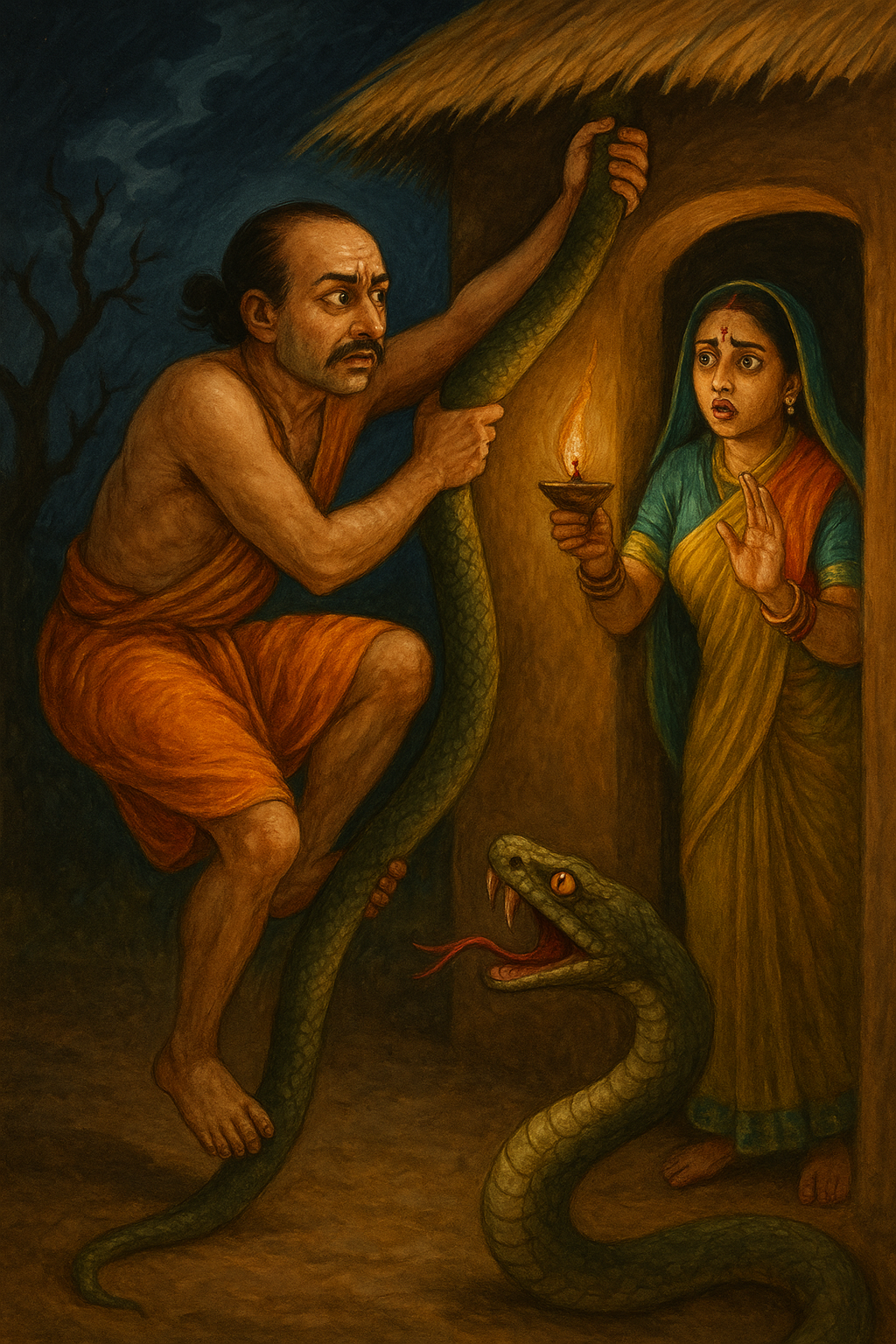
The night was deep; all doors were bolted. Searching for a way to enter, he saw a huge serpent dangling from the roof-beam. Mistaking it for a rope, he caught hold of it and climbed up into the house. As he entered, the servants awoke in alarm, and Mamatā, startled from sleep, saw her husband standing before her.
“O fair one,” said Tulsīdās, “why did you leave me? I have walked all night through peril to find you.”
She exclaimed, “The Yamunā is swollen with flood—how did you cross and climb this house?”
He replied, “Your love for me is so strong that you threw down a rope, and I came by it.”
Mamatā said, “Why speak untruth? I threw no rope!” She took a lamp to look—and there they saw the monstrous serpent still hanging. All were terrified.
Holding his hand, she led him inside and spoke gravely:
“O lord of my life, you call yourself wise, yet you have no sense. Why did you leave your family and wealth and come running after me in the middle of the night? If that serpent had bitten you, your life would have ended. Many have perished through such folly.”
Her Words of Wisdom
With deep feeling she continued:
“Men lose themselves in the pursuit of women, just as the moth rushes into the flame. Indra was ensnared by Ahalyā, and Rāvaṇa lost his life for the sake of Sītā. The Lord alone is the true beloved; those who forget Him and chase sensual pleasure are doomed.
“You, my husband, risked your life for a fleeting attachment. If men would love Śrī Hari’s lotus feet as they love their wives, wealth, and sons, life would become meaningful. Remember the eternal Rāma, the resting place of all.”
Tulsīdās’ Transformation
Her rebuke pierced his heart like lightning. Tulsīdās bowed to her and said, “Mother, what you have spoken is truth. As a mother snatches her child from the fire, so you have saved me today.”
At that very moment he renounced worldly life. Leaving his wife’s house, he journeyed to the sacred city of Benares. Remembering his divine purpose, he said within, “I am Vālmīki reborn. I came to sing the glories of Rāma, but I became entangled in the snare of sense-enjoyment.”
The Life of Austerity
In Kāśī he bathed in the Gaṅgā, adopted strict austerities, and lived on fallen leaves. He rejected cooked food and fruits, bathing each morning and chanting, “O Rāma, Lord of Ayodhyā, husband of Jānakī, reveal Thyself to me!” Any water left from his ablutions he poured on tree roots as an offering.
For twelve years he practiced thus, never ceasing his japa for even a moment.
Spiritual Meaning
This story marks the turning of the soul from passion to devotion. Mamatā becomes the Guru in disguise—the voice of truth awakening divine remembrance. The serpent that served as a “rope” symbolizes how dangerous attachments can appear like supports but hide deadly poison. Her chastisement becomes his initiation, transforming worldly love into pure bhakti.
Through one night’s peril, the poet was born again—a pilgrim on the path to the eternal Rāma.
Reflections – Lessons for the Heart
- Grace often hides in rebuke. The Lord can speak through the wisdom of a loved one who corrects us.
- Attachment can become a teacher. When love turns toward God, even past entanglements guide us home.
- Renunciation is not rejection of love, but purification of it. Tulsīdās did not cease to love; he learned to love rightly.
- The night journey of the soul—through darkness, danger, and longing—is the passage from illusion to divine remembrance.
Source: Bhaktavijaya, Chapter III, verses 31–68 (Mahīpati).