A Generous Disciple
In the sacred city of Jagannātha Purī, there lived a noble merchant, a man of great faith and generosity. He was deeply devoted to Lord Jagannātha and loved to serve the saints who visited the holy city. His heart was pure and full of reverence. Seeing his sincerity, Śrī Jayadeva accepted him as his disciple.
Jayadeva instructed him in the path of devotion, saying, “A true disciple must be faithful, humble, and generous. He should not seek faults in others or covet their property. He should live a life of purity and compassion, worshiping the Lord with a steady heart.”
The merchant followed his Guru’s teachings perfectly. He served Jayadeva with his body, mind, and words. Every day he would visit his Guru’s home, bringing gifts of food, flowers, and sandalwood paste, and would listen to his saintly instructions with great eagerness.
The Invitation of Love
One day, the merchant invited Jayadeva to his home, saying, “O revered Guru, please bless my house by your presence.” Jayadeva, ever merciful, agreed.
When the day arrived, the merchant arranged a beautiful chariot and seated his Guru upon it, accompanying him with songs and offerings. The whole city rejoiced to see Jayadeva passing through the streets. Wherever he went, the people bowed, saying, “This is the great poet who sings the glories of Kṛṣṇa!”
Upon reaching his home, the merchant washed Jayadeva’s feet with tears of devotion and offered him a seat of honor. He served him day and night, with humility deeper than the ocean. For a full month Jayadeva remained in his house, performing kīrtana and teaching the people the sweetness of loving devotion to the Lord.
The Secret Offering
At the end of the month, Jayadeva said gently, “My son, it is time for me to return to Jagannātha. May the Lord bless your home and heart with unending devotion.”
The merchant, overcome with emotion, placed his head upon Jayadeva’s feet and said, “Master, may I ever remain your servant.” He seated his Guru on a golden chair and worshiped him with flowers and garlands.
But in his heart, the merchant thought, “Jewels and gold are of no value to this saint. He desires nothing for himself. Yet I must offer something with love. I shall send these gifts to his devoted wife, Padmāvatī, who serves him so faithfully.”
So, without Jayadeva’s knowledge, he secretly loaded a carriage with fine clothes, ornaments, and jewels, and told one of his servants, “Go with the Guru to his home. Offer these gifts to his wife in my name, and then return quickly.”
The Plot of the Thieves
As Jayadeva’s chariot moved through the forest, two thieves learned of the merchant’s secret gift. They decided to follow the saint, thinking, “He must be carrying great treasure. Let us rob him on the way.”
The servant accompanying Jayadeva then requested permission to return home, saying, “O revered one, I have some urgent business to attend to.” Out of compassion, Jayadeva agreed, saying, “May the Lord protect you.”
Thus, the poet continued the journey alone, guiding the chariot through the quiet forest. The thieves followed at a distance, pretending to be travelers. When they came close, they bowed to him respectfully, hiding their evil intentions.
Jayadeva, ever wise, understood their hearts and said gently, “My sons, if you desire the wealth I carry, take it. Do not commit violence. All that I have belongs to the Lord.”
But greed blinds even the pious-hearted. The thieves thought, “If we let him live, he will inform the king or the merchant, and we shall be punished.” Yet another thought came: “Let us not kill him; we shall only disable him.”
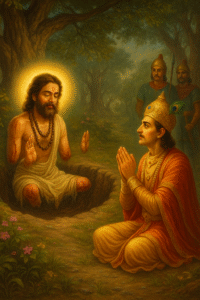
So, with cruel hands they seized Jayadeva and cut off his feet and hands, leaving him bleeding in a pit by the roadside. They took the carriage and the jewels and fled.
Jayadeva’s Meditation
Lying helpless, Jayadeva was not distressed. Instead, he thought deeply upon the Lord:
“This body is temporary—it can be destroyed, but the soul is eternal and untouched by pain. The body is the seat of lust, anger, and disease, but the soul is pure, changeless, and blissful. Let this body perish, but may my remembrance of Kṛṣṇa never fade.”
Immersed in divine meditation, he forgot all pain. His mind rested in the ocean of the Lord’s mercy, and his heart glowed with peace.
Reflection
The story of Jayadeva’s suffering teaches that the saint is untouched by misfortune. Even when cruelly wounded, Jayadeva remained absorbed in Kṛṣṇa’s remembrance. He did not curse his attackers but saw them as instruments of the Lord’s will.
A devotee does not measure happiness or sorrow by bodily comfort. He knows that all things—gain or loss, praise or blame, pleasure or pain—come by the Lord’s arrangement. True faith means accepting both joy and hardship as the Lord’s grace.
Jayadeva’s forgiveness also reveals the height of spiritual maturity. Where ordinary men would cry for justice, he saw only an opportunity to deepen his dependence on Kṛṣṇa. His heart, purified by surrender, became a vessel of divine compassion.
Thus, when faced with life’s trials, the devotee should remember Jayadeva’s example—responding not with bitterness, but with faith, humility, and prayer. For the Lord dwells nearest to the heart that remains peaceful in pain and thankful in adversity.
Source: Bhaktavijaya, Chapter II, Verses 66–105.