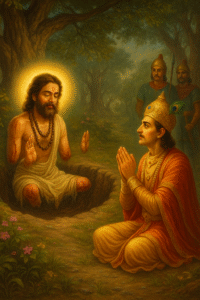
A Devout Brāhmaṇa’s Vow
In the holy city of Jagannātha Purī lived a devout brāhmaṇa learned in the Vedas, who daily performed sacrificial duties in service of the Lord. In his home was born a jewel among women—his daughter, Padmāvatī. Her beauty resembled that of Lakṣmī herself, her virtues were countless, and her demeanor was pure and gentle. Seeing her divine qualities, her father gave her the name Padmāvatī, “the lotus-like one.”
The brāhmaṇa often thought within himself, “My daughter is a treasure of beauty and goodness. I must, with full devotion, offer her to Lord Jagannātha.” Thus, whenever men came seeking her hand in marriage, the brāhmaṇa would refuse, saying, “I have already offered her to Kṛṣṇa, the Lord of the universe.”
The Lord’s Command in a Dream
As time passed, Lord Jagannātha, pleased with the brāhmaṇa’s sincerity, appeared to him in a dream. With a gentle smile, the Lord said:
“You have offered your daughter to Me, and your vow has reached My ears. But know that in this age of Kali, I live among men in many forms. I am now present in the world as the poet Jayadeva, who is My own avatāra. Therefore, give your daughter Padmāvatī to Jayadeva in marriage, adorned with all ornaments. In doing so, you shall fulfill your vow, for to give her to My devotee is the same as offering her to Me.”
Upon awakening, the brāhmaṇa was filled with joy and reverence. He immediately sent messengers to invite Jayadeva to his home, and when the saintly poet arrived, the brāhmaṇa greeted him with deep humility.
The Auspicious Union
The brāhmaṇa revealed the Lord’s command to Jayadeva and proposed the marriage. Jayadeva, who accepted all things as the Lord’s will, agreed silently. The astrologers were called, and their calculations revealed perfect harmony between the two—thirty-six points of auspiciousness. Preparations began at once.
The sacred fire was kindled, the marriage deity was installed, and the Brahmins were joyfully feasted. The remover of obstacles, Lord Gaṇapati, was worshiped. Then, as the marriage curtain was held between bride and groom, the officiating priest invoked blessings upon them, reciting sacred mantras:
“O Keśava, O Nārāyaṇa, O Mādhava, O Govinda, O Gopāla, O Supreme Lord, O Destroyer of the demon Madhu—protect this bride and bridegroom.
O Viṣṇu, O Rāma, O Vāmana, O Trivikrama, O Protector of the devotees, O Ocean of goodness—protect this couple.
O Lord of Dvārakā, O Protector of the cowherds, O Beloved of Rukmiṇī, O Lord of Vaikuṇṭha, O Dweller in the ocean of milk, O Recliner on Śeṣa, O Shelter of Your devotees—protect this bride and bridegroom.”
The sound of conch shells and drums filled the air. A cry of “Victory! Victory!” arose as the marriage was completed. Musical instruments played joyfully, and for four days, the wedding festivities continued with honor and happiness.
The Life of Devotion Begins
After their marriage, Jayadeva and Padmāvatī settled in Jagannātha Purī. Each day, Jayadeva sang the Lord’s glories with deep love, while Padmāvatī, chaste and gentle, served him and the Lord with devotion. Their home became a center of divine worship, where the sound of prayer and kīrtana never ceased.
Theirs was not an ordinary union. The Lord had joined them for a divine purpose. Through Jayadeva’s poetry and Padmāvatī’s devotion, the love between Rādhā and Kṛṣṇa would be revealed to the world. She was not merely his wife but the personification of bhakti—Lakṣmī herself come to serve her Lord in the form of a devotee’s consort.
Reflection
The marriage of Jayadeva and Padmāvatī illustrates that when one surrenders a vow to the Lord, He fulfills it in ways far greater than one can imagine. The brāhmaṇa’s intent was pure—to dedicate his daughter to God—and God accepted that offering by uniting her with His own devotee. Thus, to serve a true bhakta is equal to serving the Supreme Himself.
Their home became a temple. Jayadeva’s heart was the altar where devotion burned like a lamp, and Padmāvatī’s service was the fragrant offering that kept it alight. Together, they embodied the divine relationship between the soul and God—where love takes the form of service, and service matures into union.
For married devotees, Jayadeva and Padmāvatī’s example shines as a model of spiritual partnership. When both husband and wife see the Lord as the center of their love, household life becomes sanctified. Every meal becomes an offering, every word a prayer, and every day an act of worship.
In the union of Jayadeva and Padmāvatī, we glimpse the secret of bhakti: that love, when offered selflessly to the Lord, transforms even worldly duties into divine service.
Source
Bhaktavijaya, Chapter II – Verses 49–65.