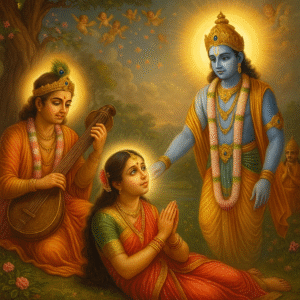
The Birth of a Devotee-Historian
In the land of Gwalior, there lived a noble and learned brāhmaṇa named Nabhaji (Nābhājī), a great devotee of the Lord and a scholar among Vaiṣṇavas. He was born in a family of the Nāgar brāhmaṇas, pure-hearted and deeply devoted to Kṛṣṇa. His nature was gentle, and his life was governed by humility and service.
Nābhājī was no ordinary devotee; he was a divine incarnation, a portion of Lord Brahmā Himself, sent to continue the work of glorifying the saints and devotees of the Lord. By his pen flowed rivers of devotion, describing the lives and teachings of those who had attained perfection through bhakti.
He gathered the sacred stories of saints from every region—those of poets, ascetics, and householders—those who sang, wept, and danced in divine ecstasy—and compiled them so that future generations might never forget the path of devotion.
The Writing of Bhakta-Māla
Inspired by the Lord, Nābhājī composed a monumental work known as the Bhakta-Māla, the “Garland of Devotees.” In this book, he wove together the lives of great bhaktas like a string of precious jewels, each shining with the radiance of divine love.
He wrote not from imagination but from the testimony of saints, from sacred texts, and from his own realized vision. The purpose of his writing was not literary fame but the awakening of devotion in the hearts of all. “Let this body perish,” he prayed, “but may the name of Kṛṣṇa never leave my lips.”
His Inspiration from Jayadeva
Nābhājī’s inspiration flowed directly from the life and works of Śrī Jayadeva. He saw in Jayadeva the perfection of bhakti expressed through art—the fusion of poetry, humility, and surrender.
It was after hearing the stories of Jayadeva’s miracles, his Gīta-Govinda, and the compassion that moved even Lord Jagannātha to appear before him, that Nābhājī felt impelled to continue this mission of glorifying the Lord’s devotees.
He said, “Let me be the dust at the feet of such saints. If I cannot reach their greatness, at least let me praise them. If I cannot sing their glory with their power, let me speak their names with love.”
The Spirit of Continuation
Thus, Nābhājī began his work not as an author but as a servant of devotion. Just as Jayadeva’s words brought God to Earth, Nābhājī’s verses brought the saints into living memory.
He declared, “The saints are the visible body of God’s mercy. To remember them is to remember Him. Their stories are the scriptures of love, the holy waters in which all sins are washed away.”
Through his writings, the flame of bhakti that Jayadeva had kindled continued to burn brightly across the generations.
The Connection to the Bhaktavijaya
Centuries later, the saint Mahipati, author of Bhaktavijaya, read Nābhājī’s works and was deeply moved. It was from Nābhājī’s Bhakta-Māla that Mahipati drew inspiration to compose his own series of devotional biographies in Marathi, preserving the lives of saints for his own people.
Mahipati wrote:
“Just as the dolls of a puppeteer dance when he pulls the strings, so my lips have moved by the inspiration of the Lord. It is not I who have written these stories, but the Life of the world, the Husband of Rukmiṇī, who composes them through me.”
Thus, through Nābhājī’s sacred work and Mahipati’s inspired heart, the current of bhakti continued to flow—linking Vyāsa, Jayadeva, Nābhājī, and Mahipati in one golden chain of divine storytelling.
Reflection
This story concludes the line of divine descent—from Vyāsa to Jayadeva, from Jayadeva to Nābhājī, and from Nābhājī to Mahipati—each a lamp lit from the previous one, carrying forward the light of devotion.
It reminds us that spiritual heritage is never lost. When one saint completes his service, another rises to continue it. The Lord arranges this eternal succession so that His glories may never fade from the world.
The saints do not compete; they cooperate in eternity. Vyāsa gave the world knowledge; Jayadeva gave it love; Nābhājī gave remembrance; and Mahipati gave understanding.
To study their lives is to enter the living temple of bhakti, where the soul finds its purpose—not in argument, but in song; not in conquest, but in surrender.
May we, too, become instruments in this unbroken current of devotion, carrying forward the fragrance of divine love in our time.
Source: Bhaktavijaya, Chapter II, Verses 248–254.