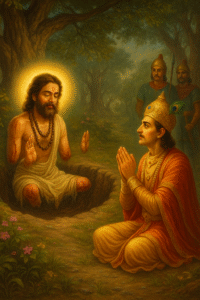
The Return of the Thieves
The two thieves who had once mutilated Jayadeva and robbed his treasure soon heard of a wonderful event — that the same Jayadeva, whom they had left for dead, was now being honored by the King of Krauncha as a saint and spiritual master.
Greed still clouded their hearts. “This king gives gold and jewels to every saint that visits him,” they whispered. “Let us disguise ourselves as holy men and go there. We will act like Vaiṣṇava ascetics, and we shall surely receive great wealth.”
But they did not know that Jayadeva, whom they had wronged, was now living in that very palace.
The Deceptive Appearance
The thieves dressed themselves in the garb of renunciants. They smeared gopī-candana clay upon their bodies, drew twelve sacred marks upon their arms and chest, and placed tulasī beads around their necks. They held prayer beads in their hands and walked with a show of detachment.
From a distance, they looked like true saints — just as a crane appears to meditate like a sage while plotting to catch fish, or as tin shines brighter than gold when struck by sunlight.
The king, seeing their apparently holy appearance, received them with honor. “Welcome, O venerable sadhus,” he said. “Please bless my home with your presence.”
But as they entered the royal hall, their eyes fell upon Jayadeva sitting on a golden seat beside the king. The sight froze their blood. Fear and shame burned in their hearts like fire. They signaled to each other with their eyes, trembling inwardly, “We have fallen into a furnace! The man we maimed is here before us!”
Jayadeva’s Compassion
Jayadeva saw them from afar and immediately recognized them. Yet, in his saintly heart, there was not a trace of anger or vengeance. He felt only compassion.
“Look,” he thought, “these men once caused me pain, yet they too are souls of the Lord. They have come now, perhaps by divine arrangement, to be purified.”
He rose from his seat and bowed before them with folded hands. The king, astonished, said, “O master, why do you bow to them?”
Jayadeva replied softly, “They are saints who have come here by the will of God. Honor them.”
Then he turned to his attendants and said, “Bring offerings for these holy men. The king should worship them with full devotion.”
The King’s Service
The king obeyed his Guru’s words. He washed the thieves’ feet, offered them garlands, clothes, and ornaments, and bowed before them with humility. The thieves could hardly bear the weight of such mercy. They trembled as the king said, “O revered sadhus, remain in my palace as long as you wish.”
At night, however, the two men could not sleep. Fear gnawed at them. “Surely this saint will expose us,” they thought. “Tomorrow, the king will know what we have done.” They began to whisper anxiously, “We have been deceived by our own wickedness. We came for gold, but have fallen into death!”
The Saint’s Vision and the King’s Doubt
The next morning, the king went to Jayadeva and said, “Master, when other saints visit, you remain seated and bless them from afar, but before these two you bowed to the ground. Why this special reverence?”
Jayadeva replied, “O king, these are not ordinary saints. They are utterly detached from worldly pleasures. To those who have renounced desire, even luxury tastes like poison. Such souls are rare. Your fortune is great that they have chosen to stay here.”
The king accepted his words with faith, not realizing the deeper truth behind them.
The Thieves’ Departure
After some days, the thieves said to the king, “We must now return to our holy city. Please give us permission to leave.”
The king replied warmly, “Ask for whatever you desire; I will gladly give it.”
The thieves said, “Fill two carts with money and ornaments for us to distribute in charity.”
Without hesitation, the king obeyed. He filled two carts with gold and jewels and sent two soldiers to accompany them safely through the forest.
The Judgment of Truth
As they traveled, the soldiers, curious about their master’s special favor, asked, “O holy men, many saints visit the palace, but none have received honor like you. What is your connection to our Guru, Jayadeva?”
The thieves, eager to justify themselves, wove a false story. “Once we served under a wicked king,” they said. “Jayadeva was his minister, but he angered the king, who ordered us to kill him. Out of compassion, we only cut off his hands and feet instead. For saving his life, he now shows us gratitude.”
But as soon as this lie passed their lips, the earth herself trembled. With a thunderous sound, the ground split open beneath them. The two impostors were swallowed into the depths, vanishing from sight. The soldiers, terrified, fell to the ground in awe and returned swiftly to the palace.
Divine Forgiveness
When the soldiers told Jayadeva what had happened, tears welled in his eyes. “O Lord,” he cried, “why have You sent them to hell? Even Rāvaṇa, though an enemy, was granted liberation by Your touch. Why not these men?”
Hearing the saint’s prayer, the Supreme Lord appeared before him in His four-armed Viṣṇu form, smiling with compassion. He said, “O Jayadeva, your heart overflows with mercy. Because of your prayer, I have brought them to Vaikuṇṭha. Behold My grace!”
As He spoke, Jayadeva’s hands and feet miraculously regrew, shining like new lotus buds. The king and all present fell to the ground, crying “Victory! Victory to the Lord and His devotee!”
The air filled with divine fragrance, and celestial flowers rained from the sky. Jayadeva, radiant with humility, bowed to the Lord, who said, “Blessed is your devotion, O poet-saint! You see friend and foe alike, and your heart knows only forgiveness. To such a devotee, even I become a servant.”
Then the Lord disappeared, leaving behind the echo of His eternal smile.
Reflection
This story reveals the perfection of forgiveness and divine compassion. Jayadeva, though grievously wronged, harbored no resentment. Instead, he saw his tormentors as instruments of God’s will and prayed for their redemption.
True devotion is not shown by miracles or scholarship but by the ability to love even those who harm us. The Lord Himself is drawn to such a heart, for in it He sees His own reflection.
The fate of the thieves also teaches that false sainthood—hypocrisy dressed as holiness—cannot deceive God. External symbols may fool men, but not the all-seeing Lord who dwells within. Yet even for such sinners, redemption is possible through the intercession of a true devotee.
Finally, the miracle of Jayadeva’s restored limbs symbolizes the healing power of forgiveness. When we release hatred and surrender to God’s will, He restores what life has taken from us — not only our peace, but our divine strength.
Source: Bhaktavijaya, Chapter II, Verses 132–198.