The Quiet Afternoon at Yāvat
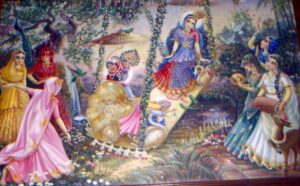
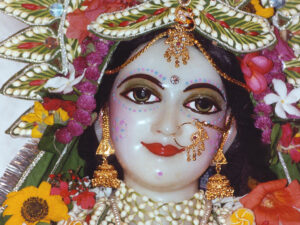
The afternoon sun of Vṛndāvana filtered softly through the groves surrounding Yāvat. Śrīmatī Rādhārāṇī sat in Her inner chamber, surrounded by the gentle laughter of Her sakhīs. Lalitā and Viśākhā were helping Her adorn Herself with ornaments — golden bangles, a string of pearls, anklets that chimed like music, and a fine belt of bells that seemed to dance with every movement.
“Rādhe,” Lalitā said teasingly, “why do You dress so beautifully today? Jaṭilā and Kuṭilā are not hosting a festival.”
Rādhā smiled, Her eyes lowered. “When the heart is restless, one finds comfort in flowers and jewels.”
Viśākhā whispered with a knowing smile, “Or perhaps the heart knows that Śyāmasundara is near.”
At that very moment, a soft knock came at the window — three times in a rhythm known only to the sakhīs. Lalitā leapt to open it, and in stepped Śrī Kṛṣṇa, His body glistening with the dust of the pastures, His peacock feather still wet from the Yamunā’s mist.
The Secret Meeting
“Govinda!” Rādhā gasped. “What are You doing here? If Jaṭilā or Kuṭilā sees You, all will be ruined!”
Kṛṣṇa smiled playfully. “Let them see — then even they will understand what true beauty is.”
The sakhīs covered their laughter, while Rādhā looked away, blushing. “You risk everything for Your mischief,” She said softly.
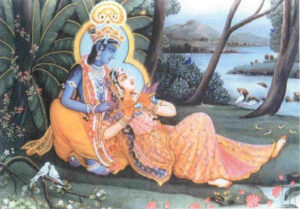
Kṛṣṇa approached Her slowly. “Not mischief — worship. You are the temple, and every ornament You wear is My offering.”
He took one of Her bracelets in His hand and said, “This bangle is like My heart — bound to You.”
Rādhā whispered, “Then let Me also give You something of Mine.” She removed Her golden ring, shaped like a blooming lotus, and placed it in His palm.
The Exchange
Kṛṣṇa slipped the ring onto His finger and, in return, unclasped His pearl necklace. “This pearl,” He said, “was born of the ocean’s churning — just as My love was born of separation. Let it rest upon Your heart.”
Rādhā accepted it shyly, fastening it around Her neck. The pearls gleamed against Her golden skin, each one shining like a moon of remembrance.
Lalitā clapped her hands softly. “Ah, what a beautiful exchange! The Lord of Vṛndāvana has traded His jewels for His own jewel of love.”
Kṛṣṇa laughed gently. “Indeed, I have given away My wealth — and gained everything.”
Rādhā looked into His eyes and said, “Keep this ring not as an ornament but as a secret vow — that no matter how far You wander, You will always return.”
Kṛṣṇa replied, “And You, keep this necklace not as decoration but as remembrance — that even when unseen, I am bound around Your heart.”
The Sign of Love
Suddenly, footsteps echoed in the hallway — Jaṭilā’s voice calling, “Rādhe! Where are You? The priest is coming to bless the house!”
The sakhīs froze. Rādhā whispered, “Śyāma, hide quickly!”
Kṛṣṇa vanished behind a curtain, His laughter barely restrained. Jaṭilā entered, fanning herself. “The heat is unbearable! Have You finished Your prayers?”
Rādhā bowed respectfully. “Yes, Mother. I was just offering flowers to the household deity.”
Jaṭilā’s eyes narrowed. “And what is this new necklace You wear? It looks costly — where did You get it?”
Before Rādhā could speak, Viśākhā replied swiftly, “O Mother, it was given by Paurnamāsī Devī as a blessing. She said it would bring peace to this home.”
Jaṭilā nodded, pleased. “Ah! Then let it stay — perhaps it will also keep that Kṛṣṇa boy away!”
When she left, the sakhīs burst into laughter, and Kṛṣṇa emerged from hiding, his eyes full of affection. “Your devotees are cleverer than even the gods.”
The Promise
Before departing, Kṛṣṇa turned to Rādhā and said softly, “If ever You feel alone, touch this necklace. You will feel My heartbeat within it.”
Rādhā answered, “And if ever You forget Me, look at Your hand. The ring will remind You of My love — unbroken, unchanging.”
They bowed their heads together for a moment — no words, only the silent exchange of hearts. Then He slipped away into the garden, vanishing like moonlight into mist.
The Hidden Meaning
This exchange of ornaments is not mere romance — it is the symbol of eternal devotion between the soul and the Lord.
The ring represents sankalpa — the devotee’s vow never to forget Kṛṣṇa. The necklace represents smaraṇa — the Lord’s promise to remember His devotee.
When the devotee offers love, Kṛṣṇa gives remembrance in return. Thus, their bond becomes eternal — tied by faith, sealed by service, adorned with surrender.
Lessons to Be Learned
- Love is strengthened by trust, not possession. Kṛṣṇa and Rādhā’s gifts were tokens of remembrance, not ownership.
- Devotion is an exchange, not a demand. The Lord accepts what is offered with sincerity, not grandeur.
- The Lord never forgets His devotee. The “necklace” He gives is the heart’s peace, His constant presence within.
- Secrecy in love represents humility in devotion — silent offerings speak louder than words.
Reflections
In our spiritual life, we too exchange gifts with Kṛṣṇa. We offer Him our words, our thoughts, our daily service — and in return, He offers His presence, His peace, and His guidance.
Sometimes, we may not see Him, yet a “necklace” of calm or joy suddenly adorns our heart — that is His answer. At other times, our ring — the promise of faith — reminds us to hold steady, even when the Lord is unseen.
To love God is to live in that sacred exchange — giving and receiving, remembering and being remembered.
Prayer
O Śrīmatī Rādhārāṇī, who offered the ring of eternal love to the Lord of Your heart, please teach me to make my devotion steady and pure.
O Śrī Kṛṣṇa, who gave the necklace of remembrance to Your beloved, please adorn my heart with the jewel of Your holy name.
Let every breath I take be a garland for You, every thought a pearl of love.
May my faith remain unbroken like Your vow, and may our souls remain bound forever by the thread of devotion.
Origin of the Story
Adapted from “Vraja-līlā – Part 2” by Deena Bandhu dāsa (Yāvat Part One, “The Exchange of Ornaments”), drawing from Śrīla Viśvanātha Cakravartī Ṭhākura’s Camatkāra-candrikā and Gopāla-campū by Śrīla Jīva Gosvāmī.