THE MYSTERIOUS ILLNESS
One radiant morning in Nandagrāma, the usual laughter of the cowherd boys was replaced by silence. Mother Yaśodā entered her darling son’s room, expecting to find Him ready for play. But instead, Kṛṣṇa lay motionless, His cheeks pale, His breath heavy. When Yaśodā gently touched His forehead, He moaned weakly, “Māyā, I feel so sick…”
Those words pierced her heart like lightning. Tears filled her eyes as she called for help. In moments, the entire household gathered—Nanda Mahārāja, servants, friends, and even the royal physician. One by one, doctors examined Kṛṣṇa, shook their heads, and whispered gravely, “The boy burns with fever… yet no cause can be found.”
Panic spread through Vraja. The birds at the window, usually singing for Kṛṣṇa, fell silent. The cows in the courtyard refused to eat. The gopīs prayed fervently, for even a moment without Kṛṣṇa felt like a lifetime of darkness.
PAURṆAMĀSĪ’S DIVINE REMEDY
Just then, the wise Paurṇamāsī, the elderly sage and embodiment of Yogamāyā, arrived. She examined Kṛṣṇa and said gravely, “This fever is no ordinary illness—it can be cured only through the blessings of the Sun-god and his daughter, Yamunā-devī. But that blessing will come only if a perfectly chaste, married woman fetches Yamunā water in a golden pot pierced with one hundred holes.”
The crowd gasped. A pot with one hundred holes could hold no water! Yet Paurṇamāsī spoke with such confidence that all accepted her words. “Go,” she continued, “bring me the most chaste woman in all of Vraja.”
At once, the gopīs began nominating each other. Every woman in Vraja was pure, yet humility prevented any from claiming such perfection. Some said, “Perhaps it is Yaśodā Mā.” Others whispered, “Maybe it is Rohiṇī.” But the murmuring soon led to prideful boasts, and Jatilā and her daughter Kutilā, known for their arrogance, stepped forward.
“We are the most chaste,” Kutilā declared confidently. “Let us prove it before everyone!”
THE TEST AT THE YAMUNĀ
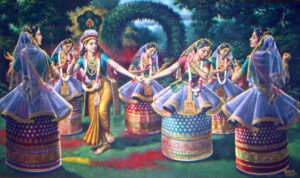
The gopīs followed Paurṇamāsī to the Yamunā’s bank. There, Nanda-mukhī brought forth the golden pot. It glittered like the sun—but when dipped into the river, water streamed out of its hundred holes in glittering threads. The gopīs gasped in wonder.
Kutilā stepped forward proudly. “Watch and see my purity,” she said, plunging the pot into the Yamunā. But the moment she lifted it, the water gushed out in a hundred streams, soaking her from head to toe. Laughter rippled through the gopīs. Humiliated, she handed the pot to her mother. “You are purer than I, Mother. You try.”
Jatilā, grumbling, took the pot and tried again—but with the same result. She stood drenched, her pride washed away like the water through the pot.
Then Paurṇamāsī turned to the assembly and said, “Who now shall carry the water? If none can, Kṛṣṇa may perish!”
A hush fell over the riverbank. Then, from among the gopīs, Lalitā Sakhī stepped forward. “There is one,” she said firmly, “whose chastity is above all others. The daughter of King Vṛṣabhānu—Śrīmatī Rādhārāṇī.”
At once, the crowd murmured—some in awe, others in disbelief. But Rādhā, ever humble, lowered Her eyes and said softly, “Whatever you order, I shall do.”
RĀDHĀ’S MIRACLE
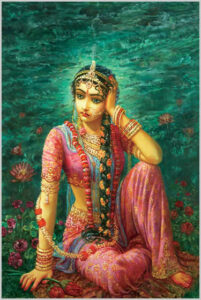
Śrīmatī Rādhārāṇī, radiant like molten gold, approached the Yamunā. Her anklets jingled like tiny bells of devotion. Bowing to the river, She whispered, “O sacred daughter of the Sun, if my heart has never strayed from my beloved Kṛṣṇa, please let this water stay.”
She dipped the golden pot into the river. All eyes watched in silence. Then, wondrously, when She raised the pot, not a single drop escaped. The water sparkled through the holes like diamonds—but did not fall. It was as though the Yamunā herself held the water in Rādhā’s honor.
The gopīs gasped. Jatilā and Kutilā stood frozen in disbelief. Rādhārāṇī placed the pot gracefully on Her head, and not one stream leaked as She walked back toward Nandagrāma.
THE RESTORATION OF HONOR
When Paurṇamāsī sprinkled that sacred water upon Kṛṣṇa, His fever vanished at once. He opened His lotus eyes, smiled faintly, and said, “Māyā, I’m hungry.” Mother Yaśodā wept with relief, and the gopīs cheered, “Jaya! Jaya!”
But the true wonder came afterward. All of Vṛndāvana heard of the miracle—that Rādhā alone could carry the golden pot without spilling a drop. The whispers of jealousy that once clouded Her name dissolved into songs of praise.
“The Sun-god himself has testified to Her purity,” said one.
“Even the Yamunā bowed to Her chastity,” said another.
And those who once accused Her of secret meetings with Kṛṣṇa now begged forgiveness in their hearts.
From that day, no one dared question Śrī Rādhā’s comings and goings. For they had witnessed that Her love was not bound by worldly rules but sanctified by divine truth.
THE ETERNAL LESSON
In this pastime, Kṛṣṇa revealed the glory of His dearest devotee. What the world calls “unfaithful,” the divine calls supremely faithful—for Rādhā’s heart belonged wholly to Kṛṣṇa alone.
The achāryas say: “Though other women are faithful to their husbands, Rādhā is faithful to the Supreme Husband—the Lord of all hearts.”
Her purity was not of the body but of devotion, and even the Sun bowed to bear witness.
REFLECTIONS
- True purity is single-hearted devotion. Chastity is not merely physical restraint but unwavering loyalty to the Divine Beloved.
- Faith triumphs over doubt. Rādhā’s serenity in the face of ridicule teaches us that divine love shines brightest when tested.
- Love transcends rules. The highest dharma is surrender to Kṛṣṇa—sarva-dharmān parityajya mām ekaṁ śaraṇaṁ vraja.
PRAYER
O Śrīmatī Rādhārāṇī, most chaste among all beings, whose heart holds no desire but to please Kṛṣṇa, purify our hearts as You purified the Yamunā’s golden waters.
Let our love for Kṛṣṇa be steady, fearless, and pure like Yours—untouched by pride, doubt, or worldly concern.
O Queen of Vṛndāvana, may we serve at Your lotus feet, carrying not pots of water but the nectar of devotion, without losing even a single drop on the journey home.
Origin: Lecture by HH Indradyumna Swami, “One Hundred Tiny Streams – Yāvat Part 3