The Arrival of the Saintly Elder
One peaceful morning, the fragrance of freshly blossomed kadamba flowers filled the air around Yāvat. The village was alive with the sound of cowherd boys calling their herds, the gentle laughter of gopīs drawing water, and the soft jingling of bells from the temple courtyard.
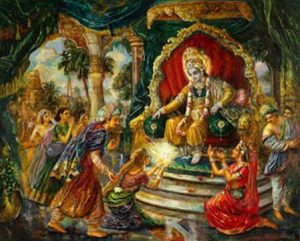
In the midst of this serenity, Paurnamāsī Devī — the revered grandmother of Vṛndāvana and the divine orchestrator of all of Kṛṣṇa’s pastimes — arrived at Yāvat. Her eyes shone with compassion, her white garments glowed like moonlight, and her presence radiated the peace of one who knows the Lord’s plans even before they unfold.
Jaṭilā hurried to greet her. “O respected mother,” she said, “please enter our humble home. Your arrival has sanctified this house.”
Paurnamāsī smiled kindly. “O Jaṭilā, this home was already sanctified — for within it dwells she who is the very goddess of devotion.”
Jaṭilā frowned, puzzled. “Whom do you mean?”
Paurnamāsī replied with a gentle smile, “Your daughter-in-law, Śrīmatī Rādhārāṇī. Her name alone makes the three worlds pure.”
Jaṭilā bowed awkwardly, not fully understanding the depth of those words.
Rādhārāṇī’s Humility
Rādhā came forward with folded palms. “O Grandmother,” She said softly, “You honor Me too highly. I am but a village girl, bound by household duties. Whatever little devotion I have is only by Your mercy.”
Paurnamāsī placed her hand upon Rādhā’s head. “Child, humility such as Yours is the crown of all virtues. Where others seek to be known, You seek only to love. This is why even the Supreme Lord loses Himself in You.”
The sakhīs, standing nearby, bowed their heads, their hearts swelling with joy. For they knew that every word of Paurnamāsī was the voice of divine revelation.
The Blessing Revealed
Paurnamāsī then turned toward the courtyard, gazing upon the trees and flowers that surrounded Yāvat. Her eyes filled with a faraway light — as if she were seeing not the present, but eternity itself.
She spoke in a deep, resonant tone:
“O land of Yāvat! You shall forever be known as the home of divine longing.
Here, love and separation shall dance in eternal embrace.
Here, the hearts of the Lord and His beloved shall taste the sweetness of yearning,
teaching the world that even sorrow, when offered to God, becomes bliss.”
Rādhā and the sakhīs listened in awe, their hearts trembling with devotion.
“The Lord of Vraja may wander to Mathurā and Dvārakā,” Paurnamāsī continued,
“but His heart will always return to Yāvat — the place where humility conquers pride,
and love shines brightest through tears.”
She then turned to Rādhā and said softly, “Child, You may feel imprisoned in this house by the chains of Jaṭilā’s watchfulness, but know that these walls shall one day be known as the walls of patience — the temple of faith. For wherever You reside, that place becomes sacred.”
The Prophecy of Divine Memory
As the morning sun rose higher, Paurnamāsī lifted her hands and blessed all present.
“A time shall come,” she declared, “when devotees from distant lands will walk barefoot through the forests of Vraja, seeking to find this very Yāvat. They will chant Your names and weep with longing.
For in this place, the soul learns that love is not merely to meet but to wait, not merely to possess but to serve.”
Rādhā bowed deeply, Her eyes filled with tears. “O Grandmother, Your words are a great burden upon My heart. How can I live up to such mercy?”
Paurnamāsī smiled gently. “By doing what You already do — by loving without condition, by forgiving without pride, by remembering Kṛṣṇa even in absence. In this way, You have already fulfilled the prophecy.”
The Departure of Paurnamāsī
After offering Her blessings, Paurnamāsī departed from Yāvat. The moment She stepped beyond the gate, a gentle breeze passed through the village, carrying with it a fragrance never felt before — as though the air itself had absorbed her words.
Jaṭilā stood silently, awed by what she had heard. The sakhīs whispered among themselves, and Rādhā sat quietly beneath a kadamba tree, gazing at the sky.
Lalitā said softly, “O Rādhe, Paurnamāsī’s words are true. Yāvat will be forever remembered because You have made it the heart of divine separation.”
Rādhā replied, “Then let this place remain not as a memory of My pain, but as a mirror of My Lord’s mercy. For even in absence, He gives presence through remembrance.”
The Hidden Meaning
Paurnamāsī’s prophecy reveals the highest principle of bhakti — that the Lord’s separation from His devotee is never a curse but a divine gift. It deepens love, purifies attachment, and transforms longing into union within the heart.
Yāvat represents this truth eternally: that the devotee’s wait, patience, and surrender are themselves sacred acts of worship.
Lessons to Be Learned
- Love’s highest test is separation. It purifies devotion from desire and fills the heart with remembrance.
- A devotee’s humility sanctifies even the most ordinary place. Wherever Rādhā lives becomes Vṛndāvana itself.
- Divine guidance often comes through elders and saints. Their words are not just counsel but prophecy — seeds that bloom over lifetimes.
- Even in absence, the Lord reciprocates love through remembrance and inner peace.
Reflections
Paurnamāsī’s visit to Yāvat reminds us that spiritual life is not measured by outer comfort or success but by the heart’s sincerity. Rādhā, confined and misunderstood, is the very emblem of divine patience — proving that one can be imprisoned outwardly yet be eternally free within love.
In our own lives, we too have our “Yāvats” — moments or places where we feel confined, misunderstood, or alone. But those are the very places where faith is ripened and love is refined. When we bear our difficulties with remembrance of Kṛṣṇa, even our sorrow becomes holy ground.
Prayer
O Paurnamāsī Devī, eternal guide of the devotees, please bless my heart as You blessed Yāvat.
Let my difficulties become the soil where love grows deeper, and my tears become offerings of faith.
O Śrīmatī Rādhārāṇī, who turned separation into sanctity, please teach me to wait for Kṛṣṇa not with despair, but with devotion.
O Śrī Kṛṣṇa, who returns to every heart that remembers You, please let my remembrance become the home where You dwell forever.
Origin of the Story
Adapted from “Vraja-līlā – Part 2” by Deena Bandhu dāsa (Yāvat Part One, “The Blessing of Paurnamāsī”), reflecting the prophecies and teachings of Śrīla Viśvanātha Cakravartī Ṭhākura’s Camatkāra-candrikā, as well as Gauḍīya Vaiṣṇava oral traditions