The Unexpected Visitor
One day in Kāśī, during a great feast organized by Tulsīdās for hundreds of brāhmaṇas, an extraordinary incident occurred. Rows of brāhmaṇas sat on clean mats, sacred mantras were chanted, and plates filled with rice, ghee, and sweet preparations were ready for offering.
Just as Tulsīdās lifted his hand to offer the first morsel to the Lord, a strange figure appeared at the doorway — a dark, trembling man with disheveled hair and a fearful expression. He folded his hands and said in a trembling voice, “O saint, I am a killer of brāhmaṇas. Yet I beg for your mercy. Grant me some of the food offered to God.”
The assembly gasped in shock. Some brāhmaṇas recoiled, covering their faces. Others muttered, “A sinner of this kind cannot sit among us! He will defile the whole ceremony!” But Tulsīdās rose calmly, his eyes full of compassion.
The Saint’s Love Beyond Judgment
Tulsīdās walked toward the trembling man, embraced him with both arms, and said gently, “Brother, do not fear. The moment you uttered the name of Śrī Sītā-Rāma, every sin you committed was burned away. Sit beside me and partake in this prasāda.”
The brāhmaṇas protested loudly. “How can this be?” they cried. “He is an outcaste, a murderer! The scriptures forbid sharing food with such a man. You insult the sacred law!”
Tulsīdās folded his hands before them and spoke with humility and strength: “O venerable brāhmaṇas, do not judge by outer conduct. The Lord’s name purifies even the most fallen. The Bhagavata Purāṇa declares that the power of God’s holy name surpasses all rituals, austerities, and sacrifices. Once uttered with sincerity, it cleanses the heart of lifetimes of sin.”
The Proof of the Holy Name
Still, the scholars were unconvinced. “Show us proof!” they demanded. “If the power of Rāma’s name is as great as you say, demonstrate it before our eyes.”
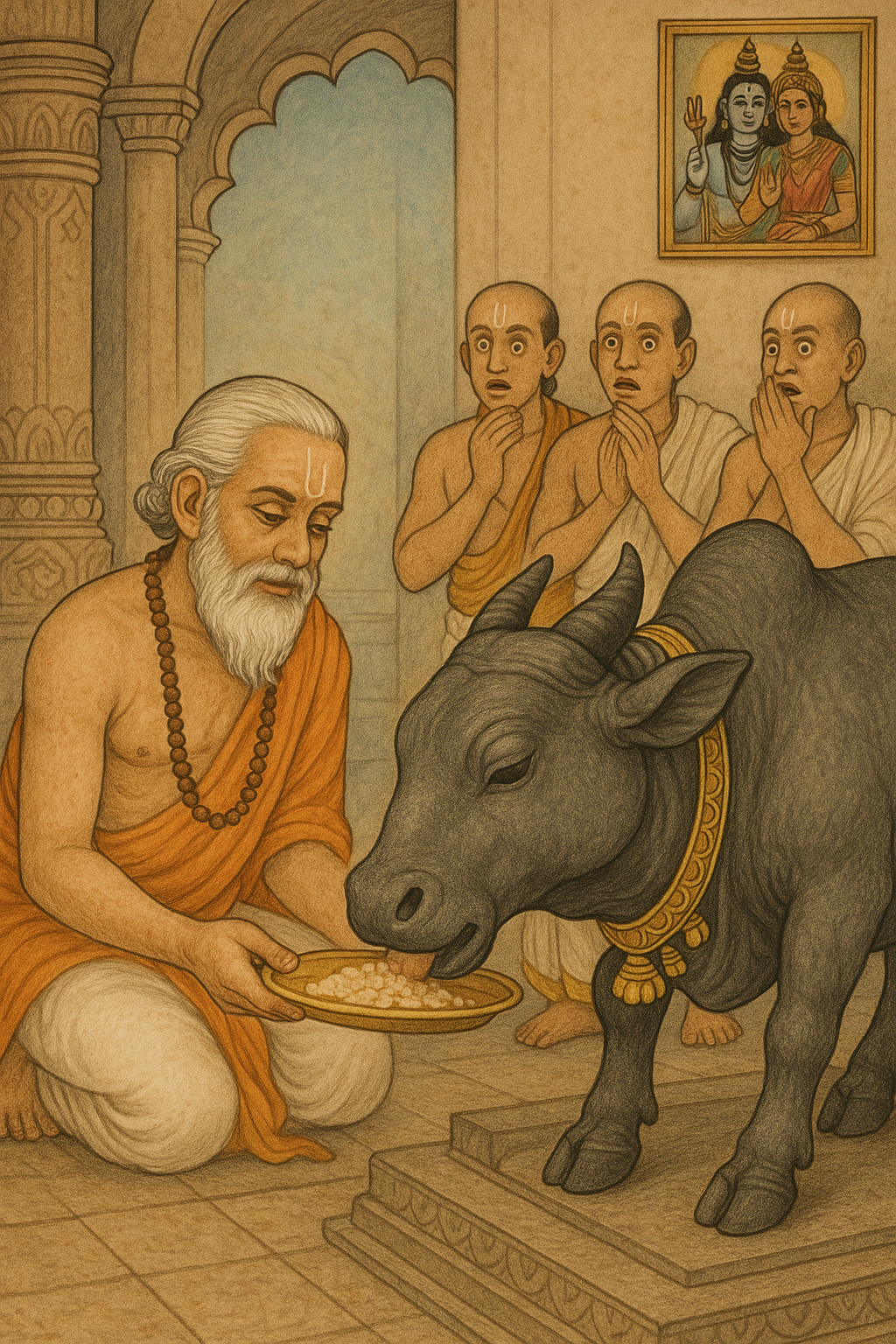
Tulsīdās smiled. “So be it,” he said. “Let Lord Śiva Himself bear witness.” He took a plate of sanctified food and went into the temple of Viśveśvara Mahādeva. There, before the great stone bull Nandī, he placed the offering and prayed with folded palms:
“O Lord of Kailāsa, blue-throated Śiva, you who once drank the ocean of poison to save the world, remember how you uttered the name of Rāma and became cool again. If that holy name truly holds the power to purify all sin, then let this stone bull accept this offering.”
The brāhmaṇas watched in astonishment. Suddenly, a vibration filled the temple. The stone bull’s nostrils flared, its eyes gleamed with life, and it began to breathe deeply. Slowly, before everyone’s eyes, it lowered its head and ate the offering. The sound of divine chanting filled the air: “Victory! Victory to Rāma!”
All present fell flat upon the ground in awe. The brāhmaṇas, tears streaming down their faces, cried out, “Blessed are you, Tulsīdās! Truly you are an incarnation of Vālmīki himself. You have revealed the unfathomable power of the Lord’s name.”
The Transformation of the Brahmin Killer
The sinner who had sought mercy now sat among the sages, purified and radiant. As he ate the remnants of the Lord’s offering, peace filled his heart. “O master,” he said, “I came here burdened by lifetimes of sin. You have made me new. From this day forward, I shall dedicate my life to chanting the name of Rāma.”
The saint placed his hand upon the man’s head. “Go, my child. The Lord never rejects anyone who seeks Him, no matter how fallen. The holy name alone is your true refuge.”
Reflections – Lessons from the Story
- The Holy Name Is the Supreme Purifier: No sin is too great for the mercy of God’s name. Even a murderer is freed when he calls upon Rāma with faith.
- Saints See Beyond Faults: Tulsīdās did not see the sinner’s past; he saw his future as a devotee. True compassion means seeing with divine vision, not with judgment.
- Miracles Affirm Faith, Not Ego: The eating of the offering by Nandī was not to glorify Tulsīdās, but to affirm the truth of Rāma-nāma for all generations.
- Equality in the Eyes of God: The Lord’s grace flows equally to all, whether brāhmaṇa or outcaste, pure or fallen — the only qualification is surrender.
Through this divine event, Tulsīdās demonstrated that the essence of all scriptures is love, and the highest ritual is the chanting of the Lord’s name.
Source: Bhaktavijaya, Chapter III, verses 202–239 (Mahīpati).


