(Canto 1, Chapter 14)
Śrī Garga Muni said: A person who hears the transcendental pastimes of Lord Kṛṣṇa with devotion becomes perfect and successful. Of this there is no doubt.
Śaunaka asked what the saintly king then asked Nārada, and Garga Muni replied: Joyful, overcome with love, and meditating on the Supreme Lord, the saintly king of Mithilā said to Nārada, “Because of you, whose devotion is so great, I have become fortunate and successful. The association of the Lord’s great devotees is very rare.”
Śrī Nārada said: O king, you have asked well, as a devotee of Kṛṣṇa should. The association of saintly devotees brings happiness and auspiciousness to everyone.
On the day of Kṛṣṇa’s birth star, Yaśodā called the gopas and gopīs and had the brāhmaṇas perform auspicious ceremonies. Her dark boy was dressed in red, His limbs decorated with golden ornaments and His lotus eyes with black añjana, and He wore a glittering half-moon necklace of lion’s nails. Holding Him, she offered obeisances to the demigods and gave great wealth to the brāhmaṇas. On that auspicious day she placed her son in His cradle and went quickly to greet the gopīs. As the cowherd people came and went, Yaśodā did not hear her son crying.
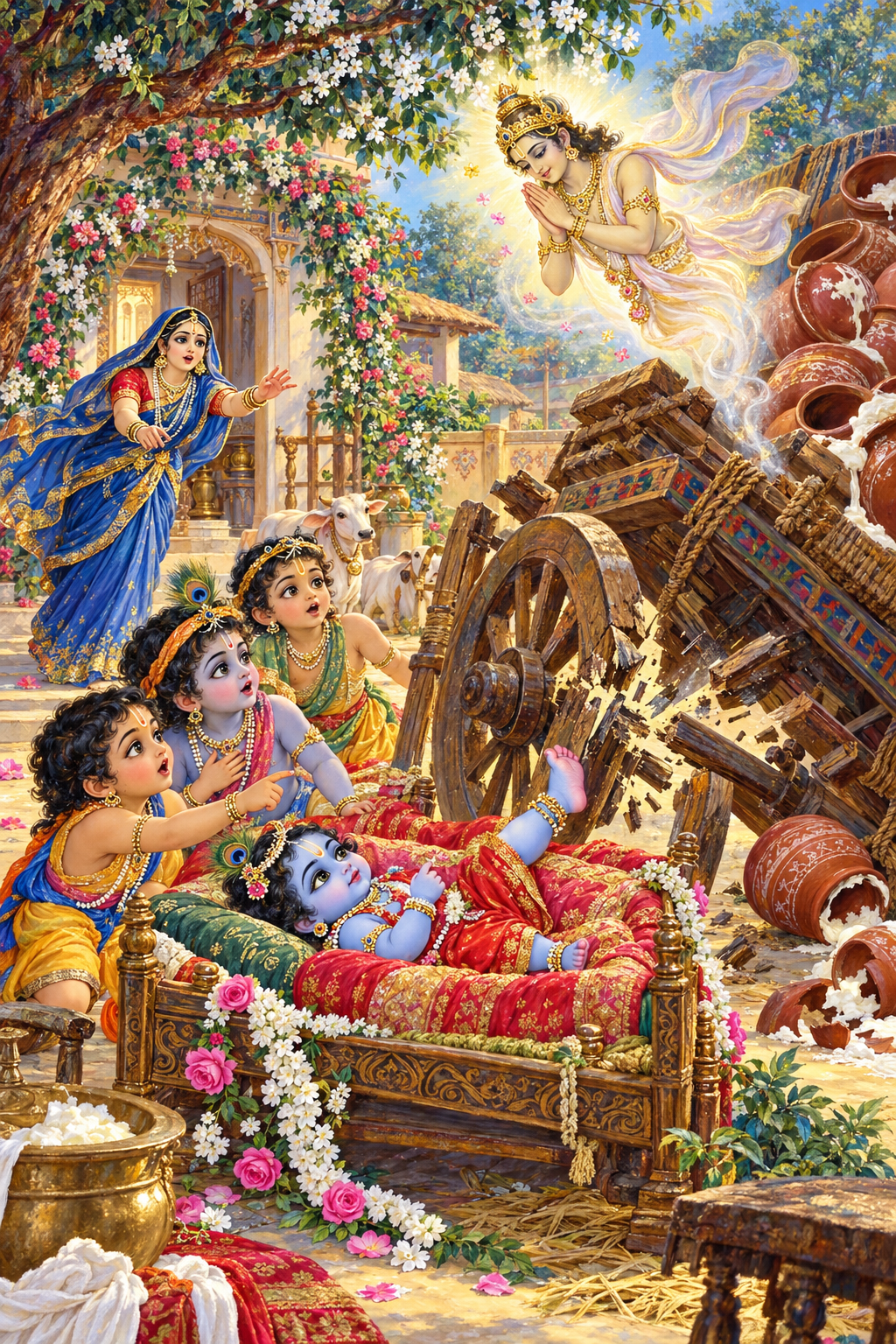
Then a demon named Utkaca, sent by Kaṁsa, whose body was made of air, entered a cart and tried to make it fall on Kṛṣṇa’s head. The infant Kṛṣṇa kicked the cart with the reddish sole of His foot. The cart broke to pieces and the demon fell. Leaving his body of air, he attained a pure spiritual body, bowed down respectfully to Lord Hari, and went to the Lord’s own abode of Goloka in a chariot pulled by a hundred horses.
The men and women of Vraja, headed by Nanda, rushed to the spot and asked the children, “How could this cart fall by itself? O children, you were here. You must know.”
The children said, “The baby was lying in the cradle crying for milk and kicking His feet. He hit the cart with one foot and it fell over.”
The astonished gopas and gopīs did not believe them. “What is this three-month-old infant compared to this heavily loaded cart?” Fearing that a ghost had come, Yaśodā took the child on her lap, gave gifts to the brāhmaṇas, and had them perform a traditional sacrifice.
King Bahulāśva asked, “O great sage, who in his previous birth was this fortunate demon Utkaca, who attained liberation by the touch of Lord Kṛṣṇa’s foot?”
Śrī Nārada said, “O king of Mithilā, Utkaca was the son of Hiraṇyākṣa. One day he went to the hermitage of Lomaśa Muni and broke some trees. Seeing this powerful giant, the brāhmaṇa became angry and cursed him, ‘O evil-hearted one, become bodiless!’ His body at once fell away, as a snake’s old skin falls away. The king of demons fell at the brāhmaṇa’s feet and said, ‘O sage, O ocean of mercy, please be kind to me. I did not know your power. O lord, please give me a body.’
“The sage, who had learned a hundred lessons of morality from Lord Brahmā, became pleased. Indeed, even the anger of saintly persons becomes a blessing. And how great is that blessing, which brings liberation! Lomaśa Muni said, ‘You may have a body made of air. When the Cākṣuṣa-manvantara has passed and the Vaivasvata-manvantara has come, Lord Hari’s foot will give you liberation.’ In this way the power of Lomaśa Muni gave liberation to the demon Utkaca. I offer my respectful obeisances to the saintly devotees of the Lord, who have the power both to bless and to curse.”
O king, one day, as Yaśodā was playing with her infant on her lap and caressing Him, she suddenly could no longer hold Him, for He had become as heavy as a mountain. Astonished, she thought, “How has my baby become as heavy as a mountain?” and at once placed Him on the ground.
Then the powerful demon Tṛṇāvarta, sent by Kaṁsa, came as a whirling wind and snatched the handsome child who was playing on the ground. Gokula was filled with blinding darkness and a terrible roar, and for an hour the dust blinded everyone. Yaśodā could not see her son in the courtyard. Bewildered and crying, she searched the roofs of the houses of Vraja. Not finding her son, she fell unconscious to the ground and wept loudly and pitifully, like a cow whose calf has died. The gopīs, filled with love, also wept, their faces covered with tears, as they searched everywhere for Nanda’s son.
Having carried the child eight hundred thousand miles into the sky, Tṛṇāvarta was troubled, for the infant on his shoulder had become as heavy as Mount Sumeru. The demon wanted to drop Kṛṣṇa, but the tiny Supreme Personality of Godhead held his neck firmly. As the demon cried “Let go! Let go!”, the wonderful infant Kṛṣṇa strangled and killed him. The demon merged into Lord Kṛṣṇa’s effulgence as lightning merges into a dark monsoon cloud. Then the demon’s body and the infant fell from the sky onto a great rock. The sound of the body breaking to pieces filled all directions and made the earth tremble.
The weeping gopīs saw the infant sitting silently on the demon’s back. They quickly brought Him to His mother and scolded her: “Yaśodā, you have no right to hold this child. You have no kindness. Your own words show how cruel you are. Who puts a baby down from her lap in blinding darkness? You were so merciless that in that terrifying moment you placed your own infant on the ground!”
Yaśodā said, “How did my child become as heavy as the king of mountains? I do not know. That is why I placed Him on the ground during the terrible whirlwind.”
The gopīs said, “O beautiful one, do not lie! Now that your trouble is over, look: this infant, with milk still in His mouth, is as light as a flower!”
Śrī Nārada said: When the infant was returned, the gopas and gopīs headed by Nanda were overjoyed and spoke happily among themselves. Yaśodā took the child, nursed Him again and again, smelled His head, and dressed Him in fine clothes. Then, still bewildered, she said to Rohiṇī:
“Fate has given me only one son. I do not have many sons. Yet at every moment so many dangers come to that one son. Today He escaped from the mouth of death. If He had died, what would have happened? What would I do? Where would I go? Where would I live? Many demons, strong as thunderbolts and terrible to see, hate my son. O fate, fate, how will we be happy? My wealth, my body, my palace, and my jewels are all only for my son’s happiness. I will worship Lord Hari, give charity, do great works for the public welfare, and build a hundred temples. Then my boy will be victorious over all dangers. My son will make me happy, and I will be like a blind person’s stick, fixed in bliss. O dear Rohiṇī, I will take my son and go to the kingdom of fearlessness.”
Then many learned brāhmaṇas came to Nanda’s palace. Nanda and Yaśodā worshiped them and gave them seats. The brāhmaṇas said, “O Nanda, O Yaśodā, queen of Vraja, do not lament. We will protect your son. He will live a long life.” With fresh twigs, kuśa grass, pure sacred water, hymns from the Ṛg, Sāma, and Yajur Vedas, and many auspicious blessings, the great brāhmaṇas performed a sacrifice, worshiped the sacred fire, and established protection for the child Kṛṣṇa. They prayed: “May the Lord of Rādhā protect Your hips. May the Lord in yellow garments protect Your abdomen. May the Lord with the lotus navel protect Your chest. May the lifter of Govardhana protect Your arms. May the Lord of Mathurā protect Your face. May the Lord of Dvārakā protect Your head. May the killer of demons protect Your back. May the Supreme Personality of Godhead give You all protection.” A person who regularly recites this prayer will always be happy and will never be afraid.
Nanda gave the brāhmaṇas a hundred thousand cows, a million gold coins, a thousand new jewels, and a hundred thousand fine garments. When they had gone, he invited the gopas, fed them sumptuously, honored them, and gave them beautiful garments and ornaments.
King Bahulāśva asked who Tṛṇāvarta had been in his previous birth, that he could merge into Lord Kṛṣṇa.
Śrī Nārada said, “He was Sahasrākṣa, a powerful king of Pāṇḍu-deśa. He was a devotee of Lord Hari, followed religion, performed sacrifices, and gave charity. On the bank of the Revā River, in a splendid place full of flowering vines, he enjoyed pastimes with a thousand beautiful women. When Durvāsā Muni came there, the king did not bow down to offer respects. The sage cursed him, ‘O evil-hearted one, become a demon!’ When the king fell at his feet, the sage blessed him, ‘O king, the touch of Śrī Kṛṣṇa’s form will give you liberation.’ Because of Durvāsā’s curse, he became Tṛṇāvarta on the earth, and by the touch of Śrī Kṛṣṇa’s form he attained liberation.”
Lessons to be learned
Both demons were once connected to great personalities, and both fell because of offenses to saints: Utkaca broke trees in Lomaśa Muni’s āśrama, and King Sahasrākṣa failed to honor Durvāsā Muni because he was absorbed in sense enjoyment. Śrīla Prabhupāda warned repeatedly that offending a Vaiṣṇava (vaiṣṇava-aparādha) is like a mad elephant that destroys the garden of devotion. Even a pious king can fall if pride and enjoyment make him neglect the saints.
Yet both curses ended in liberation. Nārada bows to the saints “who have the power both to bless and to curse,” because even their curses are mercy. When the offenders fell at the sages’ feet, the curse turned into a blessing. Humility before a devotee can transform even our punishment into benefit.
Kṛṣṇa as a tiny infant kicked over a cart and killed a demon in the sky. The residents of Vraja could not believe it, because their love made them see Him only as their helpless child. Śrīla Rūpa Gosvāmī explains that in Vraja the Lord’s sweetness covers His opulence, and that is the special charm of Vraja-bhakti.
Yaśodā’s lament shows the heart of pure parental love. She did not want anything for herself: her wealth, body, and home were only for her son’s happiness. This is the standard of pure devotion: everything for Kṛṣṇa’s pleasure. Śrīla Prabhupāda taught that the devotees of Vraja do not ask Kṛṣṇa to protect them; they want to protect Kṛṣṇa.