(Canto 1, Chapter 15: Revelation of the Universal Form to Nanda’s Wife)
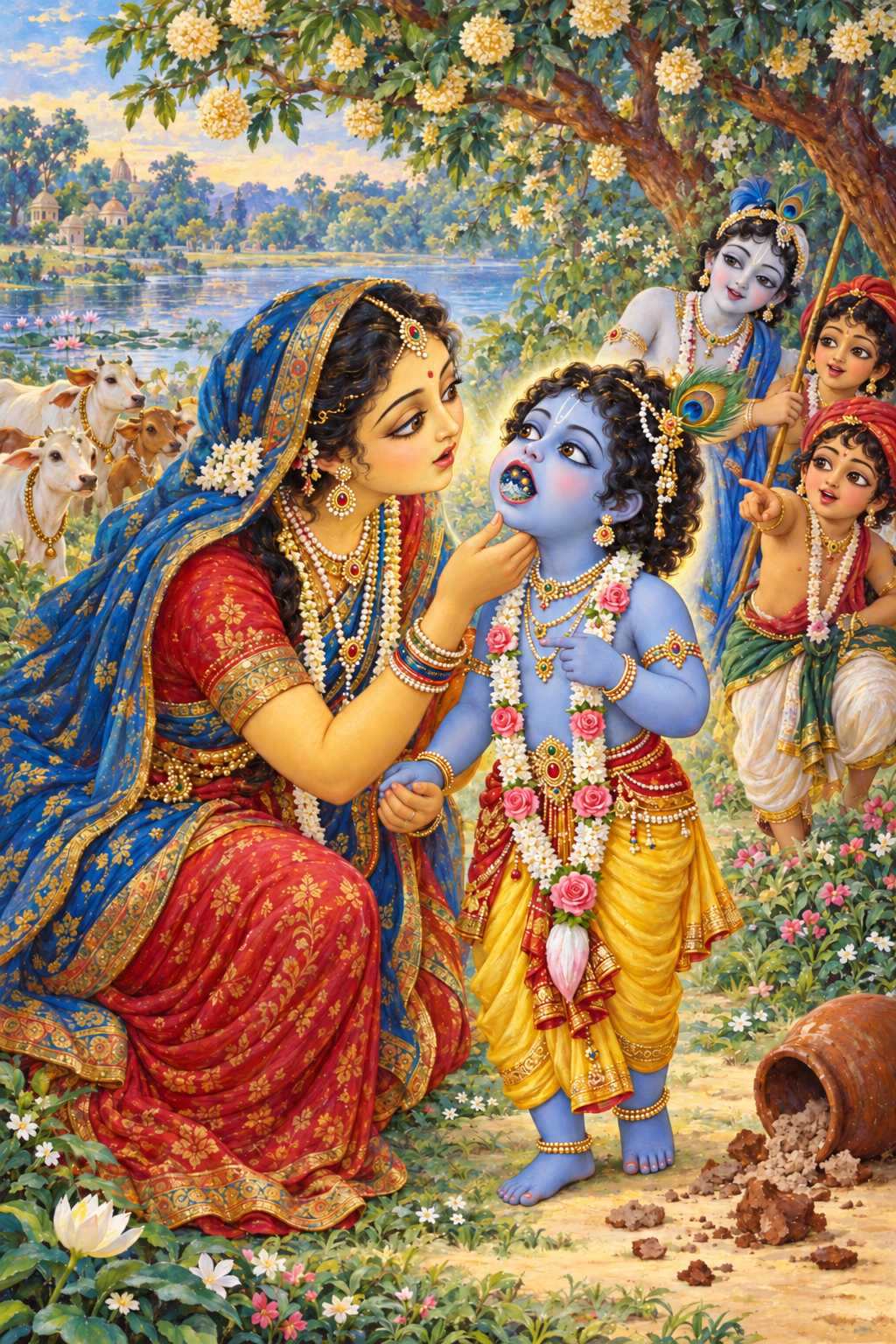
Śrī Nārada said: Yaśodā took dark Lord Hari onto her lap from His cradle of gold and jewels. His gentle smile enchanted people’s hearts, His glance took away their troubles, He was decorated with protective black dots, and His lotus eyes were anointed with kajjala. Filled with tender motherly love, the gopī was very happy as she caressed the restless child, who was sucking His foot, wearing a glittering half-moon necklace of lion’s nails, and whose curly new black hair made Him so handsome.
O king, when the child had finished drinking milk and yawned, all the elements of the universe suddenly appeared in His mouth. Seeing the whole universe and all the demigods within her son’s mouth, Mother Yaśodā closed her eyes in fear. Then, by the Supreme Lord Kṛṣṇa’s illusory potency, her memory of seeing the universe was taken away, and she was again overwhelmed with maternal love for her son. How can I describe the great austerities Nanda’s wife must have performed?
King Bahulāśva asked, “What great austerities did Nanda and Yaśodā perform so that Śrī Kṛṣṇacandra became their son?”
Śrī Nārada said, “Droṇa, the husband of Dharā, was the best of the eight Vasus. He was childless and a great devotee of Lord Viṣṇu, and he ruled a kingdom in the realm of the demigods. Desiring a child, and sent by Lord Brahmā, he went with his wife Dharā to Mount Mandara to perform austerities. First they ate only fruits and roots, then only leaves, and then they gave up even that. After they had performed these austerities for a hundred million years, Brahmā was pleased and came to them, saying, ‘Ask for a benediction.’
“Emerging from an anthill with his wife Dharā, the joyful Droṇa bowed down, worshiped him, and said, ‘O Brahmā, may Lord Kṛṣṇa, the Supreme Personality of Godhead, become our son, and may we always have love and devotion for Him, the Lord who removes His devotees’ sufferings. Love and devotion for Him enable the living beings to cross the impassable ocean of repeated birth and death. We who are performing austerities want nothing else.’
“Brahmā said, ‘Although I myself cannot attain the benediction you request, I grant that your desire will be fulfilled in another birth.’
“So Droṇa was born on the earth as Nanda, and Dharā as Yaśodā. To fulfil Brahmā’s words, Lord Kṛṣṇa went from His father’s palace to the village of Vraja. On the summit of Mount Gandhamādana I heard these beautiful pastimes of Lord Kṛṣṇa, sweeter than nectar, from the mouth of Nārāyaṇa Ṛṣi. By the mercy of Lord Nara-Nārāyaṇa I attained the goal of life. I have told you what He said. What more do you wish to hear?”
King Bahulāśva said, “When Lord Hari displayed His eternal form as a child in Nanda’s home, what pastimes did He enjoy with Balarāma? O great sage, please tell me.”
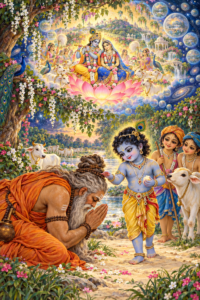
Śrī Nārada said: One day, sent by Vasudeva, the great saint Garga Muni came with his disciples to Nanda’s palace. Following the rules of tradition, Nanda washed the sage’s feet, offered him many things, circumambulated him, and fell down like a stick to offer obeisances.
Nanda said, “Today our pious ancestors, the demigods, and the fire-gods are all pleased with us. Our home is purified by the dust of your feet. O great brāhmaṇa sage, please perform my son’s name-giving ceremony. O lord, what one attains by your visit cannot be attained even by many pilgrimages.”
Garga Muni said, “I will certainly perform your son’s name-giving ceremony, and I will also tell you who He was before. O Nanda, let us go to a secluded place.”
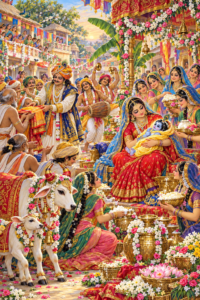
Garga Muni went with Nanda, Yaśodā, and the two boys to a secluded place in the cowshed, and there he performed the name-giving ceremony. After worshiping the deities beginning with Gaṇeśa and carefully pacifying the deities of the planets, the great saint, joyful in every limb, spoke to Nanda:
“Please hear the explanation of Rohiṇī’s son’s names. Because the yogīs find their pleasure (ramante) in Him, because He is the greatest enjoyer, and because He delights the devotees with His transcendental qualities, the sages know Him as Rāma. Because He was drawn (saṅkarṣaṇa) from one womb to another, He is also called Saṅkarṣaṇa. Because He alone remains (avaśeṣa) when the universe is destroyed, He is known as Śeṣa. And because He is extremely strong (bala), He is known as Bala.
“O Nanda, now listen carefully to the names of your son. His names at once purify all living beings and are the auspiciousness of all the universes. In His name, the letter K stands for Kamalākānta, the husband of the goddess of fortune. R stands for Rāma, the supreme enjoyer. Ṣ stands for the master of the six opulences and the resident of Śvetadvīpa. N stands for Lord Nṛsiṁha. A stands for Akṣara, the imperishable, and for the Lord who enjoys the offerings of sacrifice. And the final visarga, written as two dots, stands for Nara-Nārāyaṇa Ṛṣi. In this way these six letters together form the name of the pure Supreme Person, Kṛṣṇaḥ.
“In white, red, and yellow forms He appears in the successive yugas. Now, at the end of Dvāpara-yuga and the beginning of Kali-yuga, He has a dark (kṛṣṇa) complexion. For this reason also He is named Kṛṣṇa. He is this boy, the son of Nanda.
“The word vasu means the senses, and deva means the heart. Because He acts within the hearts and senses of all living beings, He is known as Vāsudeva. He is the husband of Rādhā, the daughter of King Vṛṣabhānu born in the palace of Queen Kīrti, and therefore He is called Rādhā-pati. He is the original Supreme Personality of Godhead, Śrī Kṛṣṇa, master of countless universes, shining in the transcendental abode of Goloka. That same Supreme Lord has now taken birth as your son to remove the earth’s burden, to kill the demons headed by Kaṁsa, and to protect the devotees. O Nanda, according to His different pastimes, your son will have countless names, names that are secret even from the Vedas. Do not be surprised at whatever He does. Ah, how fortunate you are! The Supreme Personality of Godhead, greater than the greatest, is living in your home as a little child.”
Śrī Nārada said: After saying this, Garga Muni left, and noble King Nanda and his wife reflected on the great blessing they had received.
Then Garga Muni, the great philosopher, teacher, and sage, went to King Vṛṣabhānu’s beautiful palace on the bank of the Yamunā. With his parasol he looked like a second Indra; holding his staff, like a second Yamarāja; with his bodily luster lighting up the directions, like a second sun; with a great book at his belt, like a second Brahmā; and dressed in white, he stood there like Lord Viṣṇu Himself. Seeing him, noble King Vṛṣabhānu at once rose with great respect, bowed his head, stood with folded hands, seated the sage on a great throne, washed his feet, presented many offerings, circumambulated him, and worshiped him according to scripture.
Vṛṣabhānu said, “The peaceful travels of saints are meant to bring peace to householders. It is the saint, not the sun, who removes the darkness in people’s hearts. O lord, by seeing you, we gopas have completed our pilgrimage. Saints like you sanctify the holy places of this world. O sage, my daughter is named Rādhikā. She is the abode of great auspiciousness. To whom should I give Her in marriage? Please tell me your opinion. Like the sun, your goodness travels everywhere in the three worlds. I wish to give my daughter to a splendid husband who will be Her equal.”
Garga Muni took Vṛṣabhānu by the hand and went to a beautiful secluded place on the bank of the Yamunā, where the river’s waves made a loud sound. Seating the king of the gopas there, the king of sages said, “O gopa, do not tell anyone this secret. Śrī Kṛṣṇa, the original Supreme Personality of Godhead, master of countless universes, king of Goloka, greater than the greatest, the husband better than whom there is no other, has taken birth in the home of Nanda.”
Vṛṣabhānu said, “How fortunate! How fortunate is Nanda! O great sage, please tell me everything about why Śrī Kṛṣṇa has descended to this world.”
Garga Muni said, “At Lord Brahmā’s request, Lord Kṛṣṇa has taken birth on the earth to remove its burden and to kill the demons headed by Kaṁsa. And Śrī Rādhikā, Lord Kṛṣṇa’s chief queen in Goloka, has taken birth in your home. You do not understand Her exalted position.”
Delighted and astonished, Vṛṣabhānu called Kalāvatī, and they both reflected on what Garga Muni had said. Understanding the exalted position of Śrī Śrī Rādhā-Kṛṣṇa and shedding tears of bliss, the exalted gopa said to the great sage, “O brāhmaṇa, I will give my lotus-eyed daughter to Him. You have revealed this path, so you should perform the wedding.”
Garga Muni said, “O king, I will not perform Their wedding. Their wedding will take place in Bhāṇḍīravana on the bank of the Yamunā. Lord Brahmā himself will come and perform it in a beautiful secluded place near the forest of Vṛndāvana. Know that Rādhā is half of the body of the Supreme Personality of Godhead. In the palace of Goloka She is the queen of Him who is the crest jewel of the worlds. You gopas have all come from Goloka, and by Śrī Rādhikā’s wish the cows and the gopīs have also come from Goloka. She whom even the demigods cannot see, what to speak of those who perform sacrifices for many births, is now seen by many gopas and gopīs, hidden in the courtyard of your palace.”
Joyful and full of wonder at hearing these glories, the husband and wife said to Garga Muni, “O brāhmaṇa, please tell us truthfully the meaning of the name Rādhā. O great sage, except for you, no one in this world can cut our doubts.”
Garga Muni said, “I heard this as a disciple from the mouth of Nārāyaṇa Ṛṣi when He was explaining the Sāma Veda on Mount Gandhamādana. The letter R stands for Ramā, the goddess of fortune. Ā stands for Ādi-gopikā, the first of the gopīs. Dh stands for Dharā, the earth. And the final Ā stands for the Virajā River. Lord Kṛṣṇa’s four potencies became His four consorts: Līlā, Bhū, Śrī, and Virajā. Because all these goddesses have entered the form of Śrī Rādhā, the wise say that Śrī Rādhā is the original supreme goddess of fortune.”
Śrī Nārada said: O king, those who chant the names of Śrī Śrī Rādhā-Kṛṣṇa again and again attain Lord Kṛṣṇa directly. What are the four goals of life to them? When they understood the glories of Śrī Śrī Rādhā-Kṛṣṇa, King Vṛṣabhānu and his dear wife were filled with wonder and bliss, and Garga Muni, the best of philosophers and king of sages, returned to his own home.
Lessons to be learned
Mother Yaśodā saw the entire universe in Kṛṣṇa’s mouth, yet she immediately forgot it and loved Him again as her little son. Kṛṣṇa’s Yogamāyā covers His opulence so that His devotees can relate to Him with intimate love. Śrīla Prabhupāda explained that Yaśodā’s position is higher than that of the great yogīs, because she binds the unconquerable Lord with her love.
Droṇa and Dharā performed austerities for millions of years and asked only for Kṛṣṇa as their son and for pure devotion, “which carries one across the ocean of birth and death.” They wanted nothing else. Their prayer is a model for us: not wealth or heaven, but love for Kṛṣṇa.
Garga Muni’s explanation of the names shows that Kṛṣṇa’s name contains all His incarnations. Śrīla Prabhupāda taught that the holy name is non-different from Kṛṣṇa Himself, and that by chanting it one directly associates with Him. Nārada ends the chapter by saying that those who chant the names of Rādhā and Kṛṣṇa again and again attain Kṛṣṇa directly, and the four goals of dharma, artha, kāma, and mokṣa become insignificant to them. This is the essence of the Hare Kṛṣṇa mahā-mantra, in which “Hare” addresses Śrī Rādhā, the energy of the Lord.
Śrī Rādhā is half of Kṛṣṇa’s body and the original goddess of fortune, in whom all His potencies are present. Our ācāryas teach that Kṛṣṇa can be approached only through the mercy of Śrī Rādhā. Gauḍīya Vaiṣṇavas are servants of Rādhārāṇī first.
Both Nanda and Vṛṣabhānu received Garga Muni with the greatest respect and asked him for guidance in their most important family decisions. When a family honors a saint and follows his guidance, the Lord personally enters that family.