(Canto 1, Chapter 18: Vision of the Universal Form)
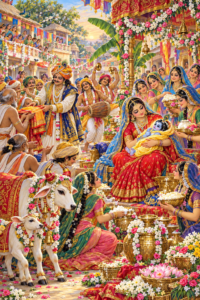
Śrī Nārada said: Wandering from one gopī’s home to another and stealing the hearts of the cowherd people, the charming, handsome, dark butter thief, whose eyes were like blossoming lotuses, brought great beauty to Vraja, like the rising full moon. The nine Nanda-gopas would take Nanda’s restless, ball-playing son into their homes, protect Him, feed Him, and sing His glories. They were so happy that they did not remember anything else in the world. They were completely enchanted.
The king said, “Who were the fortunate nine Nandas and the Upanandas in their previous births? And what auspicious deeds did the six Vṛṣabhānus perform? O sage of the demigods, please tell me.”
Śrī Nārada said, “The nine Nandas in Gokula included Raṅgavallīśa, Raṅgoji, Devanāyaka, and others. The Upanandas were Vītihotra, Agnibhuk, Sāmba, Śrīkara, Gopati, Śruta, Vrajeśa, Pāvana, and Śānta. O king, the six Vṛṣabhānus in Vraja were Nītivit, Mārgada, Śukla, Pataṅga, Divyavāhana, and Gopeṣṭa.
“The smṛti-śāstra explains that the nine Nandas, dark in complexion, holding sticks, and rich with flutes and peacock feathers, live in two forest groves in Lord Kṛṣṇacandra’s Goloka, and are devoted to protecting the millions of cows in those groves. The men who stand at the six gates holding sticks and nooses to protect the fortress of that forest grove are called the six Vṛṣabhānus. By Lord Kṛṣṇa’s wish, they all came from Goloka to this earth. Even Lord Brahmā cannot describe their glories. How can I describe their good fortune? As He displayed His childhood pastimes, Lord Hari treated them all with great respect.”
One day Kṛṣṇa ate clay on the bank of the Yamunā. The boys told Yaśodā, “Your boy ate clay.” When Balarāma also said so, Nanda’s wife took her son, whose eyes were full of fear, by the hand and said, “Why did You eat clay, when You know what is good to eat? Your friends say You did it. Your elder brother Balarāma says, ‘Mother, it is true. He would not stop eating the clay.'”
The Supreme Lord said, “The boys of Vraja are all lying. I never ate clay. I am telling the truth. Look in My mouth.”
Śrī Nārada said: When the gopī looked into her boy’s handsome mouth, she saw the entire material universe created by the modes of nature. She saw the seven continents and seven oceans, many countries and great mountain ranges, the three planetary systems up to Brahmaloka, her own relatives, and the people of Vraja. Standing on the bank of the Yamunā, she closed her eyes and understood, “My boy is Lord Hari Himself!”
Then Śrī Kṛṣṇa smiled, as if casting a spell on her with His Yogamāyā potency. From that moment Yaśodā could not remember the glory and opulence she had seen. She forgot everything.
Lessons to be learned
The Nandas, Upanandas, and Vṛṣabhānus are not ordinary cowherd men. They are Kṛṣṇa’s eternal associates from Goloka who came down with Him. This teaches that Kṛṣṇa’s pastimes on earth are not a drama with ordinary actors. His eternal family comes with Him, and the whole of Vraja is a spiritual manifestation.
Even the Lord of the universe, who respects no one as His superior, treated these cowherd men with great respect. Kṛṣṇa honors His devotees more than they honor Him. As He says in the Bhāgavatam, He follows His pure devotees so that the dust of their feet may purify Him.
When Kṛṣṇa’s friends accused Him of eating clay, He showed the whole universe in His mouth. Śrīla Prabhupāda comments that Kṛṣṇa, the source of all universes, is not limited by anything, yet out of love He behaves exactly like a small child hiding His mischief. Yaśodā understood He was the Supreme Lord, but that knowledge was immediately covered by Yogamāyā so that she could continue to love Him as her son. Knowledge of the Lord’s greatness is good, but pure love is greater, because it gives Kṛṣṇa more pleasure.