Mahanidhi Madan Gopal Das Babaji Maharaj
I. Bones Baba
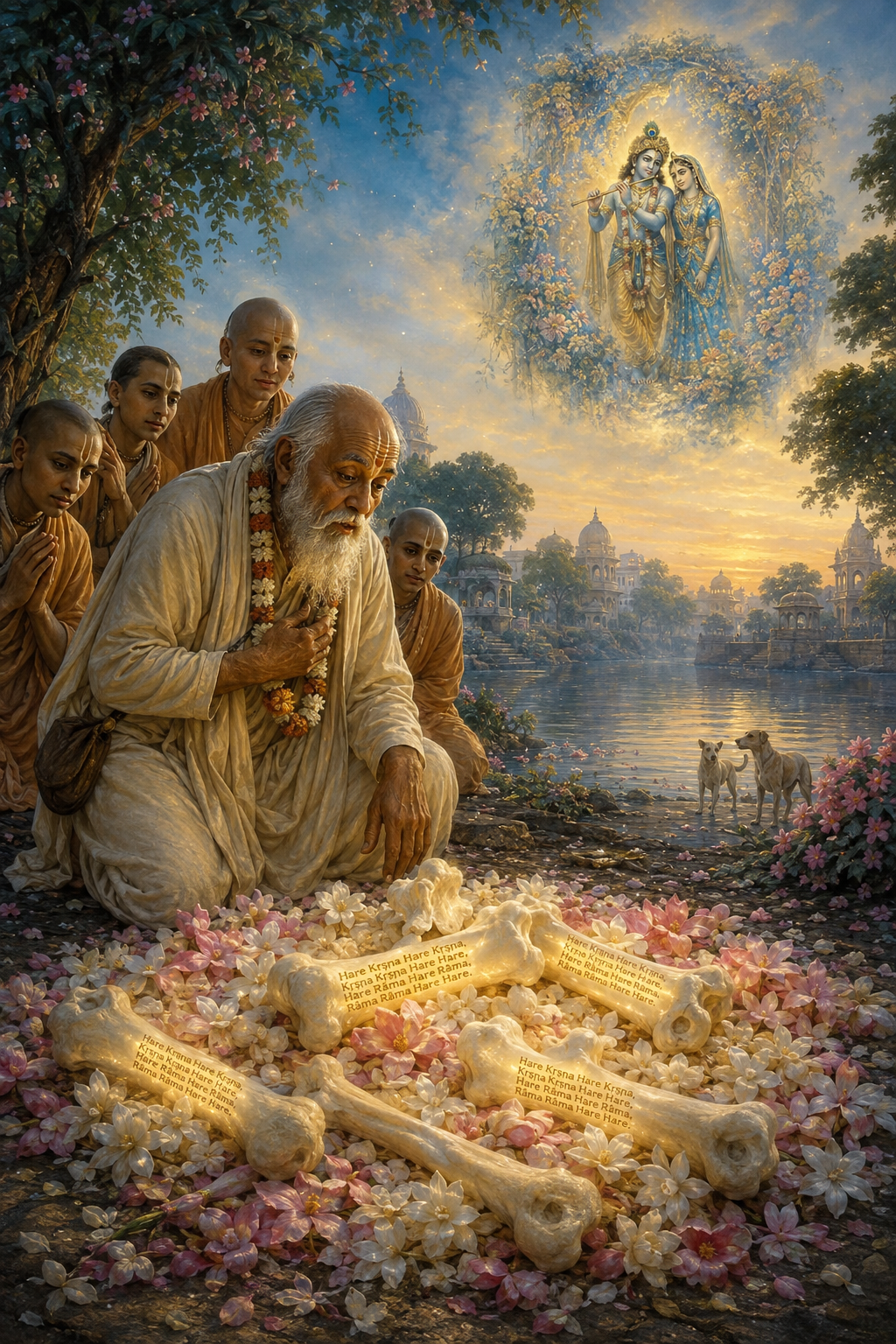
There is an astonishing story from the life of the Vraja siddha-bābā, Vijaya Kṛṣṇa Gosvāmī. One day, while walking along the bank of the Yamunā with several disciples, Bābā came upon a dead body. The Vrajavāsī dogs had already feasted upon it, leaving behind nothing but bare bones.
Drawn toward the remains, Bābā said to his disciples, “Let us go there and examine those bones.”
To everyone’s amazement, they discovered that the Hare Kṛṣṇa mahā-mantra was etched upon every bone:
Hare Kṛṣṇa Hare Kṛṣṇa
Kṛṣṇa Kṛṣṇa Hare Hare
Hare Rāma Hare Rāma
Rāma Rāma Hare Hare
Seeing this extraordinary sight, Bābā remarked, “Just see! This is clear proof that this mahātmā attained perfection in nāma-bhajana. He became a perfect nāma-siddha!”
From this incident, we can understand how completely that sādhaka had dedicated himself to chanting the Rādhā-Govinda Yugala mahā-mantra for the dark age of Kali. Day and night, week after week, year after year, throughout his entire spiritual life, he chanted with such love, concentration, and devotion that the words of the mahā-mantra became etched into his very bones. Indeed, this was a most extraordinary miracle!
While chanting Hare Kṛṣṇa japa each day, we all struggle with inattention and endlessly wandering minds. Our minds do not merely wander—they leap randomly and recklessly from one branch to another within the endless labyrinth of the banyan tree of desires, wants, needs, anxieties, and “things I must do today.”
The essential lesson of this story is complete absorption in chanting.
Let us therefore sincerely pray to this perfected saint, whom we may affectionately remember as “Nāma Bones Bābā”:
“O Bābā, please bless us so that one day, even if not our bones, at least our minds and hearts may become completely absorbed in relishing the all-encompassing, nectarean names of Rādhā and Kṛṣṇa, who dance together in the ecstasy of mahā-Vraja-prema within the kuñjas of the Hare Kṛṣṇa mahā-mantra!”
II. Lamenting Flowers
After hearing the wonderful story of “Bones Bābā,” one famous kuṇḍa-vāsī sādhaka of devotion remarked:
“After I die, and the dogs around the kuṇḍa have joyfully feasted upon my body to their hearts’ delight, please do me one favor. Go and examine the bones that remain. I sincerely hope and pray to Īśvarī Rādhā that, just as the mahā-mantra was found written upon the bones of ‘Bones Bābā,’ you will discover every verse of Śrīla Raghunātha dāsa Gosvāmīpāda’s masterpiece, Śrī Vilāpa-kusumāñjali, inscribed upon all my bones!”
Without the slightest shadow of doubt, Śrī Vilāpa-kusumāñjali—“A Flower Bouquet of Lamentations”—is one of the most important and essential books for every serious sādhaka practicing rāgānugā-bhakti in mañjarī-bhāva and longing to attain the eternal, intimate service of Śrīmatī Rādhikā within the secluded nikunjas of Vraja.
Every word, every line, and every verse is pure nectar. The work overflows with hope, intimate services, tears of separation, and practical guidance for meditating upon the loving service of Bhānunandinī Śrī Rādhā. Its verses may be remembered while one is absorbed in chanting the Hare Kṛṣṇa mahā-mantra or immersed in single-minded contemplation of Śrīmatī Rādhikā’s eternal service.
I therefore beg all those who yearn for divine love and the intimate service of Svāminī Śrī Rādhā: daily read, remember, contemplate, and drink the sweet nectar contained within every verse of Śrīla Raghunātha dāsa Gosvāmīpāda’s cintāmaṇi scripture, Śrī Vilāpa-kusumāñjali.
Through this daily practice, the beautiful flowers of intimate devotional service at Śrīmatī Rādhikā’s sweet lotus feet will gradually blossom upon the tree of your heart.