The Inspiration for Gīta-Govinda
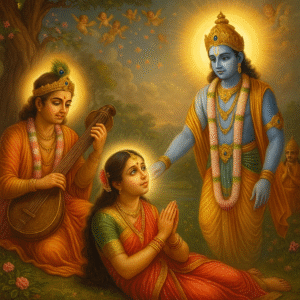
Once the Supreme Lord, the Husband of Rukmiṇī, Śrī Kṛṣṇa, said to His intimate devotee Uddhava, “In the age of Kali, I wish to be worshiped through songs of praise.”
Thus, inspired by this divine will, Śrī Jayadeva composed a work of extraordinary sweetness and devotion—the Gīta-Govinda. The poem drew upon themes from the Padma Purāṇa and depicted the divine love-sports of the Lord with Śrīmatī Rādhārāṇī in the forests of Vṛndāvana, as well as His pastimes as the young cowherd Kṛṣṇa of Gokula.
The actions of Śrī Hari are already supremely enchanting, but Jayadeva adorned them with poetry so tender and refined that it was like setting a diamond within a golden bracelet. He composed the Gīta-Govinda, and all who heard it were filled with joy. People copied it lovingly, memorized it, and sang it in every home.
Just as flowers bloom in one place but their fragrance spreads far and wide, so the fame of the Gīta-Govinda filled the entire world.
The Rivalry of King Sātvika
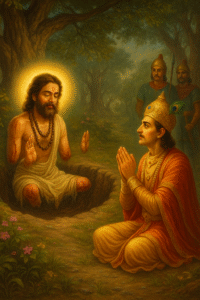
At that time, there ruled in Jagannātha Purī a certain king named Sātvika. Hearing of Jayadeva’s success, he too desired to compose a devotional poem in praise of Lord Jagannātha. Proud of his own scholarship, he wrote a book on a similar subject and distributed copies of it throughout the land, commanding that it should be read and memorized by all.
When the learned paṇḍitas heard this, they were deeply disturbed. Gathering together at the temple of Lord Jagannātha, they said to the king:
“O King, you have written a book that pleases your own mind, but you have presumptuously placed it on an equality with Jayadeva’s Gīta-Govinda. That is folly! The wise never praise their own work with their own lips, yet you order others to learn yours by heart.”
They continued, “If someone goes about shouting, ‘Take this knowledge! Take this mantra! Take this divine service! Take this rare jewel!’—then even that jewel loses its worth. To boast of one’s own cleverness or poetry is as foolish as praising the fragrance of musk, sandalwood, or saffron aloud. To appraise one’s own daughter, book, or pearl is to lower its value.
“You are driven by pride, O King. True wisdom never springs from vanity, and pride cannot please God.”
The Test Before Lord Jagannātha
The king replied humbly, “Let both books be placed before Lord Jagannātha. If my work is not pleasing to Him, He will reject it Himself.”
So both books were brought before the deity. The doors of the temple were locked for the night, and the priests left.
At dawn, the paṇḍitas and temple attendants entered to perform the morning worship. There they found that Lord Jagannātha had placed Jayadeva’s Gīta-Govinda beside Him on His altar, while the king’s book had been thrown outside the temple door!
All present clapped their hands and cried aloud, “Victory to Jayadeva! Victory to the Lord’s pure devotee!” The scholars rejoiced, while the king hung his head in shame.
The King’s Prayer of Repentance
The paṇḍitas said, “O King, the difference between milk and water has been shown! How can your book, heavy with pride, stand equal with the divine poetry of Jayadeva? How can a swan and a crow be the same? Or gold and tin? Or the fragrant sandalwood tree and the thorny babhūl? Or a saint and a reviler, a pious man and a sinner? So, too, your poem can never compare with Jayadeva’s.”
Hearing their words, King Sātvika bowed before Lord Jagannātha and prayed with tears:
“O Purifier of the sinful, O Lord of the universe! They call You impartial, yet You accept one and reject another. You are said to dwell in every being, pervading all equally—then why this partiality?
“The sun shines on every vessel; water refreshes both cow and tiger; the sky is the same for eagle and vulture; a mother’s love embraces both her wise and foolish children; the moonlight falls equally upon king and beggar. O Lord of the Yādavas, You are equal to all.
“You inspired Jayadeva to compose his poem—then who inspired my heart to write? Surely it was You alone. If You have now rejected my book, then I see no reason to live. O Jagannātha, I shall give up my life before Your eyes!”
The Lord’s Mercy
Hearing this prayer of repentance, Lord Jagannātha, the Life of the universe, was pleased. Out of compassion, He took twenty-four verses from the king’s book and added them to the Gīta-Govinda of Jayadeva. By this divine act, He accepted the king’s offering, purified his pride, and comforted his heart.
Reflection
This story is a lesson in humility, pride, and divine grace. King Sātvika’s intention was outwardly pious—he wished to glorify the Lord—but inwardly it was colored by ego. The Lord, who dwells within every heart, exposed that pride not to humiliate the king but to awaken his humility.
The test before the deity of Jagannātha shows that the Lord Himself decides what offerings are acceptable. Talent, learning, and position hold no value before Him—He accepts only sincerity. Jayadeva’s work was born of selfless love; the king’s, of pride. Therefore, one was honored, and the other was cast aside.
But when the king repented and surrendered, the Lord immediately revealed His mercy. He accepted part of the king’s work, teaching that when pride is destroyed, even the rejected can become sanctified.
The devotee should therefore remember: our only qualification is humility. Whether we sing, write, or serve, we must do so not to be admired but to please the Lord. If our offering is pure, even a single word becomes part of His eternal song. If mixed with pride, even great achievements turn to dust.
Source
Bhaktavijaya, Chapter II – Verses 12–48.