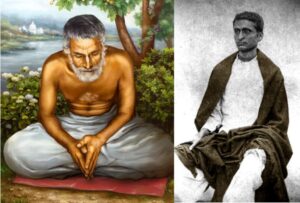
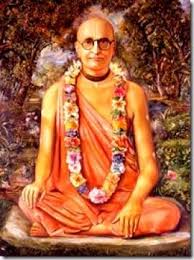
(The Divine Authority of Śrīla Bhaktisiddhānta Sarasvatī Ṭhākura)
The Passing of a Great Saint
When the exalted saint Śrīla Gaura Kiśora dāsa Bābājī Mahārāja (GK) departed from this world, the devotees and bābājīs of Navadvīpa gathered to perform his final rites. Gaura Kiśora dāsa Bābājī was known throughout Vraja and Gauḍa-maṇḍala as an avadhūta—a renounced soul who lived beyond all social convention, absorbed constantly in chanting the holy name.
Before his passing, however, he had spoken one startling instruction:
“When I leave this world, tie a rope around my body and drag it through the streets. My so-called disciples may see how little I care for honor.”
His humility was beyond comprehension. Yet, when the time came, the bābājīs took his words literally. They gathered near his body, tied a rope around his neck, and prepared to drag it through the streets of Navadvīpa.
The Arrival of Bhaktisiddhānta Sarasvatī
At that time, Śrīla Bhaktisiddhānta Sarasvatī Ṭhākura (SBS) was residing across the Gaṅgā in Māyāpura. Hearing what was about to happen, he immediately crossed the river and arrived at the scene. Approaching the group of bābājīs, he commanded them to stop.
“None of you,” he said firmly, “are his disciples. He had only two disciples—myself and Vamsivata dāsa Bābājī Mahārāja, who is an avadhūta. I am the rightful person to perform his final rites.”
The bābājīs objected. “But he was a bābājī, and you are not! You wear saffron cloth, not the white cloth of the bābājī order.”
Śrīla Sarasvatī Ṭhākura replied with unshakable authority:
“Gaura Kiśora dāsa Bābājī does not belong to the bābājī line you claim. He was initiated by Nimāi Chand Gosvāmī, a disciple in the Nityānanda-parivāra, the line descending from Lord Nityānanda. He received his veśa—his dress of renunciation—from Bhāgavata dāsa Bābājī Mahārāja, who was an initiated disciple of Jagannātha dāsa Bābājī Mahārāja. This is not your so-called hereditary line; this is the line of spiritual realization.”
The True Lineage
Śrīla Sarasvatī Ṭhākura continued:
“From the time of Śrī Caitanya Mahāprabhu, pure devotees have accepted veśa—white knee-length cloth, kaupīna, a waterpot, and bead-bag—as a symbol of renunciation. Not this formal tridaṇḍi sannyāsa which we later adopted for preaching, but simple veśa bestowed by a realized soul.
“My father, Śrīla Bhaktivinoda Ṭhākura, also received veśa from Jagannātha dāsa Bābājī Mahārāja. Though Bhaktivinoda Ṭhākura was dīkṣā-initiated by Bipin Bihari Gosvāmī, he took his śikṣā and veśa—his true spiritual inspiration—from Jagannātha dāsa Bābājī.
“Similarly, Gaura Kiśora dāsa Bābājī took śikṣā from Bhaktivinoda Ṭhākura. This is Bhāgavata-paramparā, the chain of transmission through realization, not by birth or external form.”
Then, turning to the bābājīs, he challenged them:
“Show me where, from Rūpa or Sanātana Gosvāmī, any such seminal line of inheritance has come. The term Rūpānuga means one who follows Rūpa Gosvāmī in spirit, not one who claims descent by blood.
“Did not Rūpa Gosvāmī record that Advaita Ācārya rejected his own son Madhusūdana because he accepted Lord Caitanya only, but not Lord Nityānanda? This is our standard—Bhāgavata, not jāti.”
The Challenge of Purity
Finally, Śrīla Sarasvatī Ṭhākura addressed the assembled bābājīs directly:
“If you claim to be bābājīs, then you must be fully sense-controlled. Let the one among you who has not engaged in any illicit activity in the past year come forward and perform the last rites.”
The crowd fell silent. No one moved.
He continued, “Then one month? One week? One day? Even within the last twenty-four hours—has any among you remained pure?”
Not a single man stood. The courtyard was filled with silence, heavy and humbling. Then Śrīla Bhaktisiddhānta Sarasvatī Ṭhākura stepped forward, his presence commanding both fear and reverence. With solemn devotion, he performed the samādhi ceremony himself, placing the sacred body of his beloved spiritual master in the earth.
The Triumph of the Bhāgavata Paramparā
Through that act, he established not only the samādhi of a saint but also the living principle of Bhāgavata-paramparā—succession through realized knowledge and devotion, not by external designation or hereditary claim. From that moment, the Gauḍīya Vaiṣṇava sampradāya stood on firm theological ground, anchored in scriptural purity and transcendental authority.
Reflection
This historic event at Navadvīpa reveals the fearless strength and uncompromising clarity of Śrīla Bhaktisiddhānta Sarasvatī Ṭhākura Prabhupāda.
Lessons to learn:
- True authority flows from purity, not position. Spiritual lineage is not inherited but awakened through realization and service.
- Detachment must be accompanied by discipline. External dress or title means nothing without control of the senses.
- The saint defends the honor of his guru even after death. By performing the samādhi, Sarasvatī Ṭhākura upheld the dignity of his master’s legacy.
- Bhāgavata-paramparā is living and dynamic. It connects souls through transcendental knowledge, not material hierarchy.
By protecting his guru’s honor and establishing the Śrī Bhāgavata-paramparā, Śrīla Bhaktisiddhānta Sarasvatī Ṭhākura became the fearless guardian of Lord Caitanya’s mission—a lion among saints, roaring against hypocrisy, yet bowing in perfect humility before the dust of his master’s feet.