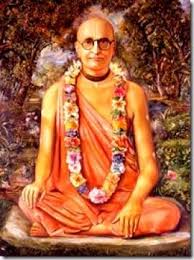
(The Hidden Ecstasy and the Birth of the Gauḍīya Maṭha)
The Search for a Successor
After the departure of the great ācārya Śrīla Bhaktivinoda Ṭhākura, one of his disciples, inspired to continue the preaching mission, began searching for someone qualified to lead it. He had heard of Śrīla Bhaktisiddhānta Sarasvatī (SBS), the powerful and spiritually radiant son of Bhaktivinoda Ṭhākura, and set out for Navadvīpa, knowing that such a soul could carry forward the mission of Lord Caitanya.
He went around asking the villagers if they knew of a saint who matched the description of Sarasvatī Ṭhākura — an ascetic, learned, and radiant personality. The people replied with bewildering words:
“We do not know of any sadhu here, but there is one madman we see wandering about, crying aloud, and sometimes rolling on the ground, shouting the names of God!”
Intrigued and humbled, the disciple followed the villagers’ directions to the nearby Ganges forest, where the “madman” was sometimes seen.
The Vision in the Forest
As the man entered the forest at sunset, he suddenly heard a piercing cry:
“Kṛṣṇa! Kṛṣṇa! Haribol! Nitāi-Gaur Haribol!”
Moments later, from the dense foliage, emerged the radiant figure of Śrīla Bhaktisiddhānta Sarasvatī—his eyes overflowing with tears, his face glowing with divine madness. Without a moment’s hesitation, he plunged fully clothed into the sacred Ganges, crying the holy names in uncontrollable ecstasy.
Standing on the riverbank, the disciple watched in awe. Sarasvatī Ṭhākura splashed about, calling out to Kṛṣṇa, as though conversing with invisible divine companions. Finally, he emerged from the river, water streaming from his saffron cloth, his face filled with the bliss of another world.
The Offer and the Refusal
The disciple approached with deep reverence. Bowing down, he pleaded, “O Mahārāja, please come to Calcutta and lead the sankīrtana mission. Without your guidance, the work of spreading Lord Caitanya’s message cannot continue.”
But Śrīla Sarasvatī Ṭhākura, still breathing heavily from ecstasy, gazed into the distance as if beholding a divine vision. He replied:
“Sankīrtana? Do you not see the wonderful sankīrtana already going on here? Look around you! The Pañca-tattva—Śrī Caitanya Mahāprabhu, Nityānanda, Advaita, Gadādhara, and Śrīvāsa—are all chanting and dancing in divine rapture, surrounded by their eternal associates! Can you not see this?”
With that, he ran off again into the forest, crying “Haribol! Haribol!” his voice echoing like thunder through the trees. The disciple, moved beyond words, stood silently. He took his bath in the Ganges, and in his heart, he renounced all plans of organizing a mission, feeling unworthy before such divine madness.
The Return of the Acharya
Years passed. Then one day, in 1918, that same disciple was sitting at his home in Calcutta when, at precisely four in the afternoon, a tall, radiant figure appeared at his door—Śrīla Bhaktisiddhānta Sarasvatī, now dressed as a sannyāsī, his head freshly shaven, carrying the daṇḍa of renunciation.
He spoke with divine authority:
“Now we are founding a Society—the Śrī Gauḍīya Maṭha. Draw up the papers immediately and have it registered.”
By the end of that same afternoon, the legal documents were complete. The spiritual revolution that would revive Śrī Caitanya Mahāprabhu’s mission had begun.
The Bold Preacher
Even before founding the Gauḍīya Maṭha, Sarasvatī Ṭhākura had already begun preaching fearlessly against the Jāti-Gosāis—hereditary caste brāhmaṇas who claimed exclusive right to initiate disciples. He boldly declared that spiritual birth came not from lineage, but from bhakti and realization.
When the caste brāhmaṇas challenged him, saying, “Where in the scriptures is the Gaura-mantra mentioned as a valid Gāyatrī? Śrī Caitanya called Himself only a devotee—why do you call Him the Supreme Lord and use His name as a sacred mantra?”
Sarasvatī Ṭhākura thundered in reply:
“Śrī Caitanya Mahāprabhu is the combined form of Rādhā and Kṛṣṇa—the original source of all incarnations. The mantra that invokes His mercy is the highest mantra, because it connects one directly with the fountainhead of love divine.”
His words carried the conviction of a realized soul, and his movement began to awaken the sleeping world to the golden radiance of Lord Gaurāṅga’s message.
Reflection
This episode reveals the hidden divinity and fearless mission of Śrīla Bhaktisiddhānta Sarasvatī Ṭhākura.
Lessons to learn:
- A saint’s madness is divine. What the world calls insanity is often the overflowing ecstasy of love for God.
- True leadership is born from vision, not ambition. Śrīla Sarasvatī Ṭhākura’s mission arose not from worldly planning but from divine inspiration.
- Faith must be bold. He challenged empty ritualism and caste pride, reviving the true spirit of devotion that transcends birth and social status.
- The heart of a pure devotee sees the unseen. When he said “Can you not see the Pañca-tattva dancing?”, he revealed that divine reality is ever-present to eyes awakened by bhakti.
From divine madness on the banks of the Ganges to the foundation of the Gauḍīya Maṭha, Śrīla Bhaktisiddhānta Sarasvatī Ṭhākura’s life was a perfect harmony of ecstasy and discipline, love and logic, humility and power—the living embodiment of Śrī Caitanya’s golden mission.