The Search for Kṛṣṇa
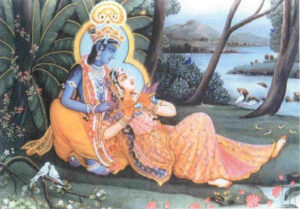
After Kṛṣṇa had departed for Mathurā, the forests of Vṛndāvana seemed empty and still. The sound of His flute no longer echoed through the trees, and every leaf, every breeze, longed for His return.
Śrīmatī Rādhārāṇī, overwhelmed by separation, wandered restlessly through the groves with Her sakhīs, searching for any sign of Her beloved.
“Perhaps He hides in the bowers near Govardhana,” She said, Her voice trembling. “Maybe He is playing by the Yamunā’s bank or resting beneath the kadamba trees.”
But Kṛṣṇa was nowhere to be found. Every place reminded Her of Him, every scent, every color, every whisper of the wind.
Mistaking the Reflection
At last, when Rādhārāṇī reached the slopes of Govardhana Hill, She paused beside a still pond. The water, shining like a polished mirror, reflected Her image so clearly that She mistook it for someone else—Her rival, the gentle Candravalī.
Her breath caught as She gazed into the pool. “O Candravalī,” She whispered, “how fortunate I am to see you.”
Her voice softened into sweetness. “Up to now, this day has been filled with sorrow. But seeing you fills me with comfort. Surely Kṛṣṇa has held you in His arms many times. Quickly, water my thirsty soul by wrapping those arms—still fragrant with His flower garlands—around my neck.”
Her sakhīs stood silently behind Her, their eyes glistening with tears. They knew She was speaking not to another gopī but to Her own reflection, blinded by love and longing.
Love Beyond Rivalry
In this tender moment, the essence of Vṛndāvana’s love was revealed. Even toward Her supposed competitor, Rādhārāṇī felt only affection. Her heart was so vast that even jealousy became transformed into compassion. She did not curse or resent Candravalī; instead, She yearned for union with Kṛṣṇa so deeply that She welcomed even the trace of His presence through another.
As Śrīla Rūpa Gosvāmī describes in Lalita Mādhava (9.44):
“O Candravalī, how fortunate I am to see you. Up to now, it has been a most inauspicious day. How many times Kṛṣṇa held you tightly in His arms! Quickly, water my thirsty soul by wrapping your arms—still carrying the fragrance of His flower ornaments—around my neck.”
Such is the nature of divine love—it knows no hatred, no boundary, no division. In separation, even the reflection of one’s rival becomes sacred, for it reminds the heart of the beloved.
The Hidden Lesson
Indradyumna Swami reflected: this pastime shows the depth of mahābhāva—the highest stage of love, which belongs solely to Śrīmatī Rādhārāṇī. In that love, there is no ego. The soul becomes fully absorbed in the beloved, so much so that the distinction between “me” and “you” disappears.
Even envy, the greatest disease of the heart, cannot survive in such purity. Where ordinary love divides, transcendental love unites all opposites.
Śrīla Prabhupāda once said, “Your love for me will be shown by how you cooperate when I am gone.” In the same way, the gopīs’ love for Kṛṣṇa is proven by how they support and console one another in His absence.
Reflection
When we feel envy or rivalry, we should remember Rādhārāṇī’s example. The spiritual heart expands by blessing others, not by competing with them. In divine love, there is no “other”—only Kṛṣṇa, appearing through every soul, every reflection, every circumstance.
Prayer
O Śrīmatī Rādhārāṇī,
May my heart mirror Yours—
So vast that even my rivals become my friends,
So pure that every reflection reminds me of Kṛṣṇa.
Let all envy dissolve into love,
And may I see only the beauty of Your devotion in everyone.
Origin: From Indradyumna Swami’s lecture “Vṛndāvana Is Such a Nice Place – Yāvat Part 4,” referencing Lalita Mādhava (9.44) by Śrīla Rūpa Gosvāmī.