The Village of Yāvat
Nestled three kilometers northeast of Nandagrāma lies the peaceful village of Yāvat, home to Abhimanyu, his mother Jaṭilā, and his sister Kuṭilā. Though simple in appearance, this village holds one of the most profound mysteries of divine love in Vraja.
Here, Śrīmatī Rādhārāṇī is said to have “married” Abhimanyu — yet, as the ācāryas reveal, this marriage was a divine illusion orchestrated by Śrī Kṛṣṇa Himself.
Śrīla Rūpa Gosvāmī and Śrīla Sanātana Gosvāmī glorify Yāvat as the sacred stage upon which the Parakīyā-rasa, the transcendental mellow of paramour love, is eternally enacted — where Rādhā and Kṛṣṇa’s love shines most brightly through separation and secrecy.
The village’s temple, Śrī Rādhā-Kānta Mandira, stands as a living witness to these divine pastimes.
The Divine Expansion
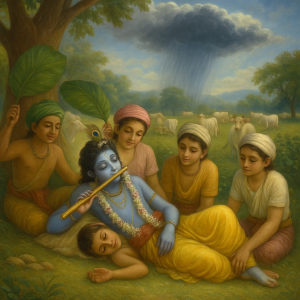
To understand this mystery, we must return to a moment described in the Śrīmad-Bhāgavatam. When Lord Brahmā once stole all the calves and cowherd boys of Vṛndāvana, Lord Kṛṣṇa, desiring not to alarm the Vrajavāsīs, expanded Himself into exact replicas of every calf and cowherd boy.
He became each of them perfectly — with their speech, gestures, and habits — so much so that no one in Vraja perceived any difference. But something extraordinary occurred: the love of the Vrajavāsīs for their “children” increased immensely.
Śukadeva Gosvāmī explains that this happened because every parent was now loving Kṛṣṇa Himself in the form of their own child. For Kṛṣṇa is the Supersoul in every heart, the ultimate object of all affection.
Thus, all the mothers of Vraja — cows and gopīs alike — experienced the rarest sweetness: loving Kṛṣṇa as their own child.
The Year of Divine Marriages
During that mystic year, Kṛṣṇa wished to bless another group of devotees — the younger gopīs, who had prayed to Him during the Kātyāyanī-vrata to become their husband.
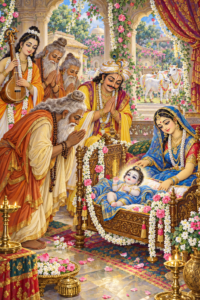
Kṛṣṇa said to Nanda Mahārāja, “Father, this year is most auspicious for marriage. Let us arrange weddings for the young cowherd boys and girls.”
Nanda Mahārāja consulted with Paurnamāsī Devī, the wise guide of Vraja. She confirmed, “Yes, indeed. These marriages will bring great fortune.”
Thus, that year, the gopas and gopīs were married in joyful ceremonies. Yet no one knew that every “gopa” groom was actually Kṛṣṇa Himself, who had expanded into their forms.
The gopīs, though outwardly marrying different boys, inwardly felt the presence of Kṛṣṇa — for their beloved had fulfilled their desire in a way beyond imagination.
The Marriage of Rādhā and “Abhimanyu”
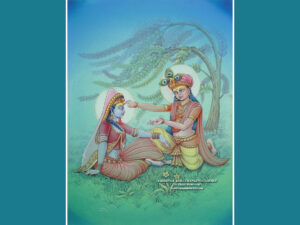
Among these marriages was that of Śrīmatī Rādhārāṇī to Abhimanyu, a cowherd boy of Yāvat. But the ācāryas explain a secret known only to the divine:
At that time, the real Abhimanyu was in a mystic slumber in Brahmaloka — and the “Abhimanyu” who married Rādhārāṇī was none other than Kṛṣṇa Himself, expanded into that very form.
For one full year, the Lord, disguised as Abhimanyu, lived in Yāvat, thus fulfilling the gopīs’ prayers that Kṛṣṇa would become their husband. Rādhārāṇī, though outwardly married, was in truth united with Kṛṣṇa Himself.
The entire drama was Kṛṣṇa’s divine arrangement — a play of love designed to deepen the sweetness of separation and the thrill of meeting in secret.
The Revelation of the Mystery
When the year ended, Lord Brahmā realized his offense and returned the stolen calves and cowherd boys to Vṛndāvana.
As Kṛṣṇa withdrew His expansions, the true boys and calves awoke, unaware that a full year had passed. Abhimanyu, too, returned from his mystic sleep, taking up his role as the apparent husband of Rādhārāṇī — unaware that for a full year, Kṛṣṇa Himself had lived in his form.
The sages explain that Abhimanyu is merely Kṛṣṇa’s shadow, existing only to intensify the sweetness of Rādhā and Kṛṣṇa’s love. Likewise, Jaṭilā and Kuṭilā — Abhimanyu’s mother and sister — exist as loving obstacles, meant to protect the secrecy of the Divine Couple’s meetings and to heighten the rasa of their union and separation.
In this way, every soul in Yāvat — whether opposing or assisting — serves the same purpose: to glorify the supreme love between Rādhā and Kṛṣṇa.
The Hidden Meaning
This pastime reveals the supreme truth of Parakīyā-rasa, the mood of divine paramour love — a love that transcends social and material conventions.
In the material world, such love would be cause for suffering, but in the divine realm of Vraja, it is the highest expression of pure devotion — love that seeks nothing but the joy of Kṛṣṇa.
By becoming even the “husband” of His own beloved, Kṛṣṇa shows that He alone fulfills every relationship — friend, son, husband, and beloved. He is the all-attractive center of every heart.
Lessons to Be Learned
- Kṛṣṇa fulfills every desire of His devotees, yet in ways that deepen their love and humility.
- Divine love transcends worldly norms — it is governed by pure selfless devotion, not social rules.
- Every role in Vraja — even those that seem opposing — serves Kṛṣṇa’s divine purpose.
- Separation enhances love. The obstacles in Rādhā and Kṛṣṇa’s path only make Their union more intense and eternal.
Reflections
The mystery of Abhimanyu’s marriage to Rādhā is not a tale of illusion but of revelation. It shows how the Lord Himself plays every role to fulfill the hearts of His devotees.
In our spiritual life, we too may not recognize Kṛṣṇa’s hand in all circumstances. Sometimes He appears as the giver, sometimes as the taker, sometimes even as the obstacle — yet behind every disguise, it is He who orchestrates the growth of love in our hearts.
Just as Rādhārāṇī’s apparent bondage in Yāvat became the stage for the purest expression of love, so too can our limitations become holy when offered to Him.
Prayer
O Śrīmatī Rādhārāṇī, divine queen of Yāvat, who transforms every circumstance into an offering of love, please teach me to see Kṛṣṇa’s hand in all things.
O Śrī Kṛṣṇa, who became even Your own shadow to fulfill the longing of Your devotees, please expand Yourself within my heart, so that every relationship and every breath may serve You.
May I learn to love You not for my happiness but for Yours, as You loved Your devotees in Vraja — perfectly, playfully, and eternally.
Origin of the Story
Based on Śrīmad-Bhāgavatam 10.13–10.14 (Brahma-vimohana-līlā), and explained by the Gauḍīya ācāryas — particularly Śrīla Viśvanātha Cakravartī Ṭhākura, Śrīla Rūpa Gosvāmī, and Śrīla Sanātana Gosvāmī