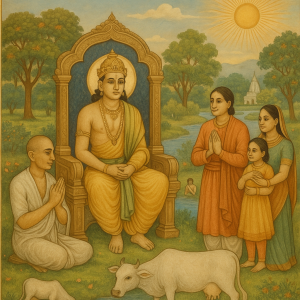
The Distress of the Devas
During a cosmic age, the Devas, the demigods responsible for universal administration, lost their strength due to a curse and the rising power of the Asuras (demons). Weakened and anxious, they approached Lord Viṣṇu, the eternal master of all beings, seeking His shelter.
Lord Viṣṇu, the all-compassionate, advised:
“To regain your strength, churn the Ocean of Milk. From it will emerge amṛta, the nectar of immortality. Cooperate with the Asuras temporarily for this task, and I shall protect and guide you.”
Thus began the most famous event in cosmic history: Samudra Manthana, the churning of the Kṣīra-sāgara (Ocean of Milk).
The Grand Cooperation and Churning
The Mandara Mountain was used as the churning rod, and the mighty serpent Vāsuki as the rope. The Devas pulled from one side, the Asuras from the other. When the mountain began to sink, Lord Viṣṇu assumed His Kūrma (Tortoise) incarnation, bearing the weight of the mountain on His divine back.
As the churning proceeded, many celestial treasures appeared—Kāmadhenu, the wish-fulfilling cow; Airāvata, the white elephant; Uccaiḥśravā, the divine horse; Lakṣmī-devī, the goddess of fortune, and many others.
The Deadly Emergence of Hālāhala
But suddenly, from the depths of the ocean emerged a terrible poison called Hālāhala, spreading its deadly fumes throughout the cosmos. The Devas, Asuras, sages, and all beings became terrified. Even the powerful Viṣṇu expansions stood aside, watching the universal distress unfold as part of the Lord’s divine arrangement.
At that moment, everyone rushed to Lord Śiva, the topmost Vaiṣṇava and servant of Viṣṇu.
Śiva Accepts the Service of Protection
Seeing the suffering of the universe, Lord Śiva, out of compassion and devotion to Lord Viṣṇu’s plan, stepped forward to accept the task of absorbing the poison.
Pārvatī-devī, his divine consort, stood by him, concerned for his safety. Śiva, fully surrendered, prayed within his heart to Lord Viṣṇu, begging for strength to fulfill this role in service.
With steady resolve, Śiva gathered the poison in his palm and drank it, all the while meditating on the Supreme Lord. He did not digest the poison but held it in his throat, which turned deep blue from its potency. Thus, he became known as Nīlakaṇṭha, the blue-throated one.
This act was not a show of independence, but a supreme act of devotional sacrifice, executed to assist Lord Viṣṇu in preserving the cosmic order.
Pārvatī’s Protective Gesture
Seeing the intense reaction of the poison, Pārvatī placed her hand gently on Śiva’s throat, stopping the poison from descending further into his body. This protective act is symbolic of the unity of Śakti and Bhakti, feminine power assisting devotional service.
Peace Is Restored
The deadly fumes were neutralized. The cosmos was saved. The Devas, with tearful eyes and folded palms, glorified Lord Viṣṇu for empowering His servant, Lord Śiva, to carry out this sacrifice.
Śiva, ever humble, simply bowed his head to the lotus feet of Lord Nārāyaṇa.
Lessons to Be Learned:
- Lord Viṣṇu is the ultimate protector, and He empowers His devotees to assist in His divine work.
- Śiva’s greatness lies not in his power, but in his humility, service, and unflinching devotion to Viṣṇu.
- Real strength is seen in the willingness to absorb suffering for the good of others—not for fame but out of love for the Supreme Lord.
- The Lord always protects His devotees—Śiva survived the poison because of Viṣṇu’s shelter and Pārvatī’s love.
- This pastime teaches that Vaikuṇṭha is maintained by love and service, not by pride or control.
Origin of the Story: Liṅga Purāṇa – Part 1, Chapters 13–15