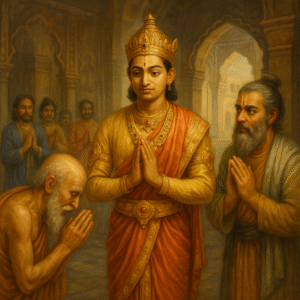
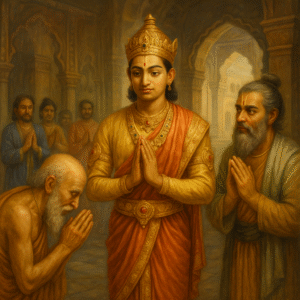
In the southern land of Bhārata, many great devotees appeared to glorify the Supreme Lord. Among them shone the noble Yamunācārya—also known as Ālabandāra, “the Conqueror.” He was the grandson of the revered Nathamuni, the compiler of the songs of Nammālvār and a mystic adept in yoga. Nathamuni’s son, Īśvaramuni, and his wife, after visiting the holy places of India, were blessed with a son whom Nathamuni named Yamuna, after the sacred river of Vṛndāvana.
But soon after, fate struck—the boy’s father, Īśvaramuni, passed away. Stricken with grief, Nathamuni renounced worldly life and took sannyāsa, leaving little Yamuna to be raised by his widowed mother and aged grandmother in great poverty.
When Yamunācārya was five, he began studying under the scholar Bhāṣyacārya. His brilliance and gentle nature quickly won his teacher’s affection, and by twelve years of age, the boy was already recognized as the foremost student of the school.
In those days, India’s learned scholars would travel from court to court, engaging in śāstrārtha—public debates of Vedic wisdom—to establish their superiority. In Madurai, the capital of the powerful Pāṇḍya kings, there lived a scholar named Kolāhala. Favored by the king, Kolāhala had defeated every opponent in debate. The king, proud of his court scholar, decreed that any scholar who lost to Kolāhala must pay him an annual tax, or else face death.
Bhāṣyacārya, though a humble and learned man, had also been defeated by Kolāhala and had been unable to pay the tax for two years. One day, while Bhāṣyacārya was away and the other students had gone home, Yamunācārya remained alone in the school. At that time, a disciple of Kolāhala arrived to collect the unpaid tax.
“Where is your teacher?” he demanded arrogantly.
Yamuna, always gentle, replied respectfully, “May I know, sir, who has sent you here?”
“What insolence!” sneered the messenger. “Do you not know that I am a disciple of the greatest scholar in all of India—Kolahala, the terror of all other panditas? Even the Pāṇḍya king bows before him. Your teacher has withheld payment for two years—has he gone mad? Or does he wish to challenge my master again, like a moth flying into a flame?”
Though Yamuna was mild by nature, his love and respect for his guru were deep. Hearing his teacher insulted in such a manner, the boy’s heart blazed with righteous anger. “How foolish you are—and your teacher as well!” he retorted. “Who but the greatest fool would train a disciple in such pride rather than humility? My noble teacher would not stoop to argue with such a man. Go tell your master that the lowest disciple of Bhāṣyacārya challenges him to a debate. If he dares to face me, let him send his reply at once!”
The messenger stood dumbfounded at the boy’s boldness, then left in a fury to report to his teacher.
Lessons to Be Learned
- True devotion expresses itself through humility and courage. Even as a boy, Yamunācārya showed that a devotee’s humility does not mean weakness. When sacred truth or the honor of one’s spiritual teacher is at stake, courage is also a form of service.
- Spiritual learning is not measured by age or position. The wisdom of a twelve-year-old devotee can surpass the pride of worldly scholars, for real knowledge arises from purity of heart, not academic titles.
- Pride blinds even the learned. Kolāhala’s arrogance turned knowledge into vanity. In contrast, Yamuna’s learning was filled with reverence, compassion, and surrender to truth.
Reflections
A devotee’s strength comes not from power or prestige but from surrender. Yamunācārya’s bold words were not born of pride but of devotion to his guru and the Lord’s truth. Śrīla Prabhupāda often reminded that humility is not cowardice; rather, real humility stands firm against falsehood. When the world mocks dharma, the pure heart of a devotee becomes the voice of divine courage. Like young Yamuna, may we defend spiritual truth not with aggression, but with faith, purity, and divine conviction.
Source:
The Life of Ramanujacarya by Naimisaranya Dāsa, Chapter One: “Yamunācārya – The Challenge.” Published by the Bhaktivedanta Book Trust, 1986.