When Kolāhala’s messenger returned to Madurai and told him of the boy’s daring challenge, the scholar laughed aloud. “A twelve-year-old child wants to debate with me? Very well, let us see what his foolish pride will bring him.”
But the king of the Pāṇḍyas was intrigued. “If this boy is truly so confident, let us summon him,” he said. “Send a royal messenger and bring him here to face Kolāhala before the court.”
The messenger went to Yamunācārya’s small school and delivered the royal command. Yamuna replied respectfully, “If His Majesty truly wishes me to debate his great scholar, then it is only proper that a royal conveyance should bring me to the palace. I am but a humble student, not a wandering brāhmaṇa disputant.”
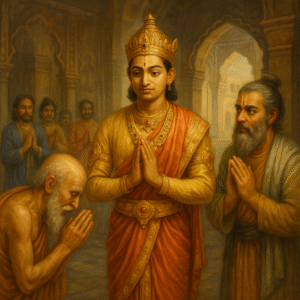
When this reply reached the palace, the king and his courtiers agreed that the boy’s answer showed dignity and intelligence. A splendid palanquin, accompanied by one hundred soldiers, was dispatched to escort Yamunācārya to the royal court.
News spread quickly throughout Madurai. People were astonished that a mere boy dared to challenge the formidable Kolāhala, whose fame as a debater filled the land. Crowds gathered along the streets to see the boy as he was carried in royal procession to the palace. The brāhmaṇas who had been humiliated by Kolāhala blessed the child, saying, “May you crush his pride as Lord Viṣṇu in His dwarf form humbled Bali Mahārāja!”
Meanwhile, a discussion arose in the palace between the king and his queen. The king scoffed, “Just as a cat plays with a mouse, so will Kolāhala defeat this child and destroy him.”
But the queen, more perceptive, replied, “Do not underestimate the spark of divine knowledge. A tiny flame can burn a mountain of cloth to ashes. This boy, I sense, is protected by the Lord Himself.”
The king laughed. “If you truly believe that, then let us make a wager. If the boy fails, you shall serve as the maid of my maidservant.”
“Agreed,” said the queen calmly. “And if he triumphs, then you must give him half your kingdom.”
By the time this unusual wager was made, the palanquin had arrived at the palace gates. Yamunācārya entered the royal assembly hall, radiant and fearless. Kolāhala sneered and, in jest, said to the queen, “Ālabandāra!—the Conqueror—has arrived, is it?”
“Yes,” she replied with a quiet smile. “Ālabandāra indeed. He has come to conquer you.”
Lessons to Be Learned
- Divine courage inspires divine protection.
Yamunācārya’s fearlessness was not arrogance but faith. When one defends truth, the Lord provides strength and shelter. - Wisdom is recognized even by kings.
The boy’s respectful yet intelligent response earned the admiration of rulers and courtiers. True dignity lies in humility joined with insight. - Faith sees what doubt cannot.
The queen’s intuition represents the vision of devotion. Where worldly eyes see only a child, a heart illumined by bhakti perceives the Lord’s hand.
Reflections
This story reminds us that spiritual power is not measured by worldly status, age, or education. It flows through purity of heart and surrender to God’s will. Śrīla Prabhupāda often said that when one stands for Kṛṣṇa, Kṛṣṇa stands beside him. The Lord loves to reveal His glory through the small and the humble, to crush the vanity of the proud. Like the queen, may we learn to recognize divine potential in every sincere soul and rejoice in the victory of truth over arrogance.
Source:
The Life of Ramanujacarya by Naimisaranya Dāsa, Chapter One: “Yamunācārya – Preparations for the Debate.” Published by the Bhaktivedanta Book Trust, 1986.