(Canto 1, Chapter 12: Description of Śrī Nanda’s Festival)
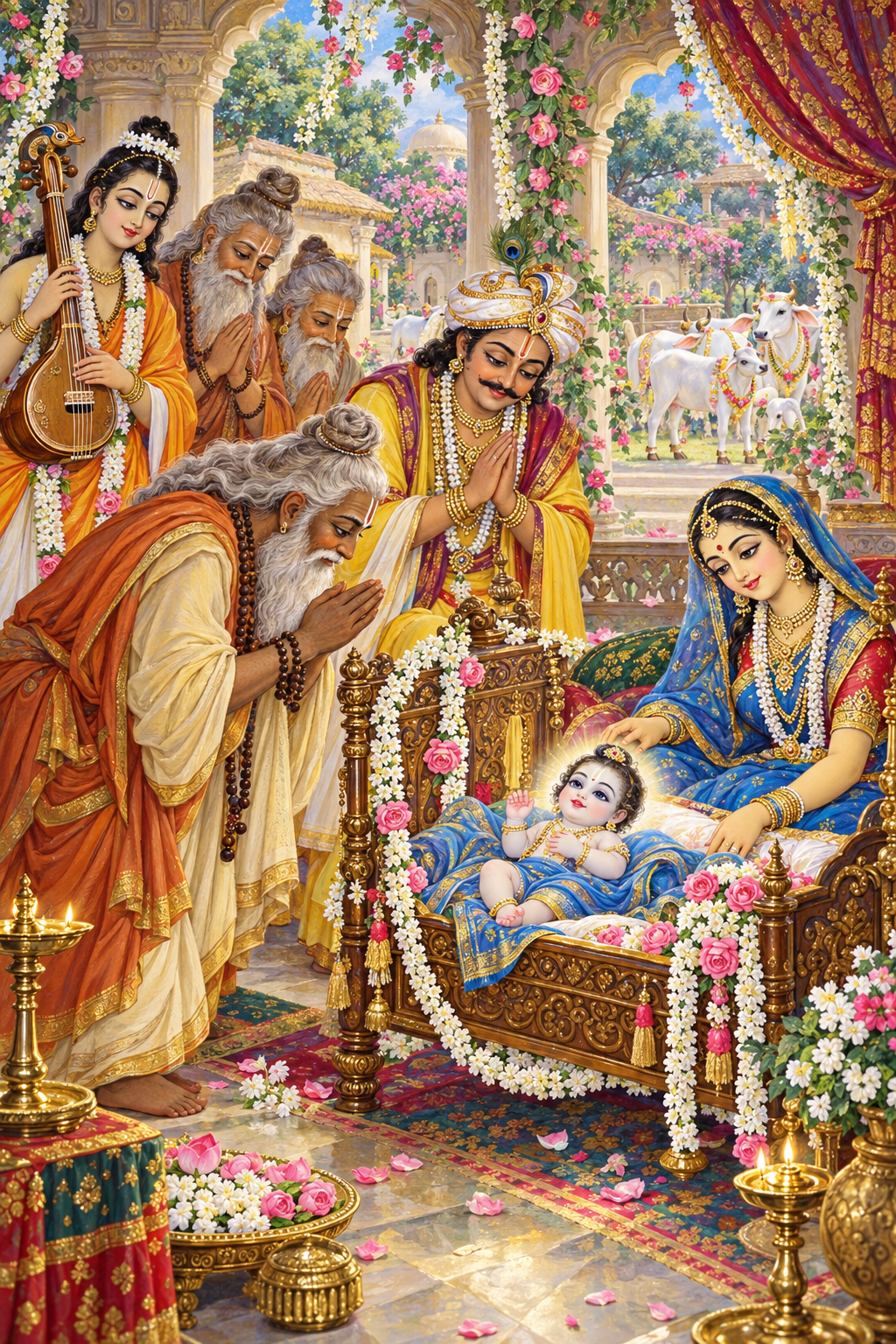
Hearing the happy news of his son’s birth, Nanda called the brāhmaṇas at dawn and had them perform all the auspicious ceremonies. When the traditional birth ceremony had been performed, noble-hearted King Nanda happily gave the brāhmaṇas a hundred thousand cows as dakṣiṇā. With bowed head he also gave them many hills of the seven grains, crowned with jewels and gold. Mṛdaṅgas, vīṇās, conchshells, and kettledrums sounded again and again, singers sang, and dancers danced at the entrance.
Śrī Nanda’s palace was decorated with beautiful, colorful flags, canopies, arched gateways, and golden pots. The highways, footpaths, entrances, walls, courtyards, platforms, pavilions, and assembly halls glistened with drops of fragrant water. The cows were decorated with red cloths, their horns covered with gold, their necks shining with golden necklaces, tinkling with many bells and ornaments. Their tails were yellow, their calves beside them, and they were anointed with turmeric and kuṅkuma and painted with designs in mineral colors. Many bulls, bearers of the principles of religion, decorated with peacock feathers and sprinkled with scented water, shone at Nanda’s door. White calves, adorned with golden necklaces, strands of pearls, and tinkling ornaments on their hooves, leapt here and there.
Hearing of the festival for the birth of a son, King Vṛṣabhānu and Kalāvatī came to Nanda’s palace riding on an elephant. The nine Nandas, the Upanandas, and the six Vṛṣabhānus all came with gifts. Many cowherd men came, their turbans decorated with flower garlands, their hair tied with guñjā beads and peacock feathers, wearing forest garlands and handsome yellow garments, carrying flutes and sticks, and decorated with tilaka. Dancing, singing, and waving their cloths, bearded men came with their sons, bringing many gifts. Elder cowherd men came with sticks in hand, bringing offerings of butter, ghee, milk, and yogurt. Overcome with love, their eyes full of tears of bliss, they talked about the birth festival of the son of the king of Vraja. With tears of joy in his eyes, Nanda honored everyone with tilaka and gifts.
The cowherd men said, “O king of Vraja, O Nanda, what can be more auspicious for a childless man who longs for a son than this festival of a son’s birth? After many days destiny has shown us this day. Gazing at Nanda’s son, our lives have become successful. When you place Him on your lap, fondle Him, and say ‘O my charming one,’ we will be happy.”
Nanda said, “Your pious blessings make me very happy. O cowherd men, I am a servant who obeys the orders of the cowherd men of Vraja.”
Śrī Nārada said: Hearing of the wonderful birth of King Nanda’s son, the gopīs at once abandoned their household duties. Their hearts, minds, and limbs flooded with joy, they rushed to the palace of Vraja’s king with gifts. O king, as they ran from their homes to Nanda’s palace, their garments, ornaments, and hair came loose, and pearls fell on the ground, and they all looked splendidly beautiful. Decorated with tinkling anklets, armlets, golden bangles, necklaces, jewelled earrings, sashes, and bracelets, they shone like a host of full moons.
With gentle strokes they anointed the child’s face with a paste of wheat and barley flour, black mustard, and salt. They gave many blessings, sang, and spoke to Yaśodā: “O Yaśodā, well done! Well done! O queen of Vraja, your fortune is very great, very great! Your noble womb that has given birth to such a son is very, very fortunate! After a long time the Lord has fulfilled your desire. O Lord, please protect this lotus-eyed, sweetly smiling, handsome, dark boy.”
Yaśodā said, “Your kind blessings make me very happy. May you always be very fortunate. O intelligent Rohiṇī, please honor the noble people of Vraja who have come here, and fulfil their desires.” Then fair-complexioned Rohiṇī, splendidly dressed and decorated with jewels, honored the people of Vraja.
When Śrī Kṛṣṇa, the original Supreme Personality of Godhead, came to the village of Vraja, many trumpets sounded and a great cry of “Victory!” arose. The joyful gopas and gopīs sprinkled one another with fresh butter and yogurt. When a large elderly gopa slipped and fell in the mud of yogurt that covered everything inside and outside the houses, everyone laughed.
Then many learned and pure sūtas, paurāṇikas, māgadhas, genealogists, and bards recited many prayers. To each of them Nanda Mahārāja gave a thousand cows and many garments, ornaments, jewels, horses, and elephants. King Nanda, the wealthy ruler of the gopas of Vraja, showered great wealth on the bards and everyone else. Wealth, mystic powers, fame, sense enjoyment, and liberation rolled about on the ground in every home and on every path, and no one had any desire left unfulfilled.
Then, accompanied by me and by the great sages headed by Sanat-kumāra, Kapila, Śukadeva, Vyāsa, Haṁsa, Dattātreya, and Pulastya, Lord Brahmā came there. Four-faced Brahmā, the author of the Vedas, came riding on his swan, wearing a crown and earrings, his complexion golden, filling the directions with light. Lord Śiva came riding on his bull, accompanied by many ghosts and spirits. The sun-god came on his chariot and Indra on his elephant. Lakṣmī came riding on Garuḍa, Durgā on her lion, and the earth goddess in the form of a cow came in an airplane. The sixteen Mātṛkās came on a swing, and the goddess Ṣaṣṭhī came in a palanquin, holding a sword and a club. The rulers of the planets Mars, Mercury, Jupiter, Venus, Saturn, and Rāhu came on their various carriers, splendid as millions of suns, to Nanda’s palace.
Arriving at Nanda’s palace, which was full of the joyful tumult of the gopas and gopīs, the demigods paused for a moment and then entered. Offering obeisances and gazing at Him, they offered many eloquent prayers to Śrī Kṛṣṇa, who, although appearing as a child, was the original Supreme Personality of Godhead. After seeing Lord Kṛṣṇa, Brahmā, the demigods, and the sages were overwhelmed with love and returned happily to their own abodes.
Lessons to be learned
This festival, still celebrated by devotees as Nandotsava, shows the mood of Vraja. The people of Vraja do not see Kṛṣṇa as God. They love Him as their own child and friend. Their love is so natural that they forget everything else. Śrīla Prabhupāda explained that this spontaneous love (rāgānugā-bhakti) is the highest form of devotion.
Nanda Mahārāja, the king, said, “I am a servant of the cowherd men of Vraja.” True greatness is humility. A Vaiṣṇava considers himself the servant of all.
The gopīs ran to see Kṛṣṇa, forgetting their housework and letting their ornaments fall. When the heart is attracted to Kṛṣṇa, everything else becomes secondary.
In Vraja, wealth, mystic powers, fame, sense enjoyment, and even liberation were rolling on the ground, and no one cared to pick them up. Śrīla Bilvamaṅgala Ṭhākura wrote that for one who has pure devotion, liberation stands with folded hands waiting to serve. The residents of Vraja wanted only Kṛṣṇa.
Brahmā, Śiva, Lakṣmī, Durgā, and all the demigods came to see the child. All the great controllers of the universe are servants of Kṛṣṇa, and they came to worship Him as He lay in the home of simple cowherd people.