The Detached Sage of Vṛndāvana
Among the saints who exemplified renunciation and complete absorption in divine remembrance, Śrī Rāmadāsa Bābājī stands like a mountain of detachment. His life was a living scripture — every act, every silence, and every tear from his eyes became a verse of bhakti.
He lived in Vṛndāvana with no possessions, no disciples, and no trace of worldly desire. Yet those who saw him once could never forget his luminous presence — like a lamp that glowed only with the light of devotion.
Early Life and Call to Renunciation
Śrī Rāmadāsa Bābājī was born in Bengal, in a devout family that regularly worshipped Rādhā and Kṛṣṇa. From childhood, he showed signs of spiritual longing that astonished his parents. When other boys played in the fields, he would sit under a tree and chant, gazing at the sky.
Once, during a family festival, a traveling sādhū came to their home and sang songs about Rādhā and Kṛṣṇa’s pastimes. The young Rāmadāsa was so moved that he fainted. When he awoke, he said softly, “I will go to Their land — to Vṛndāvana — and never return.”
His parents tried to dissuade him, but seeing his determination, they blessed him with tears. Thus, at a young age, barefoot and alone, he set out for Vṛndāvana.
Arrival in Vraja and Life of Austerity
When Śrī Rāmadāsa reached Vṛndāvana, he was overwhelmed. He rolled in the dust, crying, “This dust has touched the feet of Kṛṣṇa!”
He chose a solitary spot near Govardhana and built a small hut from straw and branches. His diet was minimal — sometimes only leaves, milk, or water. Yet he was always joyful, for his heart was full of Rādhā-Kṛṣṇa’s remembrance.
He would bathe in Mānasī-gaṅgā, chant beneath a kadamba tree, and spend hours in silent meditation. At times he sang with tears streaming down his face. Villagers often saw him dancing alone under the moonlight, his voice trembling with the words — “Rādhe! Rādhe!”
His Compassion and Humility
Despite his intense renunciation, Śrī Rāmadāsa’s heart overflowed with compassion. He often said, “There is no sinner in this world — only souls who have forgotten their Beloved.”
When beggars or animals came near his hut, he shared whatever he had. If he had no food, he would simply chant over water and give it to them as prasāda. Once, when he had gone without food for three days, a poor widow arrived seeking alms. He gave her the only thing he had — his own blanket. “Better I shiver,” he said, “than let another feel cold in Rādhā’s land.”
His Inner Visions and Bhajana
Śrī Rāmadāsa Bābājī’s bhajana was not an external practice — it was a river flowing constantly within his heart. Often, he would speak to the trees and flowers, calling them “my silent friends who have seen Rādhā-Kṛṣṇa’s games.”
Once, while chanting near Kusuma-sarovara, he fell into a trance. For hours he sat motionless, smiling. Later he told a devotee, “I saw Rādhā and Kṛṣṇa walking hand in hand. Rādhā looked at me and smiled. That smile has burned my world to ashes — I want nothing else.”
At night, villagers sometimes heard sweet flute melodies coming from his direction. When they came close, they saw no one — only the soft glow of a lamp in his hut and the sound of his weeping in love.
The Lesson of True Renunciation
Once a wealthy man from Calcutta came to see him and said proudly, “Bābājī, I have renounced everything — I have given up my house, my business, my wealth.”
Śrī Rāmadāsa smiled and asked, “Have you given up the thought that you have renounced?” The man bowed in silence, realizing that true renunciation meant freedom not from objects but from the ego that claims ownership.
Final Days and Divine Departure
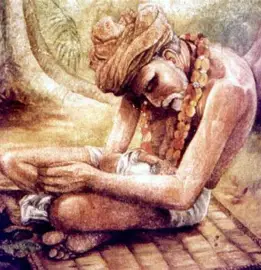
As he grew old, Śrī Rāmadāsa Bābājī’s body became frail, but his voice grew stronger. He spent his final days sitting near Rādhā-kuṇḍa, chanting with closed eyes and a blissful smile.
One dawn, after a night of deep chanting, he called the devotees who served nearby and said, “Rādhā has come. I must go.” He bowed down to Rādhā-kuṇḍa, placed some dust upon his head, and sat in meditation. Gradually, his chanting stopped — and so did his breath.
The fragrance of jasmine spread through the air, and those who came near his body felt an unearthly peace. They placed his body in samādhi beside the kuṇḍa, where even today devotees bow and feel his living presence.
Reflection
Śrī Rāmadāsa Bābājī’s life teaches that true detachment is not dry renunciation but the overflowing of divine love. When the heart becomes full of Rādhā and Kṛṣṇa, the world’s attractions fade naturally.
He lived like a man of ashes, yet within him burned the fire of eternal love. His humility shattered pride, his silence spoke volumes, and his compassion reflected the boundless mercy of the Divine Couple.
He reminds us that spiritual life is not escape but immersion — immersion in remembrance, service, and love beyond the boundaries of self.
Prayer
O Śrī Rāmadāsa Bābājī,
May your simplicity enter our hearts,
May your detachment awaken our love.
Teach us to serve without claiming,
To love without expecting,
To see every soul as a spark of Rādhā-Kṛṣṇa’s play.
Let our hearts become huts of peace,
Our breath a garland of holy names,
Our life a quiet song of remembrance.
May we, like you, depart smiling,
Hearing the whisper of Rādhā’s call in the wind.
Source: The Saints of Vraja