The Saint Who Became the Scripture He Loved
Among the holy men of Rādhā-kuṇḍa whose lives glowed with realization, Śrī Bhagavata Dāsa Bābājī was a living embodiment of the Śrīmad-Bhāgavatam. His every word reflected the purity of the scripture, and his every action sang the verses he loved.
He was called “Bhagavata Bābājī” because he lived and breathed only for the Bhāgavatam. To him, it was not a book but a living presence — Śrī Kṛṣṇa speaking eternally to His devotee’s heart.
Early Life and Renunciation
Born in Bengal in a humble Vaiṣṇava family, Bhagavata Dāsa showed from childhood an intense attraction to the holy name. When his friends played games, he preferred to sit near a small temple, chanting on tulasī beads and listening to elders recite from the Bhāgavatam.
His father was a simple householder who loved his son deeply. One day, seeing young Bhagavata absorbed in hearing kīrtana, he asked, “My child, what do you wish to become when you grow up?” The boy replied with folded hands, “I wish to become the servant of the Bhāgavatam.”
Years passed. When his parents arranged his marriage, he gently declined, saying, “I am already married — to the sound of Kṛṣṇa’s name.” Soon after, he left home and walked barefoot to Vṛndāvana.
His Life at Rādhā-kuṇḍa
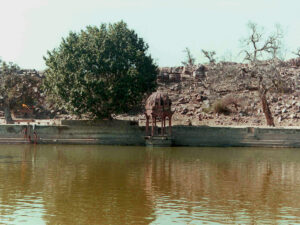
At Vṛndāvana, he visited many holy places and met several saints before finally settling at Rādhā-kuṇḍa, where he remained for the rest of his life. He built a small mud hut near the sacred water and spent his days chanting and studying the Bhāgavatam.
Every morning before sunrise, he would bathe in the kuṇḍa, apply tilaka, and sit cross-legged with his worn copy of the Bhāgavatam before him. He never began reading without first offering prayers:
“O Bhāgavatam, embodiment of divine love, may you dwell forever in my heart. Through you, may I see Kṛṣṇa everywhere.”
He read not for knowledge, but for transformation. As he read, tears often rolled down his cheeks. Sometimes he would close the book and say, “I can no longer read — Kṛṣṇa has come out of these pages and entered my heart.”
His Character and Simplicity
Bhagavata Dāsa Bābājī’s life was one of extreme simplicity. He owned nothing beyond a single white cloth, a clay water pot, and his Bhāgavatam.
He lived only on madhukarī — whatever food came from devotees. Often, he would give away even that to others and go hungry himself. When questioned about his austerity, he would say with a smile, “I am nourished by the words of the Bhāgavatam — they are sweeter than milk and rice.”
He avoided fame and would hide whenever visitors came to praise him. Once, a rich man offered him a large donation, but Bhagavata Dāsa refused, saying, “I am rich already. I possess that which even kings cannot buy — the remembrance of Kṛṣṇa.”
His Relationship with the Bhāgavatam
Bhagavata Dāsa Bābājī would read the Bhāgavatam aloud every day for several hours. When asked why he read the same verses again and again, he replied, “Because each verse opens a new window to Kṛṣṇa. The same sun rises daily, yet its beauty never fades — so it is with the Bhāgavatam.”
He treated his worn manuscript with reverence. He would not allow anyone to touch it without bathing first. When a devotee once accidentally touched the book with unwashed hands, Bhagavata Dāsa bowed to it and begged forgiveness, saying, “O Bhāgavatam, forgive the offense of this ignorant child. You are Kṛṣṇa’s own body.”
His Vision of the Lord
Once, during the month of Kārtika, while reciting the Tenth Canto describing Rāsa-līlā, Bhagavata Dāsa entered a deep trance. He sat motionless for hours, and a soft glow appeared around him.
When he returned to external consciousness, he whispered, “I saw Him — Śyāmasundara, dancing in the moonlight with the gopīs. The Bhāgavatam itself became Vṛndāvana before my eyes.”
From that day onward, he spoke very little. He said, “I have no need to speak — every verse now sings within me.”
The Final Chapter of His Life
In his final days, Bhagavata Dāsa Bābājī was too weak to read. He would rest his hand gently on the Bhāgavatam and chant softly. When asked if he wished someone to read to him, he replied, “No need — the verses rise within me on their own.”
On the last morning of his life, he bathed in Rādhā-kuṇḍa, returned to his hut, and placed the Bhāgavatam on his chest. He chanted the holy name until his breath slowly faded. When devotees came, they found his body still warm and fragrant, his lips curved into a faint smile.
They placed his body in samādhi beside his beloved Bhāgavatam, saying, “He has become one with the book he loved.”
Reflection
Śrī Bhagavata Dāsa Bābājī’s life reveals that the Bhāgavatam is not a scripture to be studied but a living person to be served. He embodied the verse:
“nityaṁ bhāgavata-sevayā — by constant service to the Bhāgavatam, all impurities of the heart are destroyed.”
(Śrīmad-Bhāgavatam 1.2.18)
In an age where spiritual life is often confused with intellect or show, his example shines like a lamp — showing that love, not learning, is the real fruit of scripture.
His life teaches us to make the holy word our companion, to hear with the heart, and to let the name of Kṛṣṇa echo within our souls until we too become living Bhāgavatams.
Prayer
O Śrī Bhagavata Dāsa Bābājī,
Embodiment of devotion and humility,
You made the Bhāgavatam your body, heart, and soul.
May your spirit awaken in us the thirst to hear,
May your purity wash our hearts clean,
May the holy verses dwell forever within our minds.
Teach us to read not with eyes but with love,
To chant not with lips but with life,
And to live as you lived —
As servants of the eternal Word of God.
Source: The Saints of Vraja