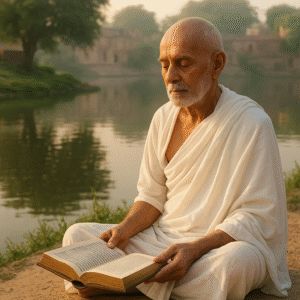
The Hidden Saint of Sevā-kuñja
Śrī Jagadānanda Dāsa Bābājī was one of the most humble and inwardly realized saints who lived near Sevā-kuñja in Vṛndāvana. He lived quietly, unknown to the world, absorbed constantly in the remembrance of Śrī Śrī Rādhā-Govinda and Their intimate service.
Unlike many saints whose spiritual greatness became widely known, he avoided even the faintest trace of recognition. He preferred to live as a shadow — known only to Kṛṣṇa and Rādhā.
Early Life and Inner Calling
Born in Bengal to a devout Vaiṣṇava family, Jagadānanda Dāsa showed signs of renunciation from an early age. His father, a pious brāhmaṇa, often found him chanting on tulasī beads late into the night.
Once, when asked why he did not play with other children, the boy replied softly, “They play with clay, but I play with Kṛṣṇa’s name.”
As he grew, his attraction to the holy name deepened into tears of longing. He spent hours reading the lives of the Gosvāmīs and praying to follow in their footsteps. Finally, he left home and came to Vṛndāvana, where he took shelter at Sevā-kuñja — the sacred grove where Rādhā and Kṛṣṇa perform Their most confidential pastimes.
Life in Vṛndāvana
In Vṛndāvana, Jagadānanda Dāsa Bābājī built a small mud hut close to Sevā-kuñja. He owned nothing except a water pot, a japa-mālā, and a torn copy of the Śrīmad-Bhāgavatam. His daily routine was austere but filled with sweetness.
Before sunrise, he would bathe in Yamunā, chant until midday, and then sit in meditation on the divine līlās of Rādhā and Kṛṣṇa. In the afternoon, he would perform simple services for visiting Vaiṣṇavas — cleaning their vessels, fetching water, or collecting flowers for worship.
He never preached, never accepted disciples, and rarely spoke. When asked why, he would reply, “I am still learning to listen to Rādhā’s footsteps — how can I speak before hearing?”
His Bhajana and Realizations
Jagadānanda Bābājī was known for his deep practice of smaraṇa, meditation on the eightfold daily pastimes (aṣṭa-kālīya-līlā) of Rādhā and Kṛṣṇa.
Sometimes, during kīrtana, he would fall unconscious, tears streaming down his face, his lips murmuring, “Śyāma… Śyāma…”
On one such occasion, devotees carried him to his hut, fearing he might have died. After a long while, he opened his eyes and whispered, “I was with Them — Rādhā was smiling, Kṛṣṇa was playing His flute. Why did you call me back?”
From that day, he became even more withdrawn, living almost entirely in divine absorption.
His Compassion and Hidden Mercy
Though he avoided fame, his compassion was boundless. Poor villagers often came to him for blessings. He never gave elaborate instructions — only a few words: “Chant sincerely, serve humbly, and wait for His mercy.”
Once, a young man suffering from despair came to him, saying, “Bābājī, my mind is restless and full of sin. Please save me.” Jagadānanda smiled faintly and said, “Throw your mind into the dust of Vṛndāvana. It will become clean there.”
The young man later testified that from that day, his heart felt lighter, and his faith returned.
His Relationship with the Holy Name
To Jagadānanda Dāsa Bābājī, the holy name was everything — the beginning, the path, and the goal. He once said, “If the name is taken with sincerity, it will one day reveal the speaker of that name.”
His chanting was not mechanical. Each name was a call, a cry, a conversation. Those who heard him said his voice carried both pain and sweetness — the pain of separation and the sweetness of love.
When someone asked how he maintained his joy in such poverty, he replied, “Because I am rich with remembrance. Every bead of my japa is a jewel; every name is a treasure.”
His Final Days
As age advanced, his body became frail, but his devotion only deepened. He stopped eating solid food and lived on a few drops of Yamunā water and constant chanting.
One evening, after sunset, he was found sitting in his hut, chanting softly. When a devotee came to offer him some milk, he smiled and said, “No more. Tonight Rādhā will come. She promised.”
At dawn, when the devotees returned, they found him sitting upright, his eyes half closed, his japa-mālā resting in his lap. A faint fragrance, like that of fresh kadamba flowers, filled the room. Jagadānanda Dāsa Bābājī had entered the eternal Sevā-kuñja of his meditation.
Reflection
Śrī Jagadānanda Dāsa Bābājī’s life was a song of silence — the silence of one who has already spoken to God.
He teaches that bhakti is not display but disappearance — not to show devotion, but to dissolve the ego in it. In his stillness, we hear the sound of divine intimacy.
He reminds us that true meditation is not escape from the world but entry into God’s heart — to live in the same world, yet see only Kṛṣṇa everywhere.
Prayer
O Jagadānanda Dāsa Bābājī, hidden saint of Sevā-kuñja,
Whose silence spoke more than a thousand words,
Whose eyes beheld Rādhā and Kṛṣṇa beyond illusion,
Teach us to listen before we speak,
To remember before we act,
To serve before we seek recognition.
May your simplicity be our strength,
Your humility our ornament,
And your remembrance our doorway to eternal Vṛndāvana.
Source: The Saints of Vraja, Vṛndāvana Saints Anthology, oral accounts from Gauḍīya Vaiṣṇava tradition.