The Desire of the Lord
The Śrīmad-Bhāgavatam declares that Śrī Kṛṣṇa is svayam bhagavān—the Supreme Personality of Godhead Himself. All other incarnations—Rāma, Nṛsiṁha, Vāmana, and others—are but partial manifestations of His divine essence. Similarly, Vraja, the eternal abode of Kṛṣṇa, is svayam dhāma, the original and complete transcendental realm, while all other holy abodes are its partial reflections.
Just as the mādhurya (sweetness) of Kṛṣṇa surpasses the beauty and charm of His other incarnations, the mādhurya of Vraja surpasses the sweetness of all other sacred places. Therefore, even the Lord’s own manifestations in other dhāmas sometimes feel an irresistible longing to experience the sweetness of Vraja.
More than two hundred years ago, such a divine longing arose in the mind of Lord Jagannātha of Purī.
The Lord’s Desire to Go to Vṛndāvana
Lord Jagannātha resides in Purī in His mūrti (deity form). Though appearing as wood, the mūrti is the Lord Himself, yet He accepts dependence upon His devotee to enjoy loving service. This descent of the Lord into the deity form is an act of both divine self-fulfillment and compassion.
It is self-fulfillment, because through this form the Lord experiences the joy of His devotee’s love. And it is compassion, because by accepting service, He opens the door of liberation for the devotee bound by Māyā.
Although outwardly resembling a statue, the mūrti is spiritually identical to the Lord, differing only by its voluntary dependence upon the love of the devotee.
Jagannātha Chooses His Devotee
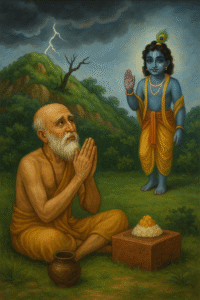
Jagannātha desired to go to Vṛndāvana, but He needed a devotee who could carry Him there and lovingly serve Him. Soon, His compassionate glance fell upon Haridāsa, a saint absorbed in bhajana on the banks of the Yamunā in Vṛndāvana. Haridāsa worshipped Jagannātha intensely, weeping day and night for His darśana.
One day, Jagannātha appeared before him in His resplendent form. Haridāsa was so overwhelmed by the Lord’s beauty that he stared in wonder until he fainted. The merciful Lord touched his head with His lotus hand, reviving him.
Upon awakening, Haridāsa fell at His feet in ecstasy. Lord Jagannātha said with affection,
“Haridāsa! I am pleased with your devotion and long for your loving service. Go to Jagannātha Purī. This year, in the month of Āṣāḍha, My image will be replaced. Bring My old form to Vṛndāvana, install Me here, and serve Me.”
Having spoken thus, Jagannātha disappeared.
Haridāsa, heartbroken at the disappearance of his Lord, fainted again. When he awoke, he remembered the divine command and began preparing for his journey to Purī.
The Journey to Purī
In those days, there were no railways or carriages. Haridāsa, accompanied by some disciples, traveled on foot, crossing dense forests and rivers, constantly singing the glories of the Lord.
When he reached Jagannātha Purī, a grand festival was underway. After thirty-six years, the replacement of Jagannātha’s wooden form was to take place because two consecutive months of Āṣāḍha had fallen together—a rare occurrence. Millions of pilgrims from across India had gathered, filling the city with divine celebration and joy.
Haridāsa’s Plea to the King
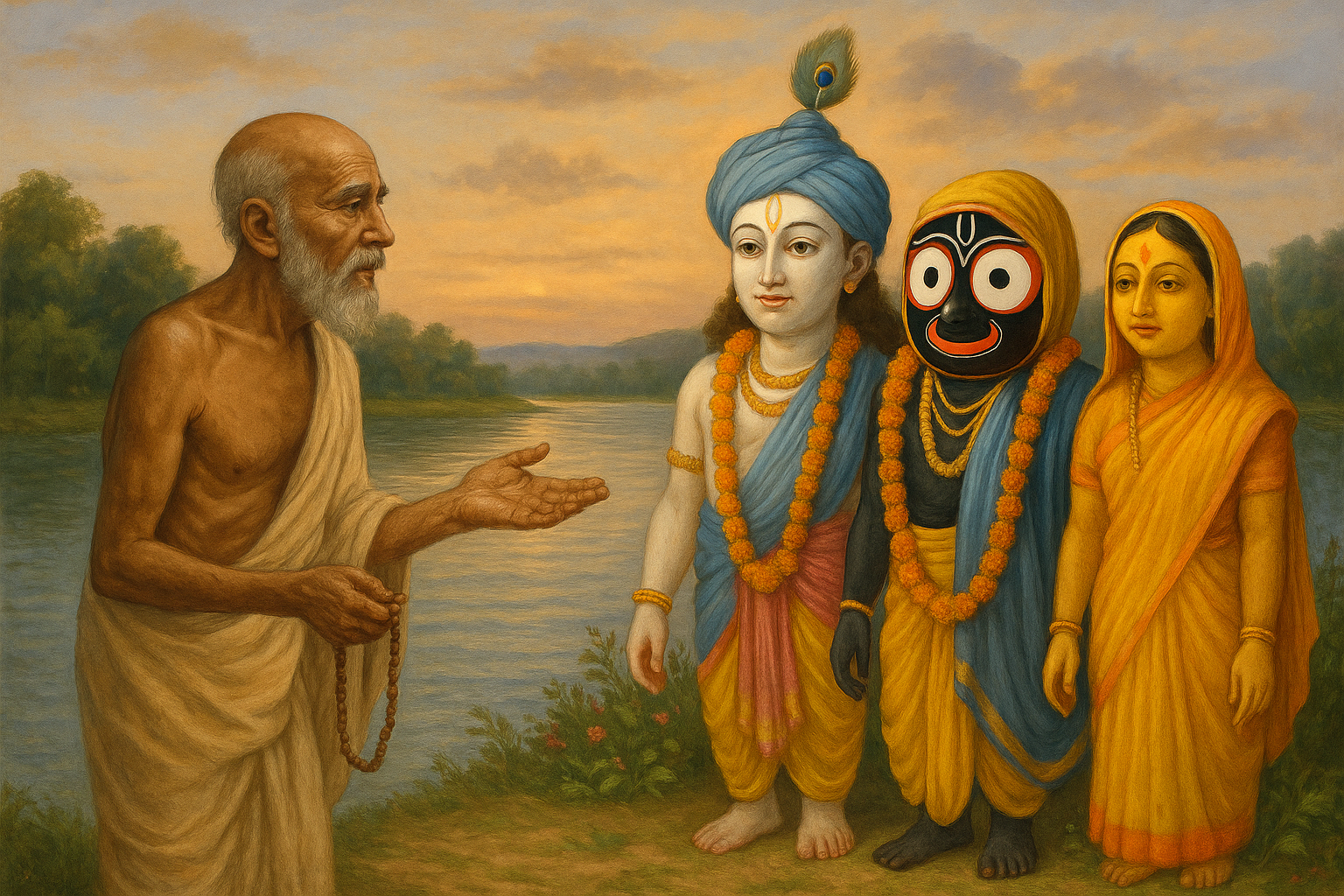
Haridāsa approached the temple priest and requested, “Please give me the old image of Jagannātha.”
The priest replied, “I am not authorized to give it. You must approach the King.”
So Haridāsa went to the King, who bowed before him with great reverence and asked how he might serve. Haridāsa explained the Lord’s command and requested the old image of Jagannātha.
The King, however, was troubled. He said, “O Mahārāja! Jagannātha has indeed commanded you, but He has given no such order to me. According to our ancient custom, the old image is consigned to the sea each time a new image is installed. How can I break this age-old tradition without the express command of the Lord? Therefore, this year also, the old image must be consigned to the sea.”
Haridāsa’s Vow of Renunciation
Hearing this, Haridāsa sighed deeply and said, “Then let it be so. When Jagannātha’s old image is consigned to the sea, my body too shall be consigned with it.”
He vowed to fast until death and went to sit on the seashore, awaiting the moment when he would drown himself with the Lord’s image.
The King’s Dream
That very night, Jagannātha appeared to the King in a dream and said,
“My devotee came to you on My command to ask for My image. You did not do well by denying him. He now fasts on the seashore, ready to die for Me. Go at once, beg his forgiveness, and send My old image with him to Vṛndāvana.”
Terrified and repentant, the King awoke and immediately rushed to the seashore, where Haridāsa sat weak but resolute. With folded hands, the King begged forgiveness and promised to fulfill his request.
The Journey to Vṛndāvana
After the new deities were installed, the King ordered that the old images of Jagannātha, Baladeva, and Subhadrā be placed in a decorated chariot and carried to Vṛndāvana with full royal escort. He also provided Haridāsa with ample funds and paraphernalia for their worship.
Haridāsa and his disciples set out on their long journey to Vṛndāvana, joyfully halting at various holy places along the way to perform kīrtana and distribute prasāda. After several months, they finally arrived in Vṛndāvana.
The Installation of Jagannātha in Vṛndāvana
On the very bank of the Yamunā where Haridāsa had once lived and performed his bhajana, he built a temple for the deities. With great devotion and proper ceremony, he installed Lord Jagannātha, Baladeva, and Subhadrā there.
Even today, these deities are worshipped in that sacred spot, known as Jagannātha Ghāṭa. Every year, on the day of Ratha-yātrā, countless devotees assemble there to take darśana of the Lord, remembering Haridāsa’s faith and Jagannātha’s mercy.
Reflection
This sacred story reveals the mutual longing between the Lord and His devotee. The Lord, though complete in all opulences, feels incomplete without the loving service of His devotee. Haridāsa Bābājī’s devotion was so pure that even the great King of Orissa received divine instruction to honor him.
In the relationship between Jagannātha and Haridāsa, we see the heart of bhakti—the Lord yearning for love and the devotee living only for the Lord’s pleasure. True devotion means to obey the Lord’s command even when the world resists, and to trust that He Himself will make the impossible possible.
Prayer
O Lord Jagannātha, Ocean of Compassion,
Who longs for the love of His devotee,
And O Śrī Haridāsa Bābājī, pure-hearted servant of the Lord,
Grant us a drop of your faith and your surrender.
May we serve the Lord with the same fearless devotion,
That even the sea and kings may bow before His will.
May our hearts become like Vṛndāvana—
A place where the Lord ever resides in joy and love.
Source: The Saints of Vraja