The Lord’s Daily Life in Purī
After returning from His South Indian pilgrimage, Śrī Caitanya Mahāprabhu made Jagannātha Purī His permanent residence for the remaining eighteen years of His earthly pastimes.
There, He lived surrounded by His intimate associates—Svarūpa Dāmodara Gosvāmī, Rāmānanda Rāya, Paramānanda Purī, Govinda, Kāśī Miśra, and many others.
Every morning, He visited the temple of Lord Jagannātha to take darśana, offering His obeisances and reciting prayers in deep love. During the day, He engaged in chanting, discussing topics of devotion, and meeting devotees who constantly arrived from Bengal, Orissa, and beyond.
Each year during the Ratha-yātrā festival, He manifested unprecedented ecstasies—dancing before the chariot with tears streaming from His eyes like rivers, chanting the holy names so powerfully that thousands joined in spontaneous kīrtana.
The Waves of Ecstasy
As the years passed, Mahāprabhu’s love for Kṛṣṇa deepened to inconceivable levels.
Sometimes He would lose external awareness and run toward the sea, crying, “O Kṛṣṇa, where are You?”
Sometimes He would enter the Jagannātha temple and faint at the sight of the Deity.
On one occasion, while absorbed in the mood of Śrīmatī Rādhārāṇī’s separation from Kṛṣṇa, He ran to the seashore in the middle of the night and fell unconscious.
When the devotees found Him in the morning, His body was stretched and thinned, the joints of His limbs dislocated, and His skin dry from the burning of separation.
Seeing this, they wept, chanting softly the names of Kṛṣṇa until the Lord regained external consciousness. When He awoke, He said weakly, “Do not lament. I only desire to feel Rādhā’s love—how She burns when separated from Her beloved.”
The Lord’s Conversations with Svarūpa Dāmodara and Rāmānanda Rāya
In His later years, Mahāprabhu spent most of His time in the small Gambhīrā room in Kāśī Miśra’s house. There, He lived in seclusion, absorbed day and night in the remembrance of the divine love between Rādhā and Kṛṣṇa.
Only Svarūpa Dāmodara Gosvāmī and Rāmānanda Rāya were allowed to be near Him.
They would sing verses from Śrīmad-Bhāgavatam, Gīta-govinda, and Jagannātha-vallabha-nāṭaka, which intensified the Lord’s ecstasies.
When Rāmānanda recited the verse—
“Let Kṛṣṇa embrace me or trample me under His feet;
He may make me broken-hearted by not being before Me—
still, He is my Lord, unconditionally.” (Śikṣāṣṭaka 8)
—Mahāprabhu wept uncontrollably and said, “This is the highest stage of love: to love Kṛṣṇa even without any hope of return.”
Svarūpa Dāmodara and Rāmānanda Rāya often saw the Lord’s transformations—sometimes His limbs withdrawing into His body, sometimes His complexion changing, sometimes torrents of tears soaking the floor. These states were beyond ordinary vision; they were glimpses of the divine experience of Rādhā’s separation from Kṛṣṇa.
The Lord’s Mercy on Devotees
Even in His final years, Mahāprabhu remained the ocean of compassion.
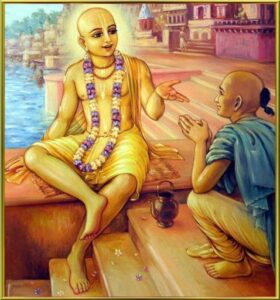
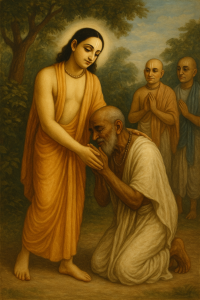
When new devotees came to Purī, He greeted them with warmth, embraced them, and spoke about Kṛṣṇa’s glories.
He sent His followers back to Bengal with instructions to preach and to chant the holy names in every town and village.
To Raghunātha Dāsa Gosvāmī, He gave the essence of instruction:
“Do not speak criticism.
Be more humble than a blade of grass.
Tolerate like a tree.
Always chant the name of Kṛṣṇa.”
To others, He said, “Always serve the Vaiṣṇavas, chant the name, and read Śrīmad-Bhāgavatam. By this, you will attain the supreme goal.”
The Lord’s Disappearance
In His final years, Mahāprabhu’s absorption in divine love became so intense that He could no longer remain bound by material vision.
One night, during the chanting of Jagannātha’s evening ārati, the Lord entered the temple, dancing ecstatically.
He ran before the Deity and embraced Jagannātha, merging into the Divine Light.
No one saw Him again in a material way.
Some say He disappeared into the temple; others believe He entered the ocean at the Tota-gopīnātha temple, becoming one with the Lord He so longed for.
But all agree that He remains eternally present in His name, in the hearts of His devotees, and in the holy dhāma of Navadvīpa and Jagannātha Purī.
Reflection
The farewell pastimes of Śrī Caitanya Mahāprabhu reveal the ultimate purpose of divine love—to become completely one in heart with God, not by merging, but by total surrender in love.
The Lord came to teach the world how to love:
- As a devotee, not as the Supreme.
- Through tears, not through pride.
- Through chanting, not through scholarship.
His life’s conclusion is not tragedy but triumph—the victory of love over all boundaries of the material and spiritual worlds.
As Śrīla Bhaktivinoda Ṭhākura wrote:
“When will that day come when Gaurāṅga’s mercy will awaken within my heart,
and the flood of divine love will carry me to the lotus feet of Kṛṣṇa?”
Source
Source: “Experiences in Bhakti: The Science Celestial,” by O. B. L. Kapoor — Chapter Six: Verification of the Law of Reciprocation (place: Jagannātha Purī, Orissa).