The Devotee’s Background
Before the advent of Śrī Caitanya Mahāprabhu, Bengal was immersed in materialism, ritualism, and dry scholarship.
It was Śrī Advaita Ācārya, a great devotee and scholar residing in Śāntipura, who first invoked the descent of the Lord.
Seeing the world bereft of love for Kṛṣṇa, Advaita would weep daily and cry out to the Lord:
“O Kṛṣṇa, without Your mercy, no one can awaken devotion in this age of quarrel! Please descend to save these fallen souls.”
He worshiped the Lord with Tulasi leaves and Ganges water, calling out loudly, “O Kṛṣṇa! O Gaurāṅga!”
Hearing his heartfelt prayers, the Lord appeared as Śrī Caitanya Mahāprabhu—the golden avatāra of divine love.
Thus, Advaita Ācārya was both the cause of the Lord’s appearance and His most senior associate.
The Relationship of Love
Though Advaita was more than twenty years older than Mahāprabhu and a learned ācārya revered by all, he never saw himself as superior. He always served Mahāprabhu as his master, rejoicing to see the Lord preach and dance in ecstatic love.
Mahāprabhu, however, often said, “Advaita is My senior, My guru, and My worshipable master. He called Me to this world. I can never repay his love.”
Their relationship was full of sweetness and divine humor. Sometimes Advaita would behave like a teacher, and the Lord would bow before him; other times, the Lord would take the role of master, and Advaita would dance in delight, exclaiming, “Now I am truly delivered!”
The Lord’s Correction
One day, Advaita Ācārya began preaching to his followers that liberation (mokṣa) and impersonal knowledge were the supreme goals of life.
He did this not out of conviction but to test Mahāprabhu’s reaction. “Let me see,” he thought, “if the Lord still considers Me His devotee or if He has forgotten Me.”
When Mahāprabhu heard that Advaita was teaching impersonalism, He became grave and said, “How can Advaita, the very one who brought Me to this world to preach devotion, now mislead people with dry knowledge?”
In a burst of divine playfulness, the Lord went straight to Śāntipura, entered Advaita’s home, and began to chastise him. “You have betrayed bhakti!” He said. “Today I shall punish you!”
Mahāprabhu began to strike Advaita lightly on the back, while the aged ācārya danced with joy, crying, “At last! My Lord accepts Me as His servant! Only when the master chastises does He show His love!”
Falling at Mahāprabhu’s feet, he wept, “Now my desire is fulfilled. You have remembered who I am—Your humble servant.”
The Lord, smiling, embraced him and said, “Advaita, you are My father and teacher. But you have tricked Me with your play. You are the ocean of devotion; none can understand your depths.”
The Devotees’ Astonishment
The devotees who witnessed the scene were amazed. They saw the Supreme Lord chastising His own spiritual elder, and that elder rejoicing in being corrected. They understood that this was no ordinary exchange—it was a divine drama revealing the mystery of reciprocal love between God and His devotee.
Advaita Ācārya’s apparent offense was only a pretext for showing the world that the Lord is bound not by hierarchy but by love.
The Feast of Reconciliation
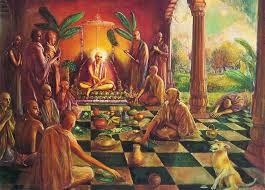
Afterward, Advaita Ācārya invited Mahāprabhu and all His followers to a grand feast in Śāntipura.
He personally cooked rice, dāl, vegetables, and sweets, and served the Lord with trembling hands, his eyes full of tears.
Mahāprabhu accepted the offering with affection, saying, “By feeding Me with devotion, you have fed the entire universe.”
The kīrtana that followed filled the entire town with bliss. People danced and sang “Haribol!” until the night echoed with the sound of divine love.
Reflection
The relationship between Advaita Ācārya and Śrī Caitanya reveals the playful intimacy of divine love, where the Lord and His devotee exchange roles of master and servant.
Advaita’s “chastisement” was a test of love—a reminder that bhakti is not formality but living affection.
Even though Advaita was the Lord’s elder, he rejoiced to be treated as His servant.
This story teaches that humility, even among the greatest, is the hallmark of true devotion.
Love that accepts both honor and correction with joy becomes indestructible.
As Mahāprabhu Himself said:
“Wherever My devotees sing My name, I am their servant. I am conquered by their love.”
Source
Source: “Experiences in Bhakti: The Science Celestial,” by O. B. L. Kapoor — Chapter Six: Verification of the Law of Reciprocation (place: Śāntipura, Bengal).