The Devotee’s Background
During His years in Jagannātha Purī, Śrī Caitanya Mahāprabhu attracted people of every background—scholars, beggars, saints, and kings. Among those who longed for His mercy was King Pratāparudra Deva, the ruler of Orissa.
Though a powerful monarch surrounded by luxury, Pratāparudra’s heart was humble. He had heard of Mahāprabhu’s divine love for Kṛṣṇa and longed to meet Him personally. “If I can touch the feet of this golden Lord,” he said, “my life as a king will find its purpose.”
But when his ministers approached Mahāprabhu with the request, the Lord refused. “A sannyāsī must avoid worldly association, especially with kings,” He said. “To see a king is to invite material contamination.”
Hearing this, the king felt crushed but not discouraged. “If I cannot see Him,” he said, “I will serve Him from afar. He is my only Lord.”
The King’s Humble Service
Determined to please the Lord, King Pratāparudra began serving the Vaiṣṇavas who were with Him.
He personally swept the road before the Ratha-yātrā chariot of Lord Jagannātha, cleaned the temple courtyard, and arranged lodgings, food, and clothes for the Lord’s associates.
When the devotees saw the king performing such humble service, they were astonished. The powerful ruler of Orissa was sweeping dust for the servants of God!
They informed Mahāprabhu, but the Lord merely smiled, saying, “He is a fortunate man, for service to the devotees brings one nearer to Kṛṣṇa.”
Still, He refused to meet the king directly.
The Test of Humility
Unable to bear separation, Pratāparudra approached Sārvabhauma Bhaṭṭācārya and Rāmānanda Rāya, who were close to the Lord, and begged, “Please arrange that I may at least serve Him once. I ask for no honor—only His glance.”
Rāmānanda replied, “The only way is through humility. If you approach Him not as a king but as a servant, the Lord’s mercy will come by its own will.”
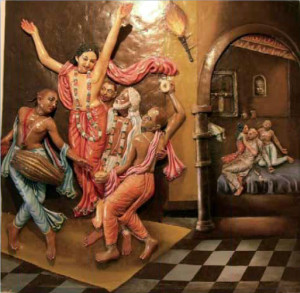
During the Ratha-yātrā festival, when Mahāprabhu danced before Lord Jagannātha’s chariot in divine ecstasy, Pratāparudra disguised himself as a simple devotee wearing white cloth.
As the Lord rested in the garden after hours of dancing, the king approached quietly and began to massage His feet.
The Lord’s Reciprocation
Softly, Pratāparudra began to recite verses from the Śrīmad-Bhāgavatam (10.31)—the Gopī-gītā, the song of the gopīs expressing their love and longing for Kṛṣṇa.
Hearing the verses, Mahāprabhu’s eyes filled with tears. He sat up, embraced the king, and cried out, “You have given Me the nectar of the gopīs’ devotion! Whoever speaks such words is most dear to Me.”
At that moment, the Lord’s omniscient nature revealed the truth: “You are not a king; you are My eternal servant. All your pride is gone, and you are now fit for My mercy.”
The king fell at His feet, trembling, his face wet with tears. “My Lord,” he said, “You have accepted me not as a ruler but as Your child.”
When the devotees later told Mahāprabhu that the man He embraced was King Pratāparudra, the Lord smiled and said, “Do not call him a king. He is a pure devotee. Kṛṣṇa sees only love, not birth or power.”
The Transformation
From that day, Pratāparudra became a model of humility. Though ruling a vast kingdom, he lived as a servant of the devotees, feeding pilgrims, funding temples, and personally attending every kīrtana.
He would often say, “I rule by the Lord’s mercy, but He rules my heart.”
Reflection
This story teaches that divine love erases worldly distinctions.
The Lord rejected the king’s crown but accepted his tears. When the ego of royalty was dissolved in the river of humility, the king found his true identity—as a servant of God.
In this lies the mystery of bhakti: God bows to love, not status.
As the Bhagavad-gītā (9.32) declares:
“Even those of low birth, or women, merchants, and laborers—anyone who takes shelter in Me—can attain the supreme destination.”
Mahāprabhu revealed that the same holds true for the highest: kings and scholars too must bow before the power of humility.
Source
Source: “Experiences in Bhakti: The Science Celestial,” by O. B. L. Kapoor — Chapter Six: Verification of the Law of Reciprocation (place: Jagannātha Purī, Orissa).