The Devotee’s Background
Śrī Govinda Ghosa was one of the intimate associates of Śrī Caitanya Mahāprabhu and Śrī Nityānanda Prabhu. He lived in the village of Agradvīpa near Śāntipura in Bengal and was a member of the kīrtana party of Nityānanda Prabhu.
During the Lord’s saṅkīrtanas, Govinda Ghosa would sing with deep emotion and a voice full of sweetness that melted the hearts of listeners. His love for the Lord was spontaneous and intensely personal—so much so that when the devotees sang the names of Kṛṣṇa, tears would stream down his face, and his body would tremble in ecstasy.
The Divine Relationship
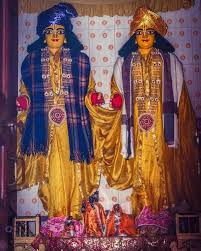
After Lord Caitanya departed from this world, Govinda Ghosa settled in Agradvīpa and worshiped the deity of Śrī Gopīnātha, whom he served as his very life and soul.
He would rise before dawn, bathe, collect flowers, prepare offerings, sing bhajans, and cook with his own hands. The Lord was everything to him—his family, friend, and master.
In time, Govinda Ghosa married and had a son. The boy grew up helping his father in the deity service. However, the boy passed away at a young age, leaving Govinda Ghosa heartbroken.
After some years, as Govinda himself grew old and weak, he began to worry, “Who will serve my Gopīnātha after I leave this world? I have no son, no one to continue the worship.”
The Lord’s Reciprocation
One night, as he sat weeping before the altar, he heard a soft, compassionate voice coming from the deity:
“Govinda! Why do you worry? I Myself will perform My worship after your departure.”
Astonished, Govinda looked up and saw that Gopīnātha’s smiling face seemed alive, His eyes gleaming with mercy. Overcome with joy, Govinda fell to the ground, crying, “O my Lord, You are so kind! How can I ever understand Your love?”
After that night, Govinda Ghosa lived peacefully, completely trusting in his Lord’s promise. In due time, when he left his body, the villagers prepared to perform the last rites. But suddenly, a messenger from the temple arrived and said, “Stop! Gopīnātha Himself has said that He will perform Govinda’s śrāddha ceremony.”
To everyone’s amazement, when they went to the temple, they saw that on the altar of Gopīnātha there were offerings of piṇḍa (rice balls)—the traditional food used in ancestral rites—and flowers, placed exactly as if by invisible hands. The priests had not done it; it was clear that the Lord Himself had performed the ritual for His devotee.
From that day onward, even up to the present time, Śrī Gopīnātha personally performs the annual śrāddha ceremony for Govinda Ghosa. On that day, devotees gather in large numbers at Agradvīpa to witness the sacred tradition.
The Eternal Bond
The relationship between Gopīnātha and Govinda Ghosa demonstrates the Lord’s unbreakable bond with His devotee. Even after the devotee leaves the world, the Lord continues to show His love. Just as a son performs the duties for his father, the Lord Himself assumed that role for His servant.
In Vṛndāvana, Kṛṣṇa calls the gopīs “My life.” Here in Agradvīpa, Gopīnātha proved those words true by becoming the son of His devotee.
Reflection
This story beautifully illustrates the Law of Reciprocation—the divine principle that God responds to His devotee’s love in kind, even beyond the limits of human existence.
For those who love Him as a parent, He becomes a child; for those who love Him as a master, He becomes a servant; and for those who serve Him as a father, He becomes a son.
The Lord’s affection is not bound by ritual or time—it is eternal. Bhakti transforms even death into a celebration of love, for when the body falls, the relationship between the soul and the Supreme only deepens.
Source
Source: “Experiences in Bhakti: The Science Celestial,” by O. B. L. Kapoor — Chapter Six: Verification of the Law of Reciprocation (place: Agradvīpa, Bengal).