Kuṭilā’s Doubt
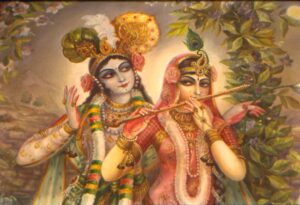
In the tranquil village of Yāvat, where the Divine Couple performed Their secret pastimes, there lived Abhimanyu’s sister, Kuṭilā. Her name itself means “crooked,” for her mind was always twisted with envy and suspicion. One cold morning, in the month of Māgha (January–February), she noticed something peculiar. Every day, her gentle sister-in-law, Śrīmatī Rādhārāṇī, would rise before dawn and go to bathe in the Yamunā River.
Kuṭilā thought to herself, “How strange! My sister-in-law is so soft, delicate, and tender. How can she bear the freezing water of Yamunā in this bitter cold? Surely there must be another reason for these morning excursions!”
Her crooked mind began to spin tales. “She must be meeting that mischievous cowherd, Kṛṣṇa! Otherwise, why would She go so early, when even the birds are still sleeping?”
Thus burning with curiosity and jealousy, Kuṭilā decided to investigate the truth for herself.
The Suspicious Inquiry
She went toward Nandagrāma and met one of the local gopīs. With false sweetness she asked, “O friend, how is the prince of Vraja today?”
The gopī smiled innocently. “Our Nanda-nandana is performing His morning austerities. Every day He bathes in the cold waters of Yamunā during this sacred month. He is very pious and strong!”
Kuṭilā sneered. “Oh really? Very pious, you say? I see… bathing in the cold water so early every morning. Hmph! Let me see for myself what kind of austerity this is.”
She smirked and went straight toward the riverbank, her heart filled with crooked intent.
Tulasī’s Warning
Meanwhile, near the river, Rādhārāṇī and Kṛṣṇa were enjoying Their confidential pastimes in a fragrant kuñja—a bower of flowers hidden from the world. Outside the bower, Rādhā’s faithful maidservant Tulasī-devī stood guard.
From a distance, Tulasī saw Kuṭilā creeping along the path, her eyes darting suspiciously in every direction. Alarmed, she ran swiftly into the kuñja and cried out, “O Queen of Vraja! O Vṛṣabhānu-nandinī! O Śyāmasundara! Disaster approaches! Kuṭilā, that crooked sister of Abhimanyu, is coming along the Yamunā, and she will be here any moment!”
Hearing this, Rādhārāṇī’s heart trembled. “Now what shall we do?”
But Kṛṣṇa, who is fearless and ever-playful, smiled calmly. “Do not worry, My beloved. I shall handle this Myself.”
Kṛṣṇa’s Clever Disguise
He turned to Vṛndā-devī, the goddess who arranges all His pastimes, and said, “Please make Me look exactly like Abhimanyu.”
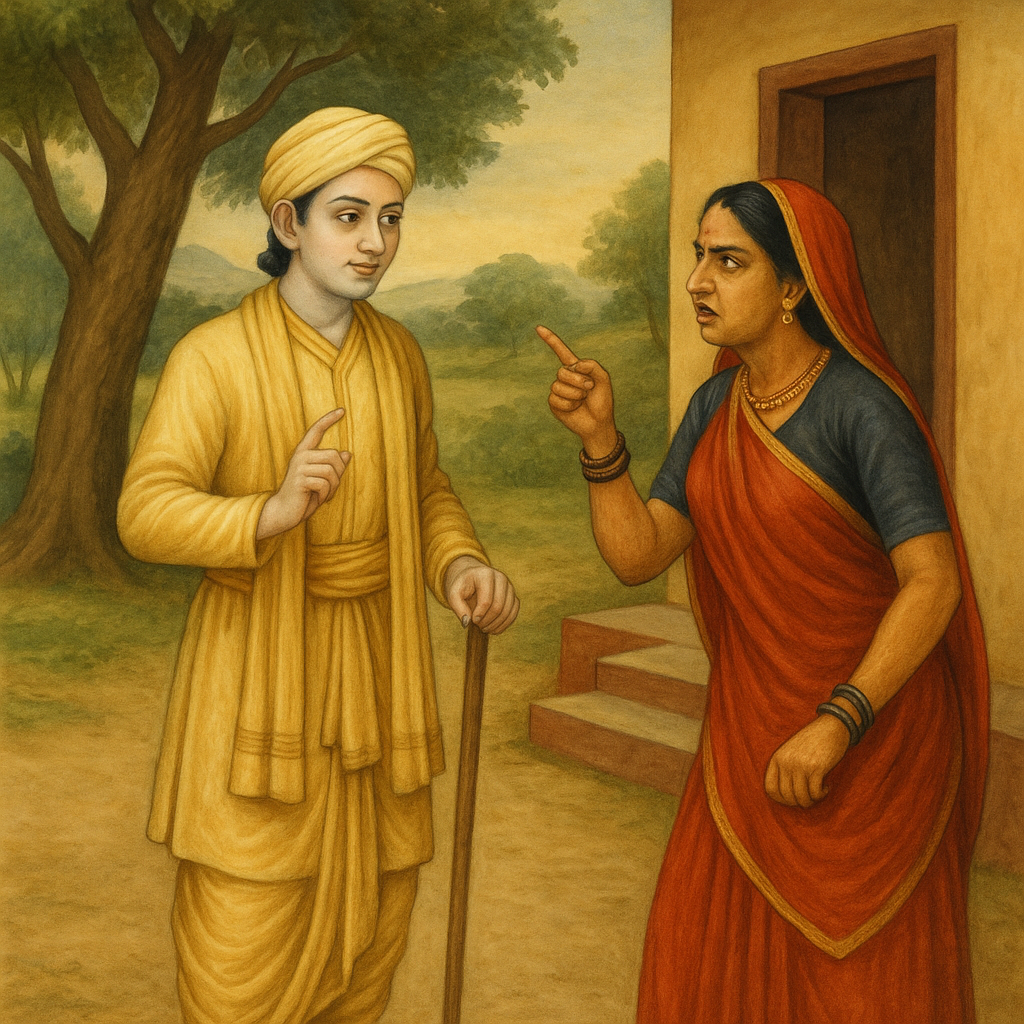
Immediately, by her mystic power, Vṛndā-devī brought fine clothes and ornaments from her secret treasury. She dressed Kṛṣṇa in Abhimanyu’s garments, tied His hair in the same fashion, and placed a plowman’s stick in His hand. His golden crown was replaced by a simple turban, and His bluish hue dimmed into a fair complexion. Even His gait and voice changed by Yogamāyā’s will.
Now appearing exactly like Abhimanyu, Kṛṣṇa went to meet “His sister.”
The Meeting of the Crooked and the Clever
When Kuṭilā saw Him, she said sharply, “O my foolish brother! You never believe me when I tell you that your wife is secretly meeting that rascal, Kṛṣṇa. Right now She must be with Him here by the Yamunā!”
Kṛṣṇa, disguised as Abhimanyu, pretended to be furious. “O sister! This is terrible news! While I was training My bull, he broke loose and ran away, but this news you bring is even more painful. I must punish that rogue Kṛṣṇa! I shall go to Mathurā and inform King Kaṁsa. He will send soldiers to arrest both Nanda and his son and throw them into prison!”
Kuṭilā, delighted to hear this, nodded eagerly. “Yes! That will teach them a lesson!”
Kṛṣṇa continued, “But before I go, you search the riverbank. If you find My wife alone, bring Her here to Me. But if you find Her with that black-faced thief, then call Me secretly. I shall come and catch Them in the act!”
Pleased with the plan, Kuṭilā hurried away, convinced she would soon expose Rādhā’s secret.
Kuṭilā’s Search and Rādhā’s Innocence
Kuṭilā searched along the river until she came to a lovely bower. Inside were Rādhārāṇī and Her sakhīs—Lalitā, Viśākhā, and others—gathered together, their faces radiant like the moon. Pretending innocence, Lalitā greeted her. “O Kuṭilā! What brings you here so early?”
Kuṭilā sneered, “I came to see your pious activities.”
Lalitā replied sweetly, “Then please look and learn.”
Kuṭilā snapped, “I already know enough! The scent of Hari fills this place!”
Lalitā exclaimed, “Hari? You mean lion (hari also means lion)? Oh, Kuṭilā! You’ve saved us! We are only helpless girls; if a lion is nearby, what will we do? Thank you for warning us!”
Kuṭilā grew red with anger. “Don’t twist My words! You know well I mean that black Kṛṣṇa!”
She kicked open the door of the bower. Inside she saw a bed of flowers, upon which lay Rādhā’s pearl necklace entwined with a garland of forest flowers. “Aha!” she cried. “This is proof! Here is your necklace and Kṛṣṇa’s garland entwined together!”
Lalitā said calmly, “Perhaps they belong to a demigod who was worshiping here.”
Kuṭilā shouted, “Don’t lie! I’ll tell Mother Jaṭilā everything!”
Rādhārāṇī, with gentle dignity, said, “Do whatever you wish. These things do not belong to Me.”
Terrified by Her serene strength and the sharp glances of the other gopīs, Kuṭilā fled from the kuñja.
The Perfect Trick
Kuṭilā ran back to her “brother” and cried, “I saw it! I saw everything! Your wife’s pearl necklace was mixed with Kṛṣṇa’s garland!”
Kṛṣṇa, still in disguise, pretended great distress. “O sister! Give Me that evidence!” Taking the garland and necklace, He said, “I shall go to My friend Govardhana Mall and tell him it belongs to his wife, Candrāvalī. Let him complain to Kaṁsa! Kaṁsa will send soldiers to capture Kṛṣṇa and Nanda. Go home now, sister; I will come later.”
Kuṭilā ran home in triumph. Kṛṣṇa, laughing, wandered along the river for some time and then went to Yāvat, still dressed as Abhimanyu.
When Jaṭilā saw Him, she shouted from the roof, “You rascal! How dare you come here again!”
Kṛṣṇa looked up in mock surprise. “Mother! It’s Me, your son!”
Jaṭilā, thinking He was Kṛṣṇa in disguise, hurled a ball of cow dung at Him. “Get out, you wicked boy!”
Kṛṣṇa, chuckling inwardly, dodged the blows and said, “Mother! I’ve just come from Kaṁsa’s court! He’s sending soldiers to arrest Nanda-nandana!”
“Don’t fool us!” she screamed, throwing another gobara-ball.
At that very moment, the real Abhimanyu arrived, bewildered as Jaṭilā and Kuṭilā rained cow-dung missiles and shouted abuses at him. He cried, “Mother! It’s me, your son Abhimanyu!”
“We know who you are, you deceitful rogue!” they yelled. “You can’t trick us this time!”
Thus, the real Abhimanyu was driven away by his own mother and sister, while Kṛṣṇa enjoyed His laughter and sweet talks with Rādhārāṇī in the locked room below.
Lessons to Be Learned
- The Lord is infinitely clever and playful, using even the crooked plans of envious souls for His divine purpose.
- Yogamāyā arranges every circumstance to increase the bliss of Rādhā and Kṛṣṇa’s love.
- Those who act with envy and suspicion only embarrass themselves, while the Lord remains ever-victorious in His sweetness.
- True devotion sees beyond appearances. Those blinded by material jealousy cannot perceive the Lord’s mercy, even when He stands before them.
Reflections
This pastime of Kuṭilā and Kṛṣṇa’s disguise reveals how the Lord, though supreme in power, delights in playfulness and humor. He is never defeated, for even in trickery He is perfectly pure and compassionate. Kuṭilā represents the doubting intelligence of the conditioned soul, always suspecting, always blaming, and therefore always humiliated by her own ignorance.
When the crookedness of the heart is purified, that same energy becomes faith and surrender. Until then, Yogamāyā arranges the divine drama — for even the foolish play a role in glorifying the Lord’s supreme beauty.
Origin of the Story
Adapted from “Vraja-līlā – Part 2” by Deena Bandhu dāsa (Yāvat Part One), which itself draws from Śrīla Viśvanātha Cakravartī Ṭhākura’s Camatkāra-candrikā, and other traditional Gauḍīya Vaiṣṇava sources describing Kṛṣṇa’s disguised pastime at Yāvat.