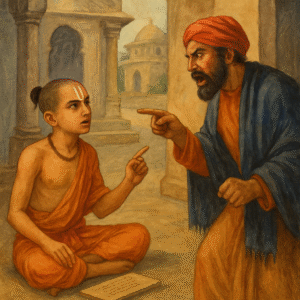
When all the royal courtiers had gathered, the great debate began. Kolāhala, confident and proud, opened the contest by asking Yamunācārya a few questions on Sanskrit grammar. The young boy answered each one perfectly, without hesitation.
Pleased with his own cleverness, Kolāhala increased the difficulty, posing questions of advanced grammar and logic that would confound even seasoned scholars. But to his astonishment, Yamunācārya answered them all with ease and precision.
Finally, the boy smiled gently and said, “O revered scholar, by asking such simple questions you insult me. I am reminded of the story of young Āṣṭāvakra, who, though but a child, defeated the great Bandi in the court of King Janaka. If you judge learning by age or size, then surely a water buffalo must be wiser than you.”
The courtiers gasped, some covering their laughter, while Kolāhala reddened with anger. Controlling himself, he sneered, “Well said, boy. Now it is your turn. Ask your questions.”
Yamunācārya bowed slightly. “Very well. I shall present three propositions. If you can refute them, I will accept defeat.”
Kolāhala nodded. “Speak them.”
Yamunācārya declared clearly:
- “Your mother is not barren.”
- “The Pāṇḍya king is supremely righteous.”
- “The queen is as chaste and faithful as Savitrī.”
The entire court fell silent. Kolāhala frowned, realizing that each statement was impossible to deny but also dangerous to contradict. If he refuted the first, he would call his own birth into question. If he refuted the second, he would insult the king. If he refuted the third, he would slander the queen.
Unable to reply, Kolāhala sat speechless, his face flushed with humiliation. The courtiers began whispering among themselves. The boy smiled and said softly, “If the great scholar remains silent, shall I consider my propositions proven?”
Stung, Kolāhala shouted, “Impudent child! You think to trap me with clever words. But you must first refute your own statements. Otherwise, you commit treason by implying the opposite of what you said!”
Yamunācārya folded his palms and replied serenely, “Then please hear how I will refute them.”
He began:
- “It is said in the Manu-saṁhitā that a woman who bears only one child is to be considered barren. Though your mother gave birth to a son as worthy as yourself, still, by śāstric definition, she is barren.”
- “The Manu-saṁhitā also states that a king shares in the pious and sinful acts of his subjects. Since the people of this age of Kali perform more sinful acts than pious ones, the king, though personally righteous, bears a portion of their sin. Hence, in that sense, he cannot be called completely righteous.”
- “And the Manu-saṁhitā further states that the king represents eight demigods—Agni, Vāyu, Sūrya, Candra, Yama, Kubera, Varuṇa, and Indra. Thus, the queen, as the king’s wife, is symbolically wedded to all eight. Therefore, in the literal sense of the word, she cannot be said to be chaste to one husband alone.”
When the courtiers heard these brilliant explanations, they erupted in wonder. The queen rose, beaming with joy, and exclaimed, “Ālabandāra! Ālabandāra! He has conquered! He has conquered!”
The king himself descended from his throne and embraced the boy. “Just as the rising sun drives away the stars,” he said, “you have vanquished the pride of this scholar. Ask of me whatever you wish.”
The young Yamunācārya bowed and simply said, “May your reign be blessed by dharma, and may learned men never again be oppressed.”
In honor of his victory, the king fulfilled his vow and gave Yamunācārya half his kingdom. Thus, the boy of twelve became the ruler of Madurai, known thereafter by the name Ālabandāra—the Conqueror.
Lessons to Be Learned
- Wisdom is greater than worldly power.
True knowledge, when grounded in humility and devotion, defeats arrogance, no matter how powerful its outer appearance. - Scriptural understanding requires both logic and faith.
Yamunācārya’s answers were not tricks of intellect but revelations of deep scriptural insight combined with spiritual realization. - Victory belongs to those who serve truth.
Though outwardly a debate of words, the real triumph lay in Yamuna’s defense of dharma and the honor of his guru.
Reflections
This contest symbolizes the eternal battle between spiritual humility and material pride. Śrīla Prabhupāda often said that Kṛṣṇa consciousness begins when one learns to bow before truth. The scholar Kolāhala, though learned, was bound by ego. Yamunācārya, though a mere boy, was liberated by surrender. The Lord loves to glorify His devotees through such impossible victories, reminding us that when knowledge is used in service to the Lord, it becomes divine wisdom.
Let us pray for the courage to uphold truth, not for our pride, but for the pleasure of the Supreme Lord.
Source:
The Life of Ramanujacarya by Naimisaranya Dāsa, Chapter One: “Yamunācārya – The Contest.” Bhaktivedanta Book Trust, 1986.