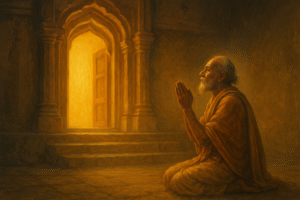
A Saint’s Compassion Tested
Once, in the holy city of Kāśī, there lived a certain Brahmin known for his arrogance and cruelty. Though born into a family of learning, he delighted in mocking the saints and criticizing the holy name. Hearing that Tulsīdās was revered throughout India, he burned with envy and sought to disgrace the saint.
He came to Tulsīdās’s hermitage pretending to be a devotee. Folding his hands, he said sweetly, “O revered one, I have heard of your great power and purity. Grant me the sight of Rāma. If you truly possess His mercy, you can surely show Him to me.”
Tulsīdās, who saw beyond deceit, smiled gently and replied, “The vision of the Lord is not attained by curiosity or pride. He reveals Himself only to hearts purified by love and humility. Begin by chanting His name sincerely — then He will come.”
The Brahmin scoffed. “So you cannot show me your Rāma! You boast of miracles, yet you hide behind words.”
Tulsīdās bowed humbly and said, “Brother, my Rāma appears only where there is faith. He hides from doubt, as the sun hides from those who close their eyes.”
The Brahmin’s Downfall
Enraged, the Brahmin left, determined to humiliate the saint. He spread false rumors that Tulsīdās used witchcraft and that his followers were fools. Soon, a group of misguided men, deceived by his words, confronted Tulsīdās during his evening kīrtana.
They shouted, “Show us your Rāma, or confess your fraud!”
Tulsīdās stood calm like the Ganga under storm clouds. He raised his hands and said softly, “If my Lord wishes, He will appear even before the proud. But His mercy is not a spectacle for the curious.”
As he closed his eyes and chanted, “Śrī Rāma, Jaya Rāma, Jaya Jaya Rāma,” the entire hermitage trembled. A fragrance of lotus and sandal filled the air. A brilliant light appeared, and in that glow stood Lord Rāma — dark, beautiful, and smiling, holding His bow and arrow.
Everyone present fell to the ground in awe. The arrogant Brahmin too trembled and covered his face, blinded by divine splendor. He cried, “Forgive me, O Lord! I am blinded by my pride!”
The Lord looked at Tulsīdās and said, “O saint, forgive this man. Let him also know My grace.”
Tulsīdās bowed and said, “O Rāma, if You have forgiven him, who am I to remember his fault?”
At that, Rāma vanished, leaving behind a fragrance and peace that filled every heart.
The Transformation
From that day, the Brahmin became a humble devotee. He spent the rest of his life sweeping the floor of Tulsīdās’s temple and chanting Rāma’s name with tears.
When people asked about his change, he would say, “Pride blinded me, but the mercy of the saint opened my eyes. Never mock those who love God, for their hearts are His dwelling place.”
Reflections – The Power of Forgiveness and Faith
- Saints See with Compassion, Not Anger: Tulsīdās never cursed or condemned the Brahmin. Instead, he responded with patience and mercy, teaching that forgiveness is the highest form of strength.
- The Lord Appears Where There Is Devotion: Rāma does not respond to arrogance, but to the saint’s loving call. The vision of God is the fruit of humility, not challenge.
- Transformation Through Grace: Even the wicked can be purified when touched by divine compassion. The Brahmin, once proud, became a servant of the Lord through the mercy of Tulsīdās.
- Faith Over Doubt: This story reminds us that spiritual truth cannot be proved like worldly things; it must be realized through surrender and sincere chanting of the holy name.
Through this story, Mahīpati teaches that saints like Tulsīdās embody God’s mercy — they do not merely speak of the Lord; they bring Him near to all who approach with even a spark of sincerity.
Source: Bhaktavijaya, Chapter III, additional accounts from the Tulsīdās section.