The Brahmin-Killer and the Sacred Feast
Once, as Tulsīdās’ hermitage flourished in Benares, great gatherings of devotees and learned brāhmaṇas assembled daily. The fragrance of clarified butter and sandalwood filled the air, and the name of Rāma echoed on every tongue.
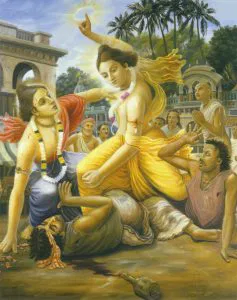
One day, during a grand festival, hundreds of brāhmaṇas sat in rows, ready to partake of the sacred meal. As the food was being served, a strange figure appeared at the gate—a man with fierce eyes and rough garments, carrying the air of a sinner. With folded hands, he cried out, “O saints, grant me a portion of this blessed food. I am a killer of brāhmaṇas!”
The assembly fell silent. Many frowned and whispered, “How can this outcaste defile our sacred feast?”
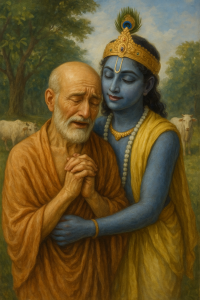
But Tulsīdās rose at once, went to the man, and embraced him warmly. “Come,” he said, “sit beside me. The moment you uttered the names of Sītā and Rāma, your sin has been burned to ashes.”
The brāhmaṇas were astonished. “On what authority,” they asked, “do you seat such a sinner among us?”
Tulsīdās smiled. “On the authority of the Lord’s own word and the witness of the scriptures,” he replied.
The Debate with the Brāhmaṇas
The scholars protested, “If the sin of killing a brāhmaṇa can be destroyed by a few syllables, what need have we for ritual purity? Give us proof!”
Tulsīdās said calmly, “Very well. Let us place the matter before Lord Śiva Himself, who dwells as Viśveśvara in this city. Prepare a plate of food, and I shall offer it to Nandī, the bull who stands before the Lord. If he eats, you will know the truth.”
The Miracle of Nandī
Before dawn the next day, Tulsīdās bathed, took a golden plate filled with sacred food, and went into the great temple. The brāhmaṇas followed, filled with doubt yet curious to see. Standing before the stone image of Nandī, Tulsīdās bowed low and prayed:
“O Lord of Kailāsa, blue-throated one who wears the crescent moon, listen to my plea. Once, when poison burned Your throat, You became cool by repeating the two syllables of Rāma’s name. If that is true, let this bull eat this offering.”
As he prayed, a stillness fell. Suddenly, Nandī—the stone image—began to tremble. With deep breaths, the bull turned its head, stretched out its tongue, and ate the offering—plate and all. The temple resounded with cries of “Victory to Rāma! Victory to Tulsīdās!”
The brāhmaṇas fell at his feet, their eyes brimming with tears. “Blessed are you, O Vaishṇava! Truly, you are Vālmīki reborn,” they said. “Just as the moon shines among the stars, so you shine among the devotees of Hari.”
The Power of the Name
Tulsīdās replied softly, “It is not I, but the name of the Lord that performs all miracles. The name of Rāma burns sin like fire consumes straw. When Śiva Himself utters that name, who else can doubt its power? Even the Lord of Death trembles when he hears it.”
From that day, the citizens of Benares took to chanting the name of Rāma with new fervor. Pride and ritualism gave way to humility and devotion.
The Resurrection of Jaitpāl
Not long after, another miracle occurred. A merchant named Jaitpāl died suddenly, and his grieving wife prepared to ascend his funeral pyre. On her way, she passed near Tulsīdās’ hermitage and bowed to him. Moved by her devotion, the saint blessed her unknowingly, saying, “May you live long and have eight sons.”
The widow smiled through tears. “My lord, my husband is already dead. How can your words come true?”
“Rāma will make them true,” Tulsīdās said simply.
When she reached the pyre, Jaitpāl suddenly opened his eyes and sat up alive. All the people shouted, “Glory to Tulsīdās!” and the woman returned to the saint’s hut, leading her living husband by the hand.
Spiritual Meaning
This story reveals the supremacy of the Divine Name. In the Kali-yuga, when ritual and austerity lose power, the Lord has made His Name the easiest and most merciful path to liberation. The same Rāma whose vision Tulsīdās beheld now dwelt upon his tongue, granting purity to all who heard.
Even a sinner, if he sincerely calls “Sītā-Rāma,” becomes sanctified. The stone image eats, the dead rise, and hearts long frozen with doubt begin to melt.
Reflections – Lessons for Devotees
- The Name is the Lord Himself. To utter “Rāma” with love is to touch God directly.
- Mercy outweighs judgment. The saint embraces the fallen where the world rejects them.
- Faith reveals miracles. Doubt sees only stone, but faith sees the living presence of God.
- Words of a devotee carry divine power. A saint’s blessing, even spoken casually, becomes truth by the will of the Lord.
May we learn from Tulsīdās to cherish the Lord’s name as our life and wealth, to see all beings as redeemable through devotion, and to speak words that heal, uplift, and awaken remembrance of the Divine.
Source: Bhaktavijaya, Chapter III, verses 190–254 (Mahīpati).