Obeisance
Obeisance to Śrī Gaṇeśa, the remover of all obstacles. Obeisance to Śrī Kṛṣṇa, who appeared among the cowherds to protect the world through His divine play.
The Lord’s Concern for the Age of Kali
Once, the Supreme Lord Viṣṇu looked upon the Earth and saw the darkness of Kali-yuga descending. People had become weak in faith, forgetful of dharma, and indifferent to the spiritual truths spoken in the Purāṇas. Even the words of the great sage Vyāsa, though luminous, were now too profound for ordinary minds to grasp.
The Lord, whose compassion knows no limit, spoke to Vyāsa and said:
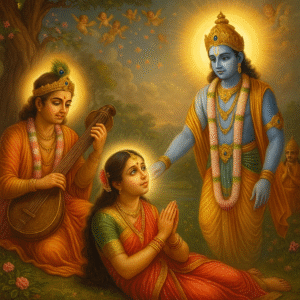
“Vyāsa, what you have composed in the Purāṇas is beyond the understanding of men in Kali-yuga. They are lost in confusion, bound by ignorance and pride. Therefore, I desire that you again descend upon the Earth in a new form—as the poet Jayadeva. Through you, I shall bring about the liberation of humankind, not by philosophy alone but through the sweetness of devotion and song.”
Vyāsa’s Submission
Hearing the Lord’s command, Vyāsa was filled with awe and joy. Bowing down to Viṣṇu with folded hands, he said:
“O Lord of all, whatever You desire shall be done. I am but Your servant, the instrument of Your will.”
Then Vyāsa, the sage of boundless wisdom, prostrated himself before the Lord, whose brilliance shone like a thousand suns, and accepted His order with humility.
The Birth of Jayadeva
In due course of time, Vyāsa appeared on Earth as Śrī Jayadeva, born into a noble brāhmaṇa family in the town of Tundubilva, near the sacred city of Jagannātha Purī. This was no ordinary birth—it was a voluntary descent, a divine avatāra undertaken for the deliverance of souls.
Jayadeva’s parents were pure-hearted and deeply pious. The child grew in wisdom and grace day by day, as if the moon itself had taken human form. At the proper age, his parents performed the ceremony of the sacred thread. From that moment, the brilliance of divine knowledge awakened within him.
The Young Genius
Without formal study, he became master of all the sciences. The scriptures flowed through his memory as effortlessly as the river Ganges flows to the sea. He was radiant among men—like the moon among the stars, the eagle among birds, Indra among the gods, Śiva among ascetics, and Kṛṣṇa among the Yādavas.
His words were like jewels strung on threads of nectar. In every gathering of scholars, his brilliance was unmatched. Among the brāhmaṇas he was known as a pure-hearted orator and poet, whose devotion glowed with the fire of realization.
His Realization and Mission
After studying the Vedas, Śāstras, and Purāṇas, Jayadeva reflected deeply and discovered a truth that filled his heart with bliss:
“In this dark age of Kali, the highest path to salvation is not austerity, wealth, or argument—but the glorification of the Lord through kīrtana, the singing of His divine names and pastimes.”
With this conviction, he set forth to express the infinite through the language of love. His heart burned with inspiration to compose songs that would awaken devotion in all hearts, songs through which even the simplest soul could feel the touch of eternity.
Reflection
This story reveals the tender compassion of the Supreme Lord for His fallen children. Seeing the people of Kali-yuga bound by ignorance, He sent His own devotee, Vyāsa, to appear again as Jayadeva.
In Vyāsa, wisdom took form; in Jayadeva, love took form. The same truth that was once hidden in the Vedas and Purāṇas was now sung with sweetness and melody in the Gīta-Govinda. Through poetry, the Lord made philosophy come alive.
Jayadeva’s effortless mastery reminds us that divine knowledge is not attained through effort alone but through grace born of devotion. When one’s heart is pure and turned toward Kṛṣṇa, knowledge flows naturally.
For devotees, this story teaches that the highest religion of this age is saṅkīrtana—the joyful glorification of the Lord’s holy name and His pastimes. The Lord may be pleased by penance or ritual, but He is conquered only by song and surrender.
Śrī Jayadeva stands as the shining emblem of that truth: that in Kali-yuga, poetry becomes prayer, and devotion becomes deliverance.
Source: Bhaktavijaya, Chapter II – Verses 1–11.