The Restless Curiosity of Kuṭilā
Among the residents of Yāvat, none was more suspicious than Kuṭilā — the sharp-tongued sister of Abhimanyu. Her eyes were quick to notice, her ears eager to hear, and her tongue swift to whisper.
Every day, she would invent new ways to spy on Śrīmatī Rādhārāṇī, convinced that somewhere behind Her innocence was hidden a secret.
“Mother,” she would say to Jaṭilā, “this Rādhā of ours pretends to be shy, but I know — I know that dark cowherd boy visits Her. I will catch them one day and prove it!”
Jaṭilā frowned. “Be careful, child. Paurnamāsī and others say Rādhā is pious. Do not earn sin by doubting her.”
But Kuṭilā’s heart was hardened by envy. “Sin?” she scoffed. “I seek only truth.”
That evening, when the moon rose and the breeze carried the fragrance of jasmine, she made her plan.
The Night of Suspicion
Rādhārāṇī had gone to the garden to offer lamps at Her household shrine. The sakhīs accompanied Her, carrying baskets of flowers.
From the shadows of a nearby tree, Kuṭilā followed, her feet soft as a cat’s. “Now,” she whispered to herself, “if that mischievous Kṛṣṇa dares appear, I shall catch Him red-handed.”
The night deepened. The garden was bathed in moonlight. Rādhā stood before the altar, Her hands folded, Her eyes closed in prayer. The sakhīs sang softly, their voices blending with the hum of the night.
Suddenly, a soft flute note floated through the air — delicate as the breath of love. Kuṭilā froze. “Ah!” she whispered. “He is near!”
The Divine Vision
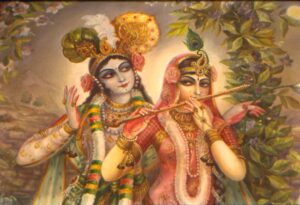
From behind the flowering creepers emerged Śrī Kṛṣṇa, His form radiant as a fresh monsoon cloud. He approached slowly, His eyes fixed upon Rādhā.
The moment She saw Him, Rādhā’s face blossomed with joy, Her heart trembling like a lotus touched by the wind.
As They met, the moon seemed to pause in the sky, and the fragrance of the flowers grew sweeter still.
Kuṭilā, watching from behind the tree, gasped. “So it is true! They are meeting secretly!”
But as she looked closer, something extraordinary happened. The light around Them began to change — no longer earthly, but golden and blue. Rādhā and Kṛṣṇa were no longer two figures but one radiance — two souls merging like the sun and its reflection upon water.
Kuṭilā’s eyes widened. Her breath caught. “What is this? Who are They?”
The air shimmered, and in that instant, she saw Their divine forms — Śrī Rādhā and Śrī Kṛṣṇa revealed as the eternal Lord and His internal potency, two bodies, one soul.
Her limbs trembled, her mind emptied, and tears flowed from her eyes without reason. She fell to her knees.
The Transformation
The vision lasted only a few moments, but for Kuṭilā, it felt like eternity. When the light faded, she found herself alone in the silent garden. The moon had resumed its course; the night wind had stilled.
She whispered to herself, “I came to find fault, and I found God.”
The next morning, Jaṭilā noticed her daughter strangely quiet. “Kuṭilā,” she asked, “what happened to you? You look pale and distant. Did you see something last night?”
Kuṭilā replied softly, “Mother, do not speak harshly of Rādhā anymore. She is no ordinary girl. To speak ill of Her is to wound heaven itself.”
From that day, Kuṭilā’s heart softened. She became gentler, her speech kind, and her suspicion dissolved like mist before the sun.
Sometimes, when no one was watching, she would go to the garden and whisper, “Forgive me, O Divine Pair. I saw You once, and that was enough for a lifetime.”
The Hidden Meaning
Kuṭilā represents the doubting soul — the mind that cannot accept pure love without proof. Yet even such a heart, when touched by divine grace, can be transformed.
Kṛṣṇa does not reject the curious or the skeptical; instead, He reveals Himself in a way that dissolves their pride. One glimpse of the divine unity of Rādhā and Kṛṣṇa removes lifetimes of envy.
Her name “Kuṭilā,” meaning crooked, symbolizes the bent nature of the conditioned mind — but when it bows before truth, even crookedness becomes devotion.
Lessons to Be Learned
- Even envy can be purified by divine vision. The Lord’s mercy reaches even the most skeptical hearts.
- True love transcends appearances. What seems worldly is often a mirror of divine reality.
- The Lord reveals Himself to the sincere, even if sincerity begins in opposition.
- Judgment turns to humility when touched by truth. Once we see divinity, criticism loses meaning.
Reflections
We all have a little Kuṭilā within us — the part that doubts, criticizes, and seeks to control what we do not understand. Yet the mercy of Rādhā and Kṛṣṇa is such that even our crooked thoughts can become offerings once turned toward Them.
When we stop judging others and begin to see the Lord’s hand in their lives, our vision too becomes purified. Like Kuṭilā, one divine glimpse can silence years of skepticism.
And then, like her, we begin to whisper softly to our own hearts: “I saw once — and that is enough.”
Prayer
O Śrīmatī Rādhārāṇī, embodiment of divine compassion, please forgive the crookedness of my mind.
O Śrī Kṛṣṇa, whose mercy transforms envy into surrender, please grant me even a moment’s glimpse of Your truth.
May my doubts melt in the radiance of Your love, and my criticism turn into praise.
Let my heart, once a spy searching for faults, become a servant searching only for You.
Origin of the Story
Adapted from “Vraja-līlā – Part 2” by Deena Bandhu dāsa (Yāvat Part One, “Kuṭilā’s Vision of the Divine Couple”), inspired by Śrīla Viśvanātha Cakravartī Ṭhākura’s Camatkāra-candrikā and traditional Gauḍīya Vaiṣṇava oral narrations.